Structural Engineering Trends 2026: 6 Shifts, FEM-Verified
Structural Engineering Trends 2026, stress-tested with a real FEM engine: 3 worked examples, −77.8% carbon on one beam. Try the free beam calculator.
Key takeaways
- S460 saves 14.6% steel where strength governs — and nothing where deflection rules: both grades need the same IPE 400, because E = 210 GPa for every structural steel grade.
- Right-sizing one beam (IPE 500 → IPE 400) cuts −26.9% of the steel; stacked with EAF procurement it takes the beam from 1.668 to 0.371 tCO₂e — a −77.8% carbon cut.
- A +25% climate wind revision fails the drift check (35.9 → 44.9 mm vs the H/150 = 40 mm limit) while ULS utilization never moves from 0.583 — and the fix costs only +6.9% frame mass.
- The browser FEM engine matched closed-form statics to the decimal (wL²/8 = 160.000 kN·m on the beam, 337.5 kN·m on the frame) — deterministic verification is now effectively free.
- AI proposes, mechanics disposes: the 2026 edge is not using AI, it is verifying AI in seconds with a deterministic solver before any number reaches a drawing.
- The FEM model includes ~5% shear deformation the hand formula ignores (24.0 mm vs 22.9 mm on the IPE 400) — the classic formula is incomplete, not wrong.
Structural Engineering Trends 2026: Six Shifts, Stress-Tested With a Real FEM Engine
Every January the industry publishes its trend lists — and almost none of them contain a single computed number. You get "AI will transform design", "sustainability is here to stay", "modular is the future", and not one bending moment to back any of it up. For a profession whose entire job is turning claims into numbers, that should bother us.
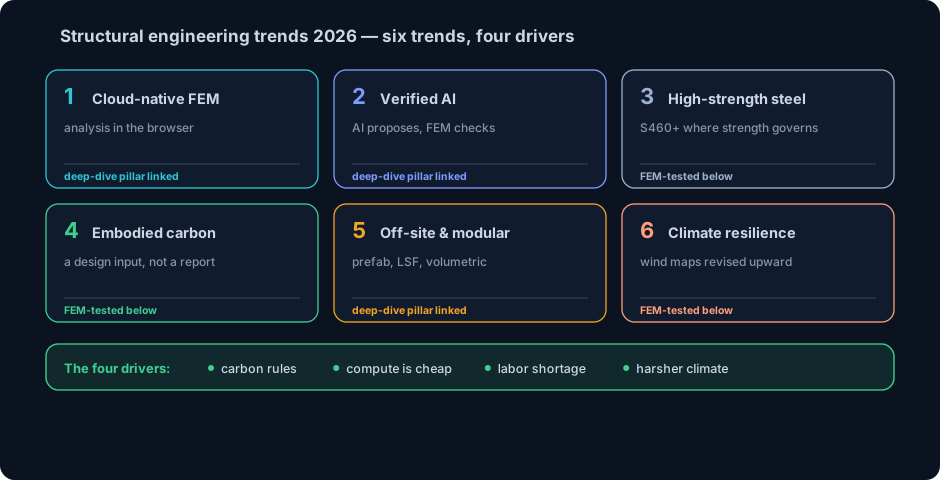
This pillar is different. We picked the six structural engineering trends that actually matter in 2026 — cloud-native analysis, AI in the workflow, high-strength steel, embodied carbon, off-site construction, and climate-resilient loading — and we stress-tested them with a real FEM engine. Not a spreadsheet, not a metaphor: CalcSteel, a free browser-native structural steel design and analysis solution whose statics are validated exactly against closed-form solutions. Three of the trends come with brand-new worked examples you will not find in any listicle: a grade-upgrade check that exposes where high-strength steel pays off (and where it buys nothing), an optimization-times-procurement carbon stack on a single beam, and a portal frame that passes today's wind check and fails tomorrow's — by a margin the strength check never even notices.
There is also a live beam calculator embedded further down, so you can rebuild the numbers yourself instead of taking our word for them.
Who this is for:
- Engineering students — you are graduating into this toolchain. Understanding why deflection ignores steel grade, or why drift governs climate adaptation, is worth more than memorizing any trend list. (And CalcSteel is free for students.)
- Practicing engineers — each trend section ends with what it concretely demands from your workflow: which checks move, which assumptions break, which habits to retire.
- Firm leaders — the through-line of 2026 is that computation got cheap and scrutiny got expensive. The firms that win are the ones whose engineers can verify anything, fast.
Let's start with the forces behind the trends — then take them one by one, numbers first.
The Forces Reshaping Structural Engineering in 2026
Structural engineering trends are the shifts in codes, materials, tools and client demands that change how engineers analyse and design structures. In 2026 they cluster around four drivers: embodied-carbon rules, near-free cloud computing and AI, a chronic skilled-labor shortage, and a harsher wind and climate loading environment.
It helps to see the six trends not as a menu but as symptoms. Behind every one of them sits one of four structural forces — and once you name the forces, the trends stop looking like fashion and start looking inevitable.
- Carbon rules and client ESG pressure. Steelmaking accounts for roughly 7–8% of global CO₂ emissions (worldsteel), and clients, planning authorities and procurement frameworks are steadily moving embodied carbon from the marketing brochure into the project specification. That single shift powers two trends at once: greener steel supply, and — more importantly for the engineer — designs that simply use less steel.
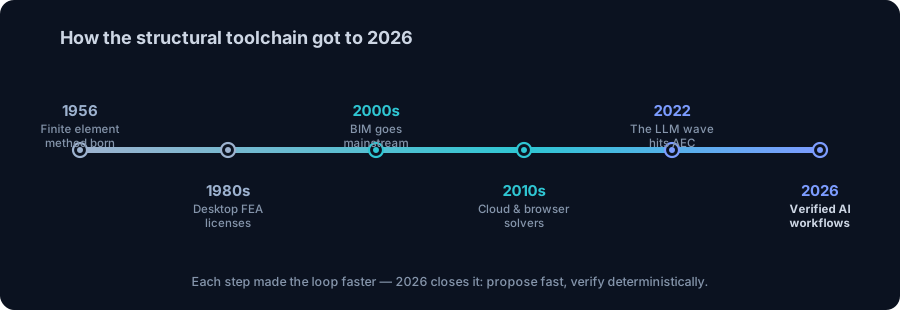
- Compute becoming effectively free. Finite element analysis was born on mainframes in the 1950s–60s, moved to licensed desktop software through the CAD era of the 1980s and the BIM mainstreaming of the 2000s, and since the 2010s has been migrating into the cloud and the browser. Layer the LLM wave that started in late 2022 on top, and the cost of running a check has collapsed. What has not collapsed is the cost of running the wrong check — which is exactly why verification is the theme of the AI trend.
- A chronic skilled-labor shortage on site. Fewer welders, fewer erectors, tighter schedules. The industry's structural answer is to move work off-site: volumetric modules, panelized cold-formed framing, pre-engineered buildings. For the engineer this is not a construction-management footnote — it changes load cases, tolerances and connection philosophy.
- A harsher loading environment. Wind maps and national annexes are being revised as the climate record accumulates, and the second-generation Eurocodes are rolling out (first parts published in 2023, national adoption running through roughly 2028). As our third worked example shows, the revision often bites first at serviceability — a frame can sail through strength checks while its drift limit quietly fails.
Every trend in the rest of this article is one of these four forces wearing work clothes. Keep the map in mind: when a new tool, material or code lands on your desk in 2026, the fastest way to judge it is to ask which force it serves — and then to check it with a number, which is what we do next.
Trend 1 — Cloud-Native Analysis and the Browser FEM Engine
The first of the structural engineering trends for 2026 is the quietest and the most fundamental: the FEM engine has finished its long migration from the machine room to the browser tab.
Three eras of structural computation
- Mainframe FEM (1950s–60s). Matrix structural analysis and the finite element method were developed for room-sized computers. Access meant a university department or an aerospace budget; the engineer queued jobs and waited.
- Desktop licenses (1980s–2000s). CAD went mainstream in the 1980s and BIM in the 2000s, and structural analysis followed the same commercial pattern: powerful software, installed locally, licensed per seat, upgraded per version. The model lived on one machine, and collaboration meant emailing files and praying about versions.
- Browser-native solvers (2010s–2020s). Cloud infrastructure and modern web runtimes made it possible to put a real direct-stiffness solver behind a URL. Zero installation, any device, and sharing a model means sharing a link — not a 400 MB file and a matching license.
What actually changes in practice
This is not "the same software, but online". Three workflows genuinely change:
- Collaboration by link. A checker, a client's engineer, or a professor opens the exact live model you see — same geometry, same loads, same results. The versioning failure mode of the desktop era ("which file did you check?") disappears.
- Versionless updates. When a solver improvement or a new profile catalogue ships, everyone is on it the same day. No IT ticket, no license negotiation, no office running a three-year-old build with a known bug.
- Mobile site checks. A phone at the site office can open the model, confirm a reaction, or re-run a member check. The gap between "I'll check it back at the office" and "checked, here's the number" closes to minutes.
To be honest about our own position: CalcSteel is an example of this trend, not a neutral observer of it. It is a free, browser-native steel design and analysis solution with a real FEM engine — the same engine that produced every number in the worked examples below, and whose statics are validated exactly against closed-form solutions. That validation matters more in the cloud era, not less: when running an analysis costs nothing, the only remaining currency is trust in the result. Later in this article you can test that claim directly in the embedded beam calculator — no install, no login for the math.
The browser engine is also the substrate for every other trend on this list. AI verification loops (Trend 2) need a solver that answers in seconds. Carbon-driven right-sizing (Trend 4) needs a shortlist search to be cheap. Climate re-checks (Trend 6) need re-running a frame under revised wind to be a two-minute task, not a two-day one. That is why cloud-native analysis is Trend 1: it is the one that makes the others practical.
Trend 2 — AI enters the workflow; verification stays deterministic
No list of structural engineering trends written since late 2022 has managed to leave out large language models — and 2026 is the year the conversation finally matures. The LLM wave has moved past the demo stage: assistants now draft load takedowns, summarize code clauses, write report boilerplate and propose starting sections for a design. That part is real, and it is genuinely useful.
Here is the part most trend lists skip: an LLM predicts plausible text, not correct forces. It can tell you a beam "probably works" in fluent prose, with a confident tone and a wrong number. Structural engineering has no tolerance for plausible — a reaction is either in equilibrium or it is not. That is why the workflow taking hold in 2026 is best summarized as AI proposes, mechanics disposes: let the AI accelerate the drafting, the searching and the option generation, then push every candidate through a deterministic solver that either confirms the number or kills it.
This reframes what the differentiator actually is. In 2026, the competitive edge is not using AI — everyone will use AI. The edge is verifying AI, fast and cheaply, inside the same session where the suggestion appeared. A browser-native FEM engine turns that verification loop into seconds: paste the geometry the assistant proposed, run the model, compare reactions against statics. If the numbers close, you proceed; if they do not, you just caught an error before it reached a drawing.
- What AI does well: drafting, code lookup, option generation, report writing, repetitive documentation.
- What it cannot do: guarantee equilibrium, solve an indeterminate frame, or take responsibility. The engineer of record still stamps — and owns — every number.
- What that demands: a verification tool as frictionless as the AI itself, so checking is never the step you skip.
We keep this section deliberately short because the full treatment — what LLMs, ML surrogates, generative design and computer vision each really do, with FEM-verified examples of AI-proposed members — lives in its own pillar: AI in structural engineering: what it can and can't do. Read it if you read only one deep dive this year. The worked examples further down this page are, in a sense, the same discipline applied to every other trend: no claim survives here without a computed number behind it.
Trend 3 — High-strength steel goes mainstream
For decades, S235 and S355 covered almost everything in buildings, with higher grades reserved for bridges and offshore work. That is shifting: mills are actively pushing S460 and S500 into mainstream building construction, and the pitch is easy to like. Higher yield strength means less steel per member for the same strength check — which cascades into lighter members, lighter connections, smaller welds, less transport mass and easier lifts. In a market squeezed by embodied-carbon budgets (Trend 4) and off-site logistics (Trend 5), "same capacity, fewer tonnes" sounds like a free win, which is why high-strength steel keeps appearing on every list of structural engineering trends for 2026.
And often it is a win. Where a member's size is set by strength — short heavy spans, tension members, hangers, many columns — a grade upgrade converts directly into saved mass. The trend is real and worth having in your toolbox.
But there is a catch that the mill brochures rarely print, and it is pure mechanics: stiffness does not scale with grade. Every structural steel — S235, S355, S460, S500 — shares essentially the same modulus of elasticity, E = 210 GPa. Yield strength fy tells you when the section fails; E and the second moment of area tell you how much it deflects. Upgrade the grade and the strength check improves; the deflection check does not move a single millimetre. So the honest question for any member is not "can I use S460 here?" but "what governs this member — strength or stiffness?" If the answer is deflection or vibration, the premium grade buys you exactly nothing.
That claim is easy to state and easy to doubt — so let's not argue it, let's compute it. Below, the same 8 m beam is designed twice, in S355 and in S460, on CalcSteel's FEM engine, first for strength only and then with the serviceability check that real floors and roofs must pass. The result is the clearest illustration of this trend's fine print that we know of.
Worked example 1: the same beam in S355 and S460
The setup is deliberately ordinary: a simply supported beam, span L = 8 m, uniformly distributed load w = 20 kN/m. The FEM engine returns reactions R = 80.000 kN at each support, maximum shear Vmax = 80.000 kN, and maximum moment Mmax = 160.000 kN·m — exactly wL²/8, matching the closed-form solution to the decimal. With the statics verified, we can trust everything that follows.
Round 1 — strength only: the grade upgrade delivers
Sizing on elastic bending capacity (Mrd = Sx·fy) against the 160.0 kN·m demand:
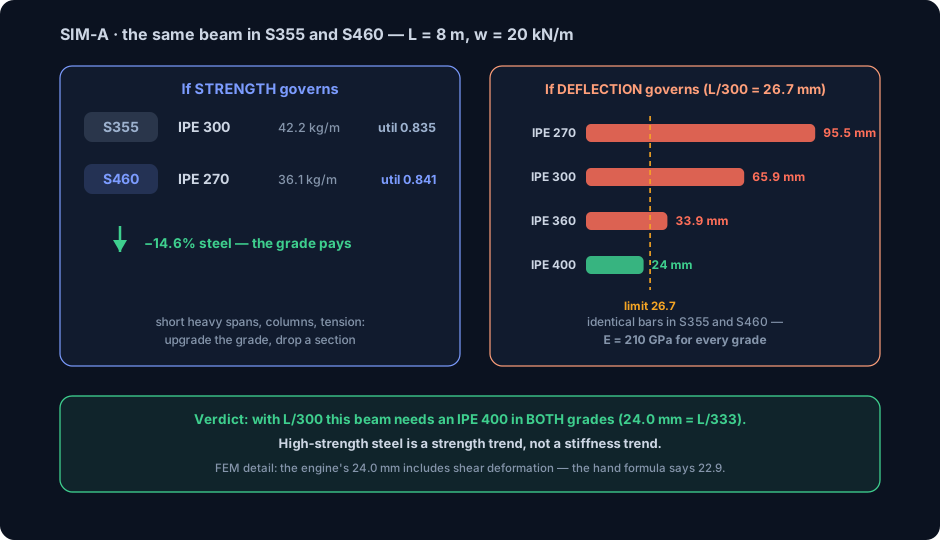
- S355: lightest passing section is an IPE 300 — 42.2 kg/m, Mrd = 191.6 kN·m, utilization 0.835.
- S460: the upgrade drops you to an IPE 270 — 36.1 kg/m, Mrd = 190.3 kN·m, utilization 0.841.
That is a 14.6% steel saving from the grade change alone. If the story ended here, S460 would be an unconditional win — and this is precisely where most high-strength-steel marketing ends the story.
Round 2 — add serviceability: the grades converge
Now apply a routine deflection limit of L/300 = 26.7 mm and re-run the same beam:
- IPE 270 (the S460 strength winner): deflects 95.5 mm = L/84. Fails badly.
- IPE 300 (the S355 strength winner): 65.9 mm = L/122. Fails.
- IPE 360: 33.9 mm = L/236. Still fails.
- IPE 400: 24.0 mm = L/333. First section to pass.
Here is the punchline: the IPE 400 is required in both grades. Deflection depends on E and inertia, and E = 210 GPa for every structural steel grade — deflection does not care about fy. All the grade upgrade changes at this point is how bored the strength check is: the IPE 400 runs at utilization 0.406 in S355 versus 0.313 in S460. You would be paying a premium price to use less than a third of the section's strength.
A nugget only the FEM model shows
The engine reports 24.0 mm for the IPE 400; the textbook Euler–Bernoulli formula 5wL⁴/384EI gives 22.9 mm — about 5% less. The difference is shear deformation, which the FEM model includes and the hand formula ignores. The classic formula is not wrong, it is incomplete — a useful reminder of why a real solver is the referee, not the shortcut. (For how these limits are chosen and checked in practice, see our deflection-limits guide; for the full sizing method, how to size a steel beam.)
The honest rule for this trend
S460 and above pay off where strength governs — short heavy spans, axial and tension members, columns — and buy nothing where deflection or vibration governs. That single sentence, backed by the numbers above, will save you from the most common high-strength-steel mistake of 2026: specifying a premium grade on a stiffness-governed floor beam and getting exactly zero benefit for the money. You can reproduce every number in this example, free, in the beam calculator — or read on, it is embedded just below.
Test any trend yourself: the live beam calculator
Trend lists ask you to believe. This one asks you to check. The calculator embedded below runs the same FEM engine that produced every number in this article — in your browser, no install, no login required for the math.
Rebuild worked example 1 yourself in about a minute:
- Set the span to L = 8 m and the load to a uniform w = 20 kN/m.
- Pick an IPE 300. You will see the strength check clear comfortably — and the deflection blow far past the L/300 limit of 26.7 mm.
- Now switch to an IPE 400 and watch the deflection drop to 24.0 mm — inside the limit, exactly as in the walkthrough above.
- Change the steel grade. Watch what moves — and, more importantly, what doesn't.
That last step is the whole point of this pillar: a claim about structural engineering trends is only worth something once you can reproduce it. Run as many cases as you like — the calculator is genuinely free and unlimited, because CalcSteel's proof has always been the tool itself, not a brochure.
Want the full version with reactions, shear and moment diagrams side by side? Open the beam calculator in its own tab and keep it next to you for the rest of the article — worked examples 2 and 3 are coming.
Max moment
45 kN·m
Max shear
30 kN
Max deflection
10.55 mm
= L/569
Bending stress σ
84.4 MPa
σ = M/Sx
Utilization
44.0%
NBR 8800 · δ ≤ L/250
Geometry & supports
Section
Ix 7999 cm⁴ · Sx 533 cm³ · 42.2 kg/m
Point loads (↓ positive)
None — add as many as you need.
Distributed loads (uniform or trapezoidal)
Model sketch
Diagrams — free PNG / SVG / CSV export, no watermark
Step-by-step — the calculation memory of YOUR beam
IPE 300 · L = 6 m · fy = 250 MPa
1. Reactions (equilibrium of the solved FEM model)
ΣFy = 0 · ΣM = 0
R_A = 30 kN · R_B = 30 kN
2. Peak shear (read from the SFD)
Vmax = |V(x)|max
Vmax = -30 kN @ x = 6 m
3. Peak moment (read from the BMD)
Mmax = |M(x)|max
Mmax = 45 kN·m @ x = 3 m
4. Peak deflection
EI = 15998 kN·m² (E = 200 GPa)
δmax = 10.55 mm @ x = 3 m = L/569
5. Elastic bending stress
σ = Mmax / Sx = 45.00 × 10³ / 533.3
σ = 84.4 MPa
6. Bending check — both codes, side by side
NBR 8800: σ ≤ fy/1.10 = 227.3 MPa · AISC 360: σ ≤ 0.90·fy = 225 MPa
NBR 37.1% PASS · AISC 37.5% PASS
7. Deflection check (serviceability — code-independent)
δ ≤ L/250 = 24 mm
10.55 mm / 24 mm = 44.0% PASS
Recomputed live from the current inputs by the direct-stiffness FEM engine — change any load and every step updates. Reproduce it by hand with the formulas in the sections below.
Lightest catalog profiles that pass (974 flexural candidates · NBR 8800)
| Profile | Std | Weight | Total steel | σ util | δ util | |
|---|---|---|---|---|---|---|
| W310x21 | AISC | 21 kg/m | 126 kg | 83% | 98% | |
| VS 300x23 | BR | 22.6 kg/m | 136 kg | 71% | 84% | |
| U 300x90x6.3 | BR | 23.1 kg/m | 139 kg | 82% | 98% | |
| U 300x100x6.3 | BR | 24.1 kg/m | 145 kg | 77% | 91% | |
| VS 250x25 | BR | 24.6 kg/m | 148 kg | 70% | 100% |
Elastic bending (σ = M/Sx vs fy/γa1, γa1 = 1.10 — NBR 8800) + deflection screening of the full flexural catalog. Lateral-torsional buckling, shear and local buckling are NOT checked here — run the full NBR 8800 / AISC 360 verification in the 3D editor.
Trend 4 — Embodied carbon becomes a design input
For years, carbon lived in the sustainability appendix. In 2026 it is migrating into the structural specification itself: clients ask for Environmental Product Declarations (EPDs) with the steel order, projects carry embodied-carbon budgets the way they carry deflection limits, and public procurement in a growing number of countries treats tCO₂e as a deliverable, not a marketing line. Of all the structural engineering trends in this list, this is the one that changes what a "good" design means.
The scale explains the pressure: steelmaking accounts for roughly 7–8% of global CO₂ emissions (worldsteel). The industry's answer is a supply-side revolution — scrap-based electric-arc-furnace routes and hydrogen-based direct reduction that deliver the same S355, same stiffness, same capacity, at a fraction of the cradle-to-gate carbon. We dissected that entire supply chain, the EPD system and the procurement playbook in our green steel construction pillar — read it for the full treatment; here we only need one idea from it.
The idea is this: the engineer's biggest carbon lever is not buying greener steel — it is using less steel. Green procurement is decided by the buyer and the mill. Tonnage is decided by you, at the sizing stage, one member at a time. Every kilogram you don't specify is carbon that never has to be abated, whatever furnace it would have come from. And because steel is the most recycled structural material on earth, the kilograms you do specify keep circulating — which makes right-sizing and recycling a compounding strategy, not a one-off saving.
Here is the question that makes this trend concrete: take one ordinary beam — the same 8 m span under 20 kN/m from worked example 1 — and ask how much carbon separates a right-sized section from a play-it-safe one, and what happens when you stack low-carbon procurement on top. That is worked example 2, and the engine has already run the numbers.
Worked example 2: right-sizing × green procurement, stacked
Same demand as before: simply supported, L = 8 m, w = 20 kN/m, S355, serviceability limit L/300. This time we do what an optimiser does: sweep the whole IPE shortlist through the FEM engine and check strength and deflection for each. The full field, with total mass for the 8 m length:
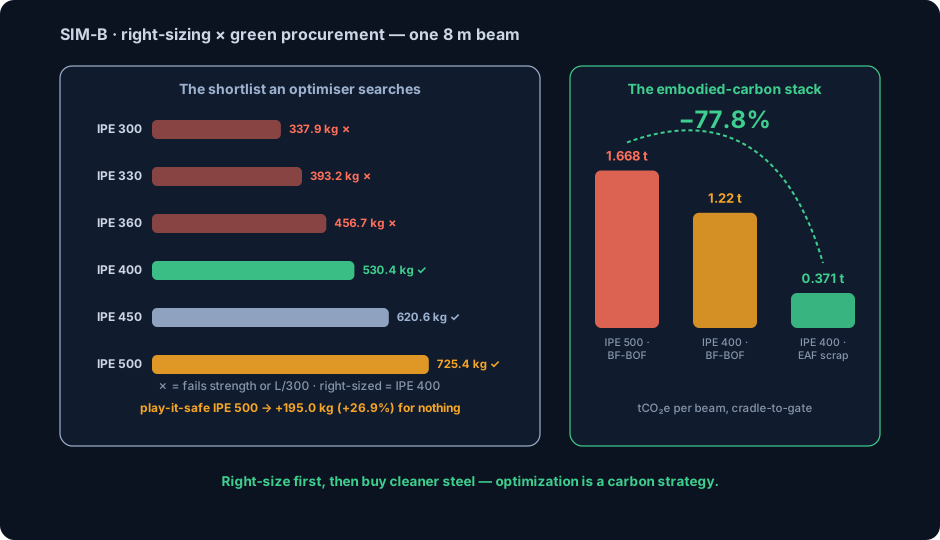
- IPE 270 — 288.6 kg, strength utilization 1.09 → fails strength.
- IPE 300 — 337.9 kg, util 0.835, deflection 65.9 mm → fails deflection.
- IPE 330 — 393.2 kg, util 0.657, 47.1 mm → fails deflection.
- IPE 360 — 456.7 kg, util 0.516, 33.9 mm → fails deflection.
- IPE 400 — 530.4 kg, util 0.406, 24.0 mm → passes.
- IPE 450 — 620.6 kg, util 0.311, 16.4 mm → passes.
- IPE 500 — 725.4 kg, util 0.241, 11.4 mm → passes.
The right-sized answer is the IPE 400 at 530.4 kg. The play-it-safe answer — the section a hurried engineer picks "to be sure", the IPE 500 — weighs 725.4 kg. Difference: −195.0 kg, or −26.9% of the steel, for a beam that passes exactly the same checks. Nothing about the structure got worse; only the waste left.
Now stack the carbon, using the same cradle-to-gate factors as our green steel pillar — blast-furnace (BF-BOF) steel at ≈ 2.3 tCO₂e per tonne, scrap-based EAF steel at ≈ 0.7:
- Over-specified IPE 500 in BF-BOF steel: 1.668 tCO₂e — the baseline nobody questions.
- Right-sized IPE 400, still BF-BOF: 1.220 tCO₂e — −26.9%, purely from engineering.
- Right-sized IPE 400 in EAF steel: 0.371 tCO₂e — the two 2026 trends stacked, −77.8% for one beam.
Read the order of those lines carefully. The engineering cut comes first and it is free — no premium, no procurement negotiation, no new supplier. The procurement cut then multiplies a smaller number. Do it the other way around — green steel on an oversized section — and you pay a premium to decarbonise kilograms that should never have been on the drawing.
This is why optimization is a carbon strategy. The sweep above is seven candidate sections through one load case — seven analyses and seven code checks — minutes of work for an optimiser, or for a careful engineer with a fast solver in the browser. Multiply −26.9% across every beam in a floor plate and "embodied carbon as a design input" stops being a slogan and becomes a line item you control. Try your own sweep in the beam calculator — same engine, same numbers.
Trend 5 — Off-site: modular, prefab and cold-formed keep climbing
The next of the structural engineering trends is driven less by technology than by demographics: the construction industry cannot hire the skilled site labor it needs, and the shortage is chronic, not cyclical. The response is to move work off the site and into the factory — where one crew, one jig and one quality system produce the same assembly hundreds of times. Add the two things factories are unbeatable at — speed and repeatable quality control — and off-site steel stops being a niche and becomes a default question on every project: how much of this can we build somewhere else?
Three families carry the trend, and each has its own deep-dive pillar:
- Volumetric modular — finished, braced steel boxes trucked in and stacked into buildings, assembled from rooms rather than built stick by stick. Our modular steel construction pillar walks a real module from a single box to a stacked tower, FEM numbers included.
- Panelized cold-formed steel (LSF) — light-gauge stud walls and joist panels framed flat in the shop and tilted up on site. The anatomy, the profiles and the design logic are in the cold-formed steel framing pillar.
- Pre-engineered steel buildings — optimised portal-frame kits for warehouses and industrial sheds, engineered once and fabricated as a package. Covered in the prefab steel buildings pillar.
What no trends listicle tells you is what off-site demands from the structural engineer. Three things change on day one:
- Transport and lifting become load cases. A module or panel is loaded on the truck, at the crane hook and in temporary stacking configurations that never appear in the finished building — and any of them can govern a member that the in-service check clears easily. If you only analyse the final structure, you have analysed a structure that briefly didn't exist yet.
- Connections must standardize. The factory's economics live on repetition: one bolted connection detail used four hundred times beats forty bespoke details used ten times each. The engineer's job shifts from detailing every joint to designing the family of joints.
- Tolerances tighten. Site-built steel forgives millimetres with shims and slotted holes; a stack of factory-built modules accumulates every deviation upward. Fabrication tolerance, erection tolerance and connection adjustability have to be designed together, not discovered on site.
In other words: off-site does not make the structural engineer less necessary — it moves the engineering earlier, where a fast analysis loop matters most. Model the transport case, iterate the standard connection, verify the stack: that is exactly the kind of quick, repeated FEM checking a browser-native solver was built for.
Trend 6 — Designing for a harsher climate + Worked example 3
The last of the structural engineering trends on this list is the one most likely to land on your desk as a code revision rather than a headline. Wind maps and national annexes are being reviewed upward in several jurisdictions, and the second-generation Eurocodes — first parts published in 2023, with national adoption running through roughly 2028 — arrive in exactly this climate-aware context. The uncomfortable part for designers: climate resilience is mostly a serviceability problem, not a strength problem. A frame can carry a revised wind load with capacity to spare and still fail the check that actually governs.
Worked example 3: the portal frame that passes today and fails tomorrow
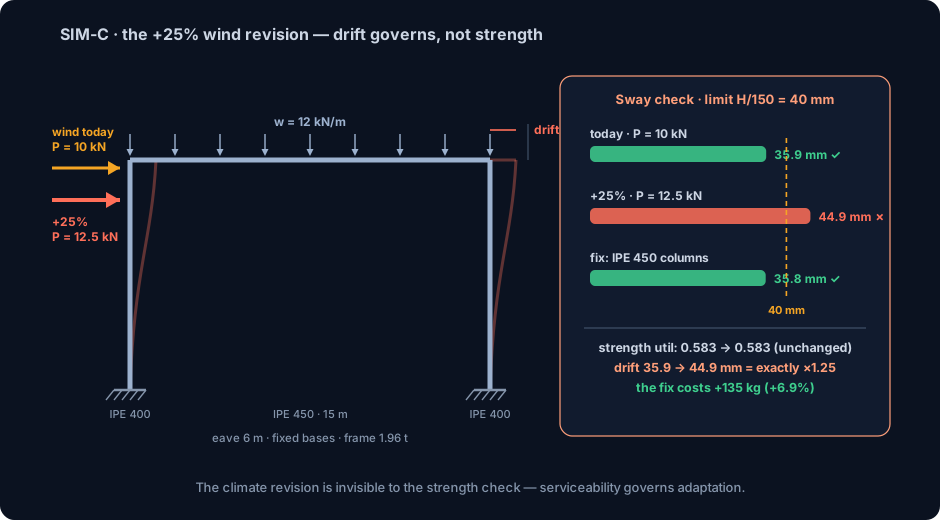
We put a realistic case through the CalcSteel FEM engine: a portal frame with a 15 m span and 6 m eave height, IPE 400 columns, an IPE 450 rafter, rigid knees and fixed bases — 1.959 t of steel — carrying a gravity load of w = 12 kN/m on the beam. This is a statically indeterminate sway frame: there is no closed-form textbook answer, only direct-stiffness FEM.
First, a sanity check under gravity alone. The engine reports a midspan moment of 299.73 kN·m and knee moments of 37.77 kN·m at each side. Add them: 299.73 + 37.77 = 337.5 kN·m — exactly wL²/8. The rigid frame redistributes moment from midspan to the knees, but equilibrium never lies, and the solver reproduces it to the decimal (support reactions too: ΣFy = 180.000 kN = 12 × 15).
Now the wind story, checked against a sway drift limit of H/150 = 40 mm on the wind-only case:
- Today's wind, P = 10 kN applied at the eave: sway = 35.9 mm — 90% of the 40 mm limit. Passes, with little to spare.
- Climate-revised wind, +25% (P = 12.5 kN): sway = 44.9 mm — fails. And it fails by exactly the ratio you would predict: 1.25× today's sway (engine ratio 1.2500 — linear elasticity, verified to four decimals).
- The strength check never notices. The beam's Mmax stays at 299.7 kN·m in both cases — the eave load barely touches the gravity moment — for a utilization of 0.583 against an elastic capacity of 514.0 kN·m. If you only re-ran ULS after the wind revision, you would sign off a frame that violates its drift limit.
Under the combined case the engine also shows the physics you would sketch by hand: knee moments split to 23.0 / 52.5 kN·m and base moments to −3.6 / −34.1 kN·m as the wind shifts moment to the leeward side, while ΣFx = −10.000 kN balances the applied wind exactly.
The adaptation fix is cheap once you know where to look: upsizing the columns from IPE 400 to IPE 450 brings the sway back to 35.8 mm under the revised wind — for +135.3 kg, just +6.9% of the frame mass. Stiffness against sway lives in the columns, and a modest section jump restores the margin the climate took away.
The lesson generalizes: when loads are revised upward, check drift and deflection first, because that is where the margin is thinnest. For the mechanics behind each half of this example, see our deep dives on wind loads on portal frames and deflection and drift limits.
What 2026 means for your practice (and your career)
Structural engineering trends only matter if they change what you do on Monday morning. Here is the honest translation for each audience.
If you are a student
Every trend above rewards the same two things: mechanics fundamentals and tool fluency. The engineer who can predict that a +25% wind gives exactly 1.25× the sway — before the solver confirms it — is the one who catches errors, whether they come from a colleague, a spreadsheet or an AI. Build that instinct by running real models, not just textbook problems. CalcSteel's education plan is free for students, with a real FEM engine in the browser — no license negotiation, no lab machine, no install.
If you are a practicing engineer
- Adopt a cloud verification loop. A browser solver that reproduces wL²/8 to the decimal is fast enough to check any number that crosses your desk — including numbers produced by AI. Owning the verification is the 2026 skill; delegating it is the 2026 risk.
- Learn basic carbon accounting. As worked example 2 showed, right-sizing a member is a carbon decision you already control. Being able to put a tCO₂e figure next to a tonnage figure is quickly becoming part of the deliverable.
- Re-check serviceability whenever loads are revised. Worked examples 1 and 3 both ended the same way: strength had margin, stiffness governed. Make that reflex.
If you lead a firm
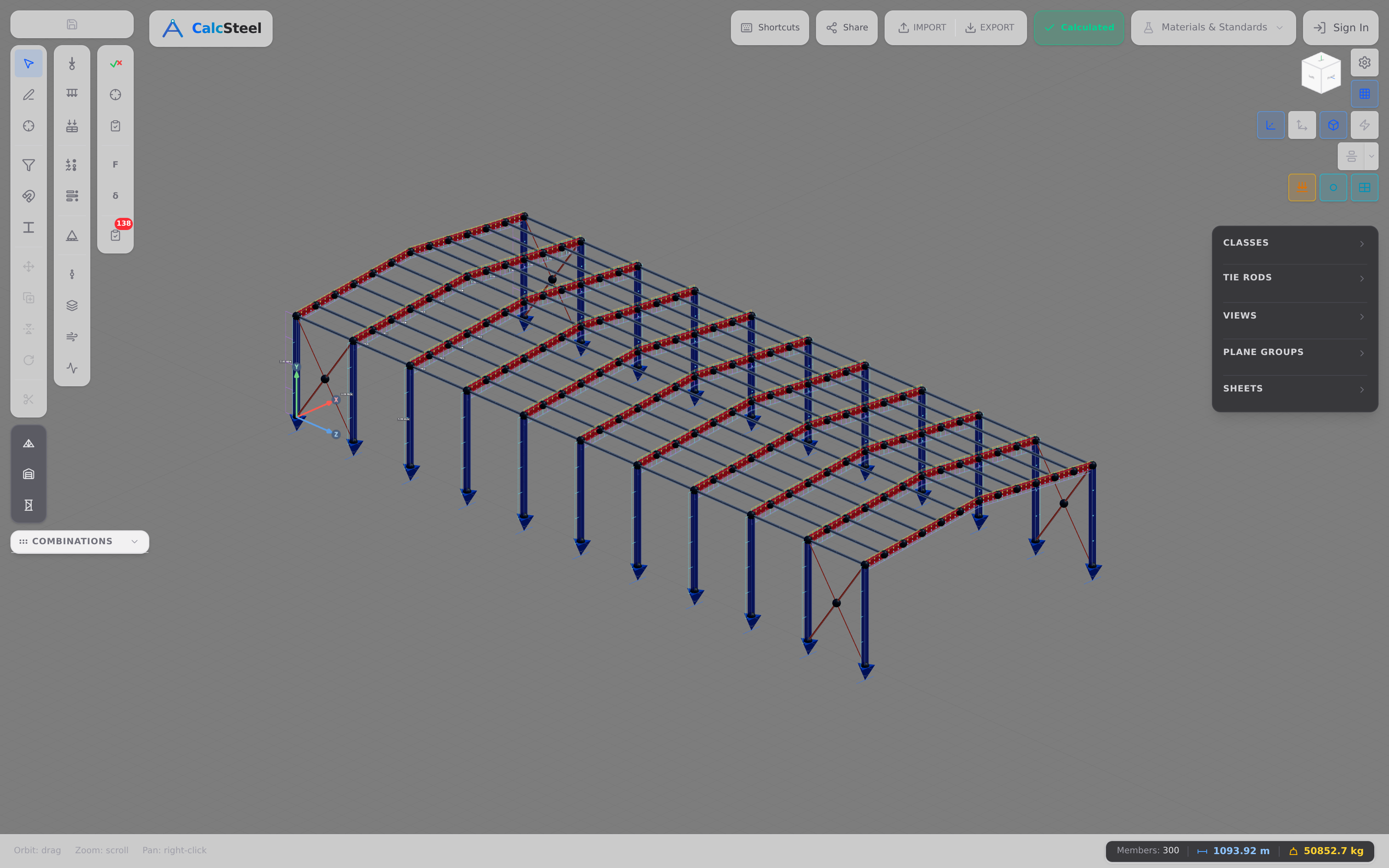
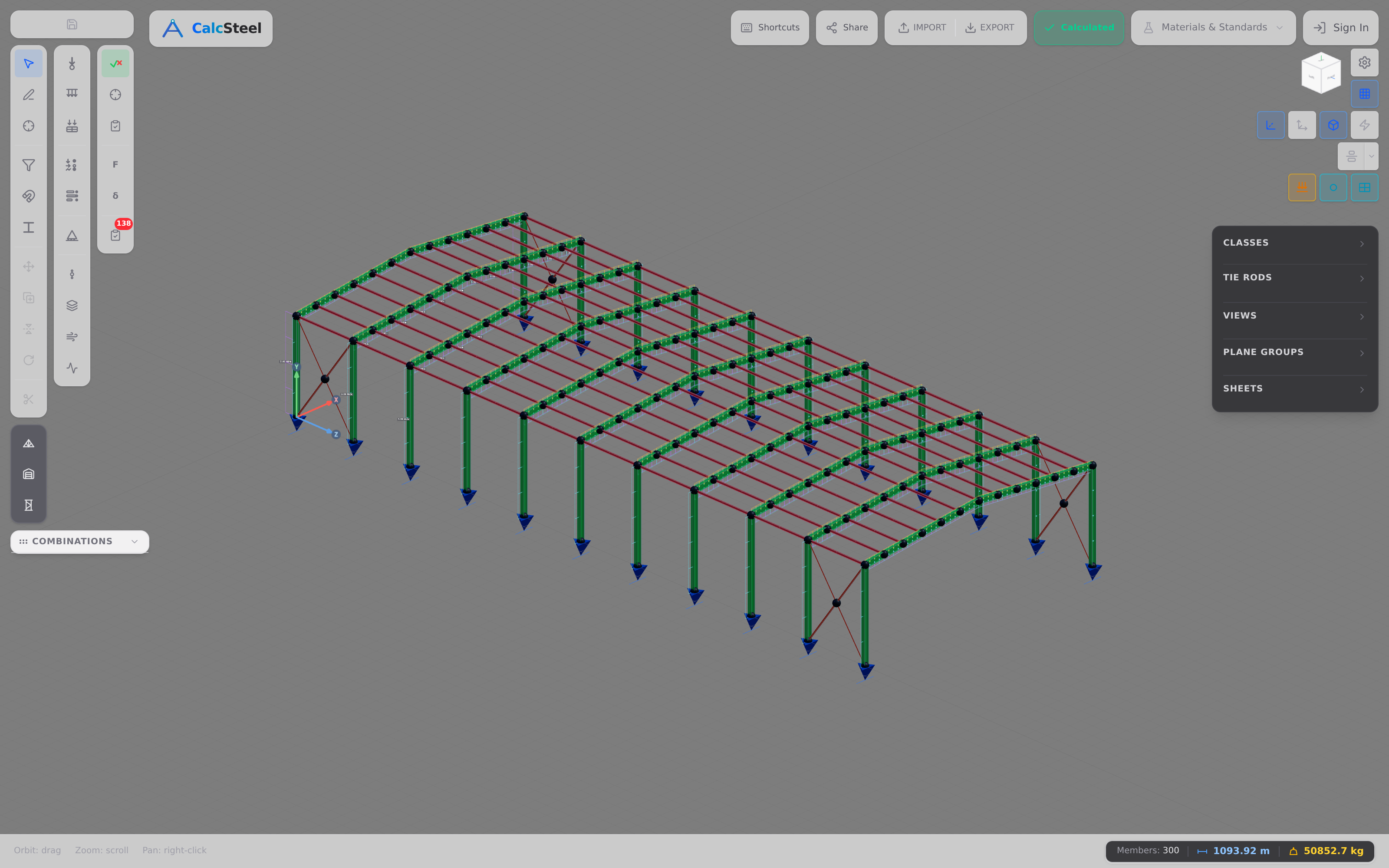
The toolchain is now a hiring argument. Graduates arrive expecting to open a model from a link, see utilization at a glance, and iterate in minutes — the screenshot below is what a verified model looks like in the browser: every member colour-coded by code-check utilization, so a reviewer sees in seconds which members govern and which are ballast. Firms that offer that workflow keep those engineers; firms that ration desktop licenses train them for their competitors.
Common mistakes & FAQ
Trends invite shortcuts. These are the mistakes we see most often when the ideas above meet real projects:
- Assuming S460 deflects less than S355. It does not. Every structural steel grade shares E = 210 GPa, so deflection is identical section for section — in worked example 1, both grades needed the same IPE 400 to satisfy L/300.
- Chasing green steel before right-sizing. Procurement can cut a beam's cradle-to-gate carbon dramatically, but the engineer's first lever is using less steel: in worked example 2, right-sizing alone cut 26.9% before any procurement decision was made.
- Checking climate-revised wind only at ULS. In worked example 3, a +25% wind left strength utilization untouched at 0.583 while drift went from passing to failing. Serviceability governs adaptation.
- Treating AI output as an answer instead of a hypothesis. "AI proposes, mechanics disposes." Every AI-suggested member still has to survive a deterministic solver and a code check — see the AI deep dive.
- Treating trends as software features instead of workflow changes. Buying a cloud tool, an AI plugin or an EPD database changes nothing if the design loop — model, verify, right-size, document — stays the same.
- Ignoring the load cases off-site construction adds. Modules and panels see lifting and transport demands their in-service checks never cover; the modular pillar covers what that means in practice.
FAQ
What are the structural engineering trends in 2026? Six stand out: cloud-native browser analysis, AI-assisted workflows with deterministic verification, mainstream high-strength steel (S460/S500), embodied carbon as a design input, off-site construction (modular, prefab and cold-formed), and designing for a harsher wind and climate loading environment. This pillar stress-tests each with a real FEM engine rather than repeating slogans.
Is AI replacing structural engineers? No. AI is compressing the drafting-and-iterating part of the job, but every proposal it makes still has to be verified against mechanics and design codes — and responsibility for that verification remains, legally and professionally, with the engineer. The differentiator in 2026 is not using AI; it is being able to verify it. Full treatment in AI in structural engineering.
Does high-strength steel reduce deflection? No. Deflection depends on stiffness (E·I), and Young's modulus is E = 210 GPa for all structural steel grades. Higher fy raises strength capacity only: in our benchmark, S460 saved 14.6% of steel where strength governed, and saved nothing once the L/300 deflection limit was applied — both grades required the same IPE 400.
How does steel design reduce embodied carbon? Two levers stack. First, right-size every member instead of defaulting to a comfortable section — worth −26.9% mass on our benchmark beam. Second, specify lower-carbon (scrap-based EAF) steel where available. Stacked, the two took one beam from 1.668 to 0.371 tCO₂e, a 77.8% reduction. Steel's high recyclability makes the second lever unusually effective — details in the green steel pillar.
Key takeaways
Six structural engineering trends, three worked FEM examples, zero invented statistics. What to carry into 2026:
- Demand computed numbers from trend claims. Every argument in this pillar was run through a real solver that matched closed-form statics exactly (wL²/8 = 160.000 kN·m and 337.5 kN·m, to the decimal). Trends that cannot survive a worked example are marketing.
- High-strength steel pays where strength governs — and nowhere else. S460 saved 14.6% of steel on the strength check, then bought nothing against deflection, because E = 210 GPa for every grade.
- Right-sizing is a carbon strategy. −26.9% mass from optimization alone; −77.8% carbon when stacked with EAF procurement on the same beam.
- Climate resilience is a stiffness problem. A +25% wind revision was invisible at ULS (utilization stuck at 0.583) and decisive at drift — and the fix cost only +6.9% frame mass once the check pointed to the columns.
- AI belongs in the loop, verification belongs to you. Cloud solvers make deterministic verification fast enough to check everything — including AI.
- The workflow is the trend. Cloud, AI, carbon and off-site all converge on the same loop: model fast, verify deterministically, right-size, document.
You can start running that loop today. CalcSteel is a browser-native structural steel design and analysis solution with a real FEM engine — the genuinely free plan lets you model and analyse without a card or an install, the beam calculator reproduces every beam number in this article in seconds, and the education plan is free for students. Open a model, put a number on a trend, and see which check really governs.
Sources
- 1.World Steel Association — World Steel in Figures & Sustainability
- 2.The Institution of Structural Engineers — How to calculate embodied carbon
- 3.European Commission JRC — The second generation of the Eurocodes
- 4.Salehi & Burgueño (2018) — Emerging artificial intelligence methods in structural engineering (Engineering Structures)
- 5.Steel Construction Institute / SteelConstruction.info — Modular construction
- 6.HYBRIT (SSAB, LKAB, Vattenfall) — world's first fossil-free steel
Try CalcSteel for free
Model, analyze and design steel structures in your browser. No install, no signup.
Open the 3D editor