Unit weight of steel: the self-weight criterion behind the code, with a worked check
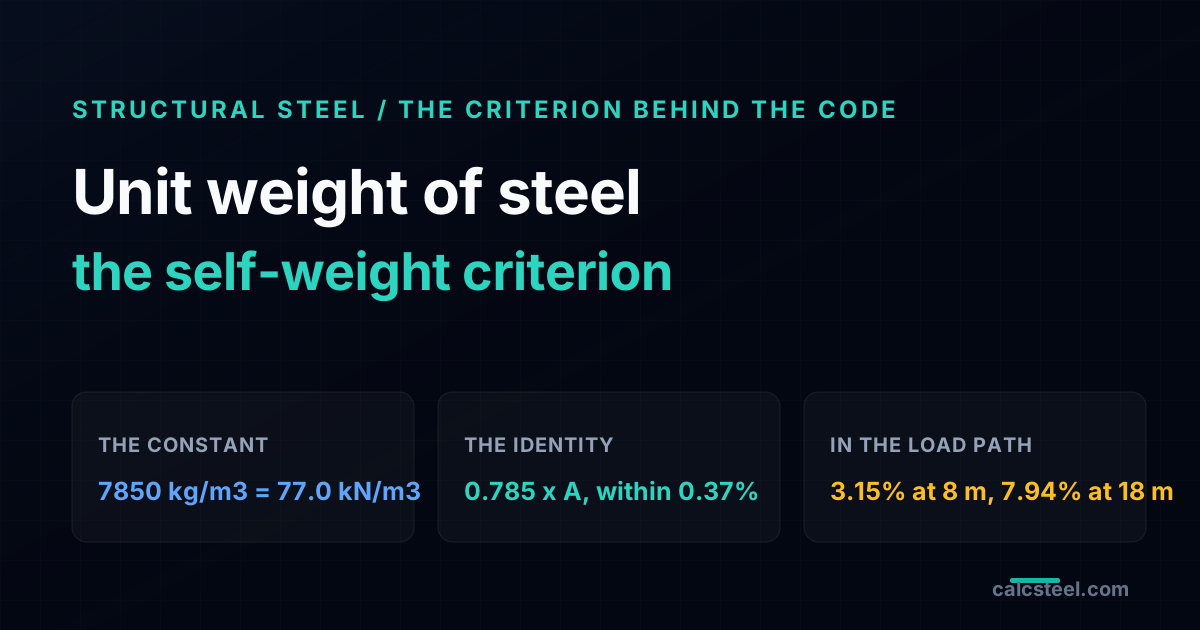
The unit weight of steel is the one material number that turns geometry into load: multiply a section's area by it and you have the self weight the structure carries before anything else lands on it. That single constant, 7850 kg/m3 as a mass or 77.0 kN/m3 as a force, is what a code fixes so self weight becomes a permanent action G, factored like every other load. This article proves the constant reproduces the whole rolled catalogue, then follows the self weight into a real beam and into the load combination.
Key takeaways
- The unit weight of steel is one constant with two faces: a mass density rho = 7850 kg/m3 and a specific weight gamma = 77.0 kN/m3, bridged only by g = 9.81.
- Codes fix the value so self weight is reproducible: EN 1991-1-1 Table A.4 lists steel as 77.0 to 78.5 kN/m3 and treats it as a permanent action G.
- The identity kg/m = 0.785 x A reproduces the whole rolled catalogue to within 0.37 percent across EN, AISC and UK sections.
- Self weight is small on short spans, 3.15 percent of the moment on an 8 m IPE 400, but climbs to 7.94 percent at 18 m and governs long-span design.
- Factor self weight like any permanent action, 1.35 in EN 1990 or 1.2 to 1.4 in ASCE 7, and add about 10 percent for connections.
The one number behind every self weight
Before a single load lands on it, a steel frame is already loaded, by itself. The columns carry the beams, the beams carry the slab, and every one of those members carries its own weight down to the foundations. The unit weight of steel is the one constant that says how much: it is the number that converts a cross-sectional area into a force per metre.
Self weight is not an afterthought you bolt on at the end. In every serious code it is a permanent action, labelled G, present in every load case and every combination, and factored like the live load beside it. Get the constant wrong and every self weight in the model is wrong the same way.
This article does two things. First it proves that one constant, 7850 kg/m3, reproduces the entire rolled catalogue across three national standards to within 0.37 percent. Then it follows the self weight into a real floor beam, watches its share grow with span, and hands it to the load combination the way EN 1990 and ASCE 7 do. Three worked checks, one number. There is a free steel weight calculator embedded further down, so you can weigh your own section as you read.
What "unit weight of steel" actually means
The unit weight of steel is how much a unit volume of it weighs. The confusion starts because the same material property is quoted two ways, and the two look like different numbers.
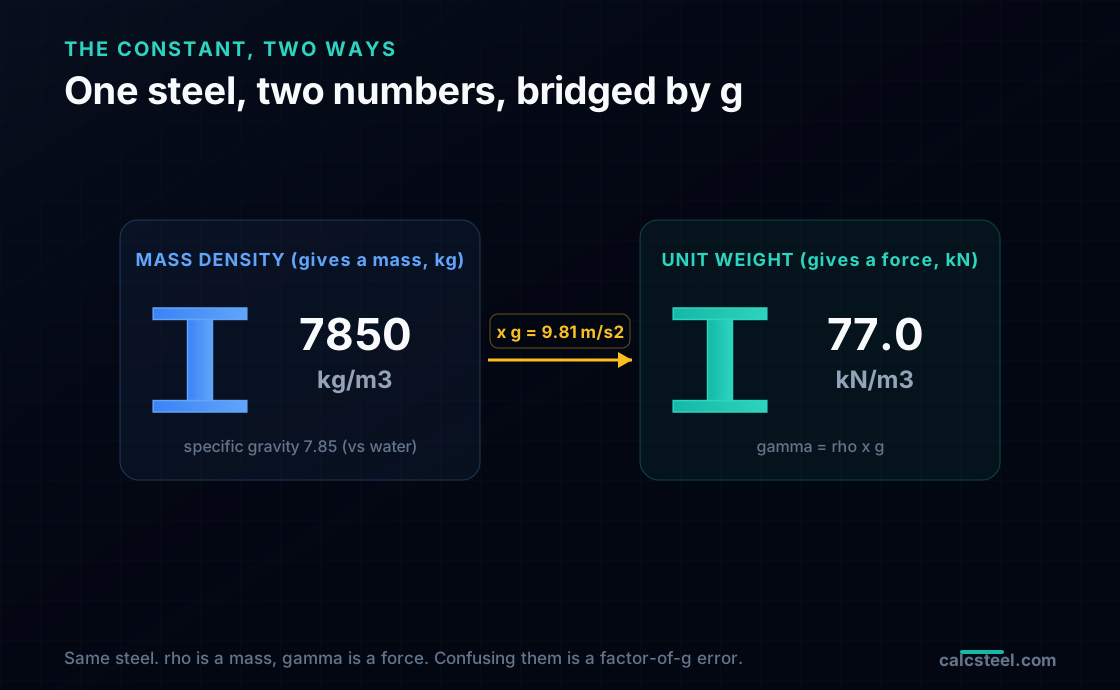
Quoted as a mass density, it is rho = 7850 kg/m3, or equivalently 7.85 g/cm3. That gives you a mass: multiply by a volume in cubic metres and you get kilograms. Quoted as a specific weight, also called unit weight, it is gamma = 77.0 kN/m3. That gives you a force: multiply by a volume and you get kilonewtons, ready to drop straight into an analysis. The two are the same steel, related by gravity: gamma = rho x g = 7850 x 9.81 = 77.0 kN/m3.
So when one source says 7850 and another says 77.0, they are not disagreeing. One is telling you the mass, the other the weight, of exactly the same material.
Where 7850 comes from, and why it is nominal
The number is a property of the material, not a convention. Pure iron sits at about 7870 kg/m3. Add the carbon, manganese and other alloying that make it structural steel, and the mixing and rolling of a real mill run, and the figure settles at a nominal 7850 kg/m3. Individual heats scatter by a few tens of kg/m3 around that, high enough to notice on a precise scale, small enough to ignore in design.
Codes round the scatter away to a single nominal value on purpose. Self weight has to be reproducible: the same beam has to weigh the same in every office, every spreadsheet and every model, without anyone weighing it. A fixed constant is what makes that possible.
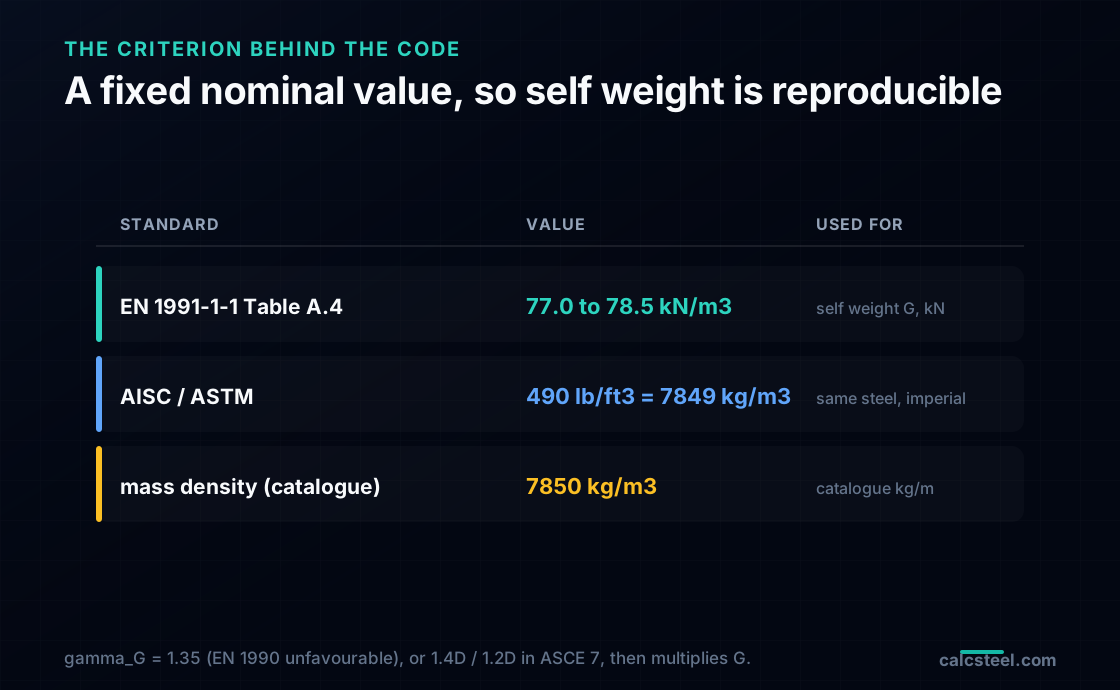
It is the same steel in imperial units. The AISC and ASTM figure is 490 lb/ft3, which is 0.2836 lb/in3, and which converts to 7849 kg/m3. The single digit of difference from 7850 is rounding, not a different material.
Mass density, unit weight, specific gravity: one material, three words
Three words get used for this property, and students trip on the difference. Keep them separate and the numbers fall into line.
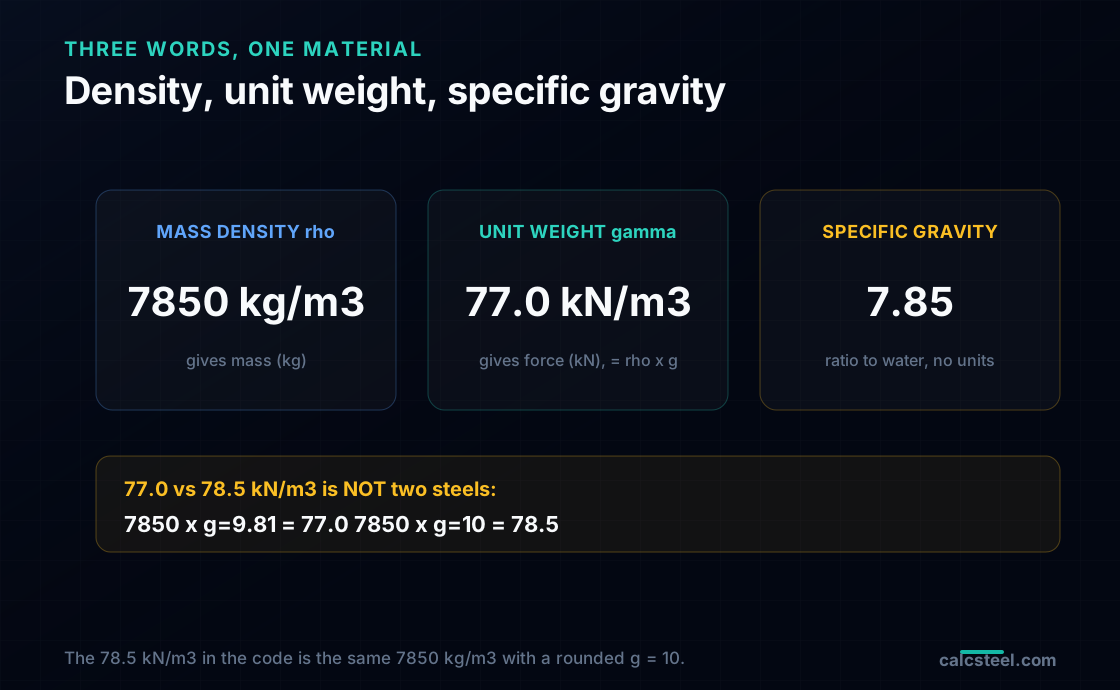
- Mass density, rho. Units kg/m3. Gives mass. For steel, rho = 7850 kg/m3.
- Unit weight, also called specific weight, gamma. Units kN/m3. Gives force. gamma = rho x g, so for steel gamma = 77.0 kN/m3.
- Specific gravity. Dimensionless. The ratio of the material's density to that of water, about 7.85 for steel. It is why 7.85 g/cm3 and a specific gravity of 7.85 are the same statement.
Now the number that confuses everyone. You will see steel quoted as both 77.0 and 78.5 kN/m3. These are not two steels, and not a measurement dispute. They are the same rho = 7850 kg/m3 multiplied by two values of g. Take g = 9.81 and you get 77.0 kN/m3. Take the rounded g = 10 that many codes use for a tidy upper bound, and you get 7850 x 10 = 78.5 kN/m3 exactly. The material never changed. Only the gravity in the multiplication did.
The criterion behind the code: a fixed nominal value
A code does not fix the unit weight to be pedantic. It fixes it so that self weight is a defined action, not an opinion. EN 1991-1-1, the Eurocode for densities and self weight, gives steel in Table A.4 as 77.0 to 78.5 kN/m3. That range is not uncertainty about the material: it is the g = 9.81 to g = 10 spread from the previous section, offered as a nominal band.
Fixing the value does two things. It makes self weight reproducible, so the same member computes the same load everywhere. And it lets self weight be handled as a permanent action, G, which the combination rules then multiply by a partial factor: gamma_G = 1.35 when the permanent action is unfavourable in EN 1990 (and 1.0 when it is favourable), or the 1.4D and 1.2D terms of the ASCE 7 strength combinations. One value in, one action out, factored like everything else.
| Standard | Value it fixes | What it is used for |
|---|---|---|
| EN 1991-1-1 Table A.4 | 77.0 to 78.5 kN/m3 | Nominal unit weight, self weight as permanent action G |
| AISC / ASTM | 490 lb/ft3 = 7849 kg/m3 | The same steel in imperial units |
| Mass-density form | 7850 kg/m3 | Catalogue mass per metre, kg/m = rho x A |
From area to weight: the identity kg/m = rho x A
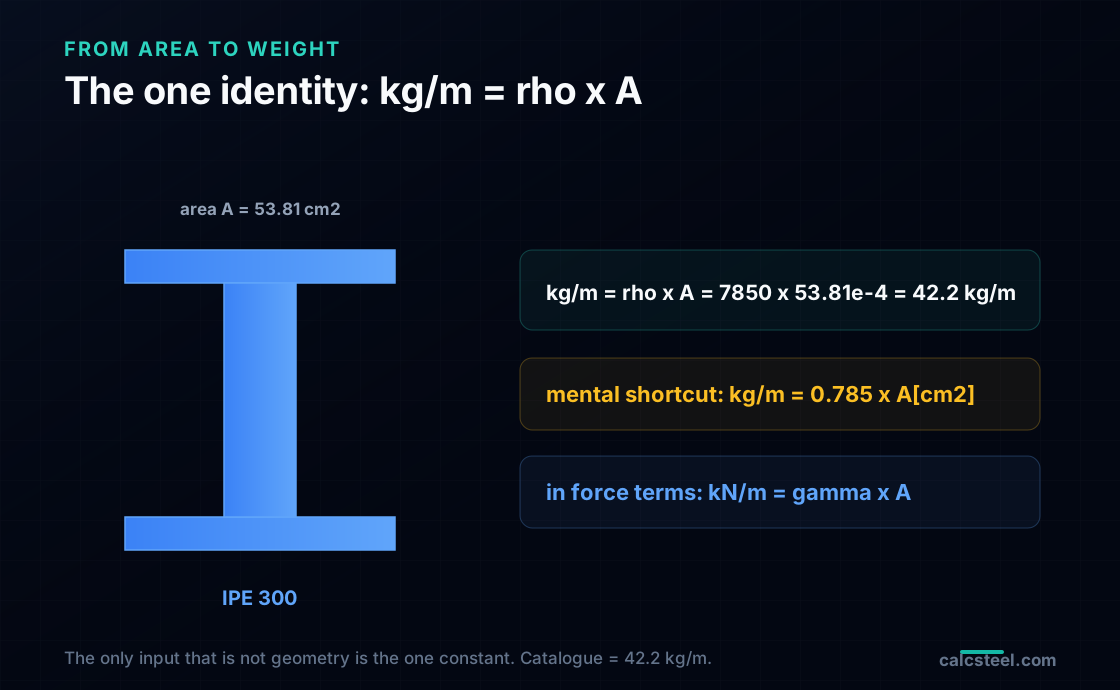
Here is the whole engine of the catalogue in one line. Mass per metre is the unit weight times the cross-sectional area: kg/m = rho x A. A prism of steel one metre long has volume A x 1 m, and its mass is rho times that volume.
The only trap is units. Areas come off a catalogue in cm2, and rho is in kg/m3, so carry the conversion once and bake it into the constant. 7850 kg/m3 times 1e-4 m2/cm2 is 0.785. That leaves a mental-math form you can run in your head: kg/m = 0.785 x A, with A in cm2.
Try it on an IPE 300. Its area is 53.81 cm2, so 0.785 x 53.81 = 42.24 kg/m, the catalogue value being 42.2 kg/m. In force terms the same identity reads kN/m = gamma x A, the self weight per metre ready for analysis. This one operation is what the code, the section catalogue and the FEM engine all perform. Every input is geometry except one: the unit weight of steel.
Worked check 1: one constant reproduces the whole catalogue
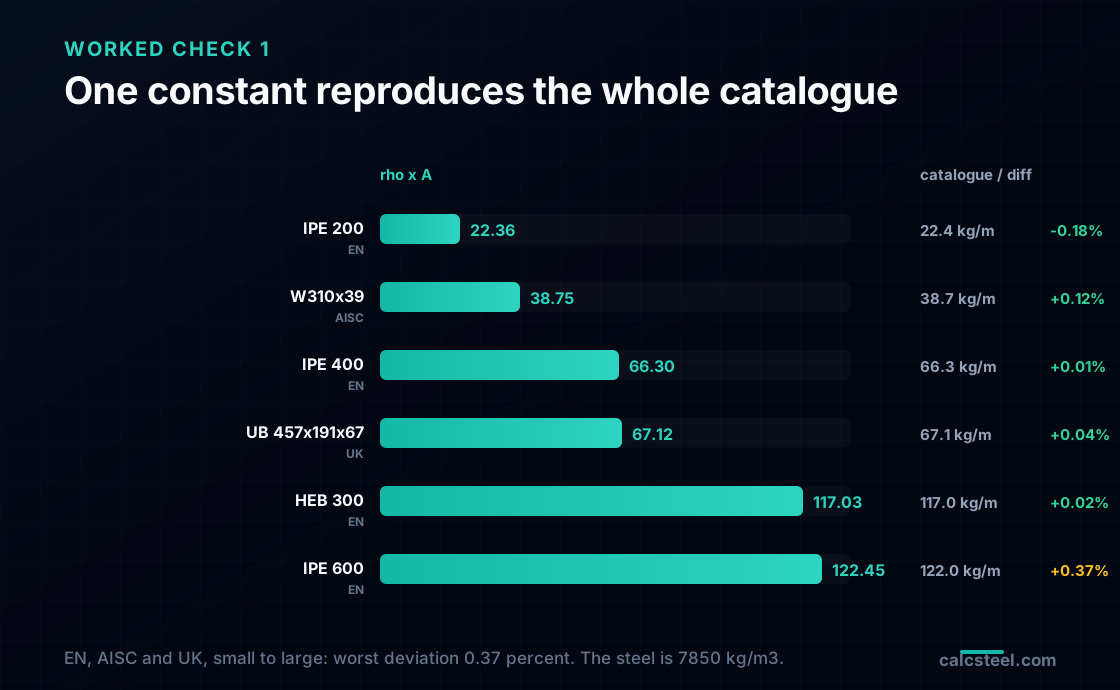
Before trusting a table of numbers, anchor the tool that produced them. Take a simply supported IPE 300, span 6.0 m, under a uniform 10 kN/m, with Ix = 8097 cm4. The closed forms say midspan deflection is 5 w L^4 / 384 E I and the moment is w L^2 / 8. The shipping CalcSteel FEM engine returns delta = 10.4202 mm and M = 45.0 kN.m, reproducing both by hand exactly. The same engine's area for that IPE 300 is 53.81 cm2, and rho x A gives 42.24 kg/m against the catalogue 42.2 kg/m, a 0.10 percent difference. Both the mechanics and the mass check out, so the ladder below can be trusted.
| Section | Standard | Engine area A (cm2) | rho x A (kg/m) | Catalogue (kg/m) | Difference |
|---|---|---|---|---|---|
| IPE 200 | EN | 28.48 | 22.36 | 22.4 | -0.18 percent |
| IPE 400 | EN | 84.46 | 66.30 | 66.3 | +0.01 percent |
| IPE 600 | EN | 155.98 | 122.45 | 122.0 | +0.37 percent |
| HEB 300 | EN | 149.08 | 117.03 | 117.0 | +0.02 percent |
| W310x39 | AISC | 49.36 | 38.75 | 38.7 | +0.12 percent |
| UB 457x191x67 | UK | 85.51 | 67.12 | 67.1 | +0.04 percent |
Six sections, three national standards, the small IPE 200 to the large IPE 600, and the worst deviation is 0.37 percent. The material is 7850 kg/m3 every time. If you only need the mass of one specific member, the profile-weight lookup gives it directly; this identity is why that lookup is nothing more than rho times an area.
Worked check 2: self weight as a permanent action
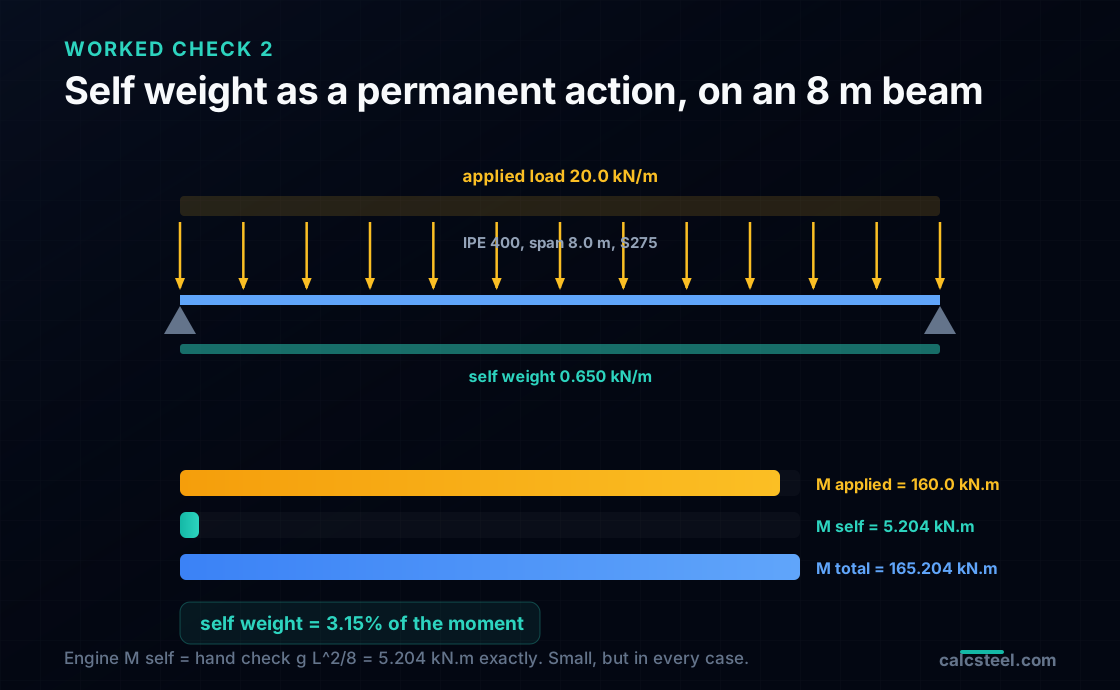
Now put the constant to work in a real member. Take an IPE 400 floor beam spanning 8.0 m in S275 steel. Its self weight per metre comes straight from the identity in force form: g = gamma x A = 77.0 x 84.46e-4 = 0.650 kN/m. On top of that it carries a superimposed floor load of w_applied = 20.0 kN/m.
Run it on the engine as three load cases and the self weight separates cleanly. The self-weight case checks by hand exactly: g L^2 / 8 = 0.650 x 8^2 / 8 = 5.204 kN.m. The applied load gives M = 160.0 kN.m, and the two together give M = 165.204 kN.m. So the self weight is 3.15 percent of the total moment. Its share of the support reaction is the same story: g L / 2 = 2.602 kN carried into the connection before the floor load is even counted (see beam reaction forces for where that goes).
Is 3.15 percent worth carrying? Yes, because it never leaves. The section's flexural capacity is phi_b Fy Sx = 275.0 kN.m, with phi_b = 0.90 and Sx = 1111 cm3, so the beam runs at 60.1 percent utilisation. The self weight is a small slice of that, but it is present in every load case, every combination and every check, permanently. A load you can hand-calculate in one line and never switch off is exactly the kind a code makes you carry.
When self weight starts to matter: the span criterion
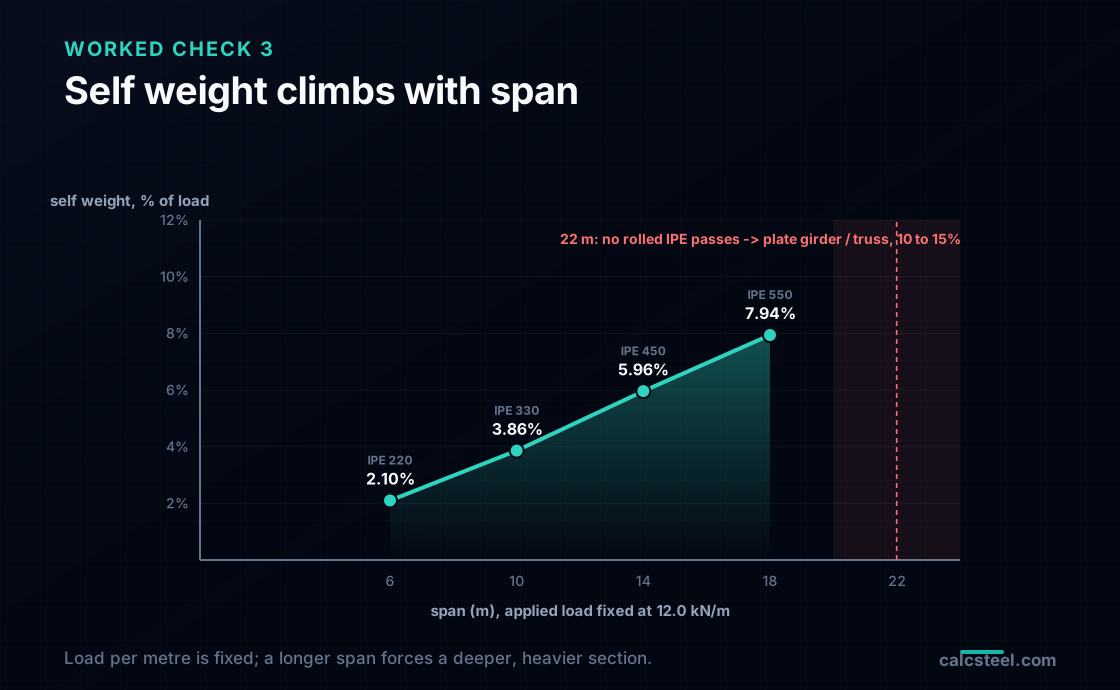
Three percent sounds ignorable. It is, on a short span. The share is not fixed, though: it climbs with span, because a longer beam needs a deeper, heavier section to carry the same load per metre.
Hold the applied load at 12.0 kN/m and, for each span, pick the lightest IPE that still passes flexure with its own self weight included. The self-weight fraction climbs steadily:
| Span | Lightest passing IPE | Self weight (kN/m) | Self-weight fraction | Utilisation |
|---|---|---|---|---|
| 6 m | IPE 220 | 0.257 | 2.10 percent | 91.3 percent |
| 10 m | IPE 330 | 0.482 | 3.86 percent | 91.9 percent |
| 14 m | IPE 450 | 0.761 | 5.96 percent | 87.2 percent |
| 18 m | IPE 550 | 1.035 | 7.94 percent | 90.5 percent |
The applied load per metre never changed. The span did, and a longer span forces a deeper, heavier profile, so self weight roughly doubles as a share of the total every 8 to 10 m of span. Past about 22 m no rolled IPE passes at all: you move to a plate girder or a truss, where the self weight typically climbs past 10 to 15 percent of the load it carries. A heavier section per metre is also more embodied carbon per metre, the same self weight seen through a different lens (see green steel construction). This is why long-span roofs, transfer beams and bridges design their own weight first, before any imposed load is added. At those spans the structure is, to a real degree, holding itself up.
What the code does with it: the load combination
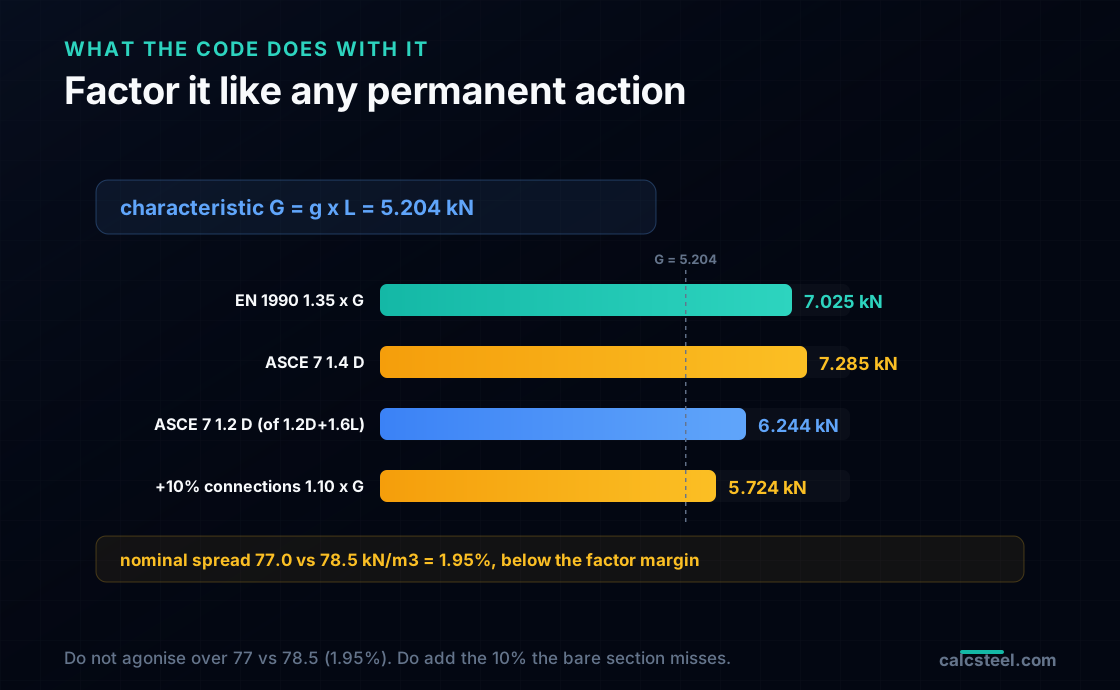
Follow the 8 m beam one step further, into the combination. Its total self weight is a characteristic permanent action, G = g x L = 0.650 x 8 = 5.204 kN. From here the code takes over and factors it like any other permanent load.
| Rule | Factored self weight |
|---|---|
| EN 1990, unfavourable G (gamma_G = 1.35) | 1.35 x 5.204 = 7.025 kN |
| ASCE 7, 1.4D | 1.4 x 5.204 = 7.285 kN |
| ASCE 7, D term of 1.2D + 1.6L | 1.2 x 5.204 = 6.244 kN |
Two honest caveats close the loop. First, do not agonise over the nominal value. Swapping 77.0 for 78.5 kN/m3 moves g from 0.650 to 0.663 kN/m, a 1.95 percent change, smaller than the partial factor's own margin and swamped the moment you multiply by 1.35. Second, do the thing that actually matters: add about 10 percent to the bare-section self weight for connections, welds, stiffeners and fittings, none of which the section area sees. That takes the design self weight to nearer 1.10 x 5.204 = 5.724 kN. For the full mechanics of how these factors combine, see the load-combination pillar.
Try it: weigh your own steel
Weigh your own steel. The calculator embedded just below takes a rolled profile, or a plate, bar or pipe you type in, and returns the catalogue kg/m; multiply by the length and you have the mass of the actual piece. It is running rho x A for you. Check it against the mental shortcut while you are there: read the area, take 0.785 x A, and watch it land on the same kg/m the catalogue prints.
Selected profile
This page ships 1,320 mill-catalog sections offline. The full CalcSteel database — 1,300+ profiles including NBR 6355 cold-formed — lives in the profile database and the 3D editor.
Nominal vs. rolling tolerance — W150x13
Permitted delivered-mass band per product standard. Invoices settle on the nominal kg/m; the band is what an incoming-inspection scale may legitimately read.
W = kg/m × L × n = 13 kg/m × 6 m × 1 = 78 kg
Total weight
78 kg
Unit weight
13 kg/m
Every input above — profile, dimensions, cut list, price — travels in the link.
Five ways the unit weight of steel goes wrong
- Confusing mass with force. rho = 7850 kg/m3 gives a mass and gamma = 77.0 kN/m3 gives a force; use one where you meant the other and you are off by a factor of g = 9.81.
- rho x A on hollow sections and angles. Corner radii remove area the flat-plate geometry keeps, so rho x A over-reads: an HSS 102x102x6.4 gives 17.73 vs a catalogue 17.2 kg/m, about +3 percent, and an L 100x100x10 angle about +4 percent, so use the catalogue kg/m for those.
- Borrowing the stainless density. Stainless steels are about 8000 kg/m3, not 7850, so do not use 8000 for carbon or mild steel.
- Mixing unit systems. 490 lb/ft3 and 7850 kg/m3 are the same steel, but adding one to the other in a single sum double-counts the conversion.
- Double-counting or forgetting the self weight. Do not add self weight by hand when the analysis already applies it from the section, and do not forget the roughly 10 percent for connections and fittings that the bare area misses.
Unit weight of steel: quick answers
What is the unit weight of steel? As a mass it is 7850 kg/m3; as a force it is 77.0 kN/m3, or 78.5 kN/m3 if you round gravity to g = 10.
Is it 7850 or 78.5? Both, for the same steel: 7850 is the mass density in kg/m3, and 78.5 is the unit weight in kN/m3; they are different quantities, not different materials.
kg/m3 or kN/m3, which do I use? Use kg/m3 when you want mass and kN/m3 when you want force; the bridge between them is g = 9.81.
What is the unit weight of steel in kN/m3 for design? EN 1991-1-1 gives the nominal value as 77.0 to 78.5 kN/m3.
How do I get kg/m from it? Multiply the area in cm2 by 0.785: kg/m = 0.785 x A.
Key takeaways
- The unit weight of steel is one constant with two faces: rho = 7850 kg/m3 as a mass and gamma = 77.0 kN/m3 as a force, bridged by g = 9.81.
- Codes fix the value, EN 1991-1-1 Table A.4 gives 77.0 to 78.5 kN/m3, so self weight becomes a reproducible permanent action G.
- The identity kg/m = 0.785 x A reproduces the whole rolled catalogue to within 0.37 percent across EN, AISC and UK sections.
- Self weight is small on short spans, 3.15 percent of the moment on an 8 m beam, but climbs with span to 7.94 percent at 18 m and governs long-span design.
- Factor self weight like any permanent action, 1.35 in EN 1990 or 1.2 to 1.4 in ASCE 7, and add about 10 percent for connections, but for hollow and angle sections use the catalogue kg/m, not rho x A.
Sources
- 1.EN 1993-1-1:2005 Eurocode 3, Design of steel structures, Part 1-1, clause 3.2.6 (unit mass of steel, rho = 7850 kg/m3)
- 2.EN 1991-1-1:2002 Eurocode 1, Actions on structures, Part 1-1, Table A.4 (nominal unit weight of steel, 77.0 to 78.5 kN/m3)
- 3.EN 1990:2002 Eurocode, Basis of structural design (self weight as a permanent action G, partial factor gamma_G = 1.35 unfavourable)
- 4.ASCE/SEI 7-22, Minimum Design Loads and Associated Criteria for Buildings and Other Structures (dead load D and LRFD combinations 1.4D and 1.2D + 1.6L)
- 5.AISC Steel Construction Manual, 16th edition (density of steel 490 lb/ft3 and tabulated mass per unit length)
Try CalcSteel for free
Model, analyze and design steel structures in your browser. No install, no signup.
Open the 3D editor