Poisson's Ratio: The Contraction Nobody Checks, and Where It Finally Matters
Pull a steel bar and it stretches. It also gets thinner, and the ratio between the two is Poisson's ratio, ν = 0.30 for steel. Almost nobody checks that contraction, because it is microscopic. Yet the same number quietly sets the shear modulus, stiffens every plate, and moves a real serviceability deflection. This guide shows where ν hides, where it finally changes an answer, and why CalcSteel never asks you to type it.
Key takeaways
- Poisson's ratio is one number, ν = − lateral strain / axial strain. For ordinary structural steel it is 0.30, and it barely moves across grades, standards or heat treatment.
- The contraction itself is real but tiny. A Ø25 tie rod at 102 MPa loses 3.82 µm across its diameter, thinner than a human hair, which is why nobody checks it.
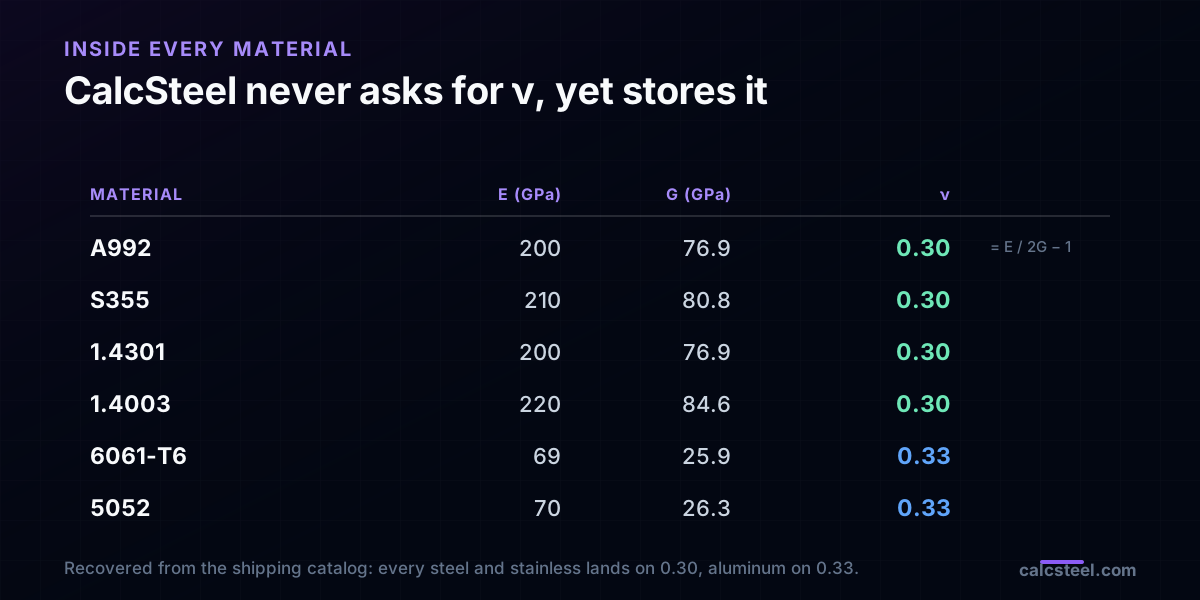
- You never type ν into CalcSteel, yet every material carries it: the engine stores G, and G = E / 2(1+ν) fixes ν exactly. Read it back and every steel returns 0.30, every aluminum 0.33.
- ν finally changes an answer through the shear modulus. On a bent tube it carries 60.7% of the serviceability deflection, and assuming 0.25 instead of 0.30 shifts that deflection by 2.33%.
- It stiffens plates too: the (1 − ν²) factor makes a base plate or slab 9.9% stiffer in bending than a bare beam strip of the same thickness.
The elastic constant nobody types
Every student learns two elastic constants in the first month of mechanics of materials: Young's modulus E, which says how hard steel is to stretch, and Poisson's ratio ν, which says how much it pinches sideways while you stretch it. E gets all the attention. It sits in every deflection formula, every buckling load, every stiffness matrix. Poisson's ratio gets a definition, a value for steel, and then it seems to vanish.
It does not vanish. It goes quiet, folded into other constants where you stop seeing it. This article follows ν from the definition students memorise to the three places it actually earns its keep in steel design: the shear modulus, the plate-stiffness factor, and the volumetric behaviour of a confined member. Along the way we run the real CalcSteel engine to show two things: that the contraction nobody checks is exactly as small as you think, and that ν is already living inside every analysis you run, whether you typed it or not.
What Poisson's ratio actually is
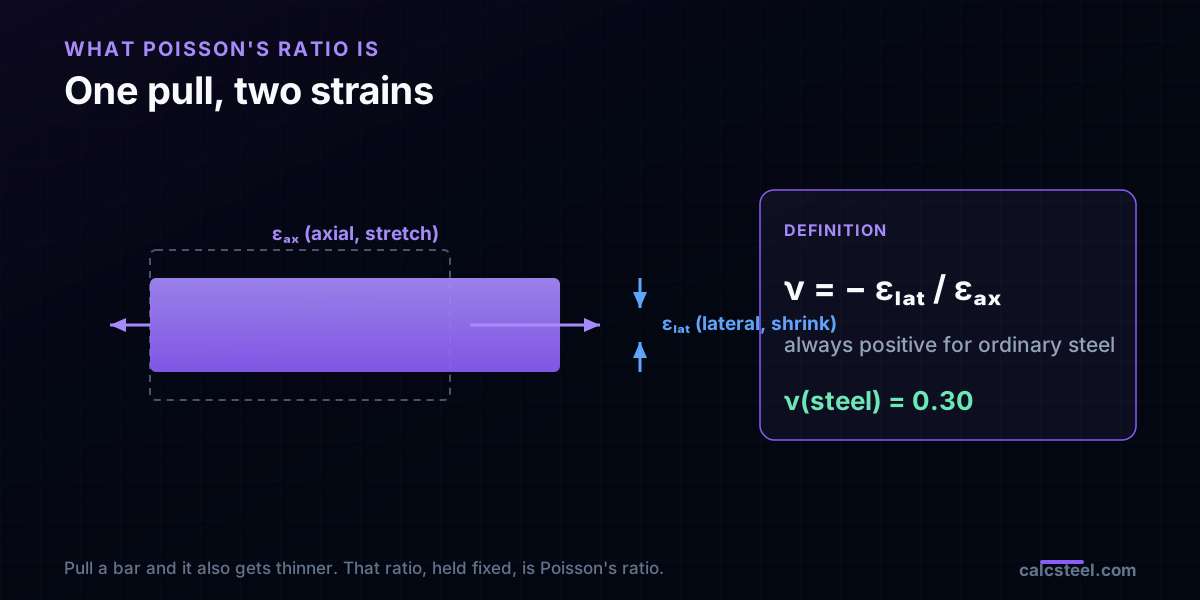
Load a prismatic bar in simple tension. It elongates by an axial strain εₐₓ, and at the same time it contracts across the two transverse directions by a lateral strain εₗₐₜ. Poisson's ratio is the negative of their ratio:
ν = − εₗₐₜ / εₐₓ.
The minus sign is there so that ν comes out positive for ordinary materials, because stretching (positive axial strain) produces contraction (negative lateral strain). For structural steel, ν = 0.30. That single value is remarkably stable: mild steel, high-strength low-alloy, quenched and tempered, austenitic or ferritic stainless, all sit at 0.30 to within a rounding error. Poisson's ratio is a property of the atomic lattice and its elastic response, not of the yield strength, so changing the grade from S235 to S690 leaves ν untouched even though it triples the strength.
Two consequences follow immediately, and both matter later. First, the lateral strain is not optional: if the axial strain is 500 microstrain, the transverse strain is −150 microstrain, always, as long as the steel is elastic. Second, ν is dimensionless. It is a pure ratio, which is exactly why it can hide inside other constants without leaving a unit behind to give itself away.
The range: from cork to rubber, and where steel sits
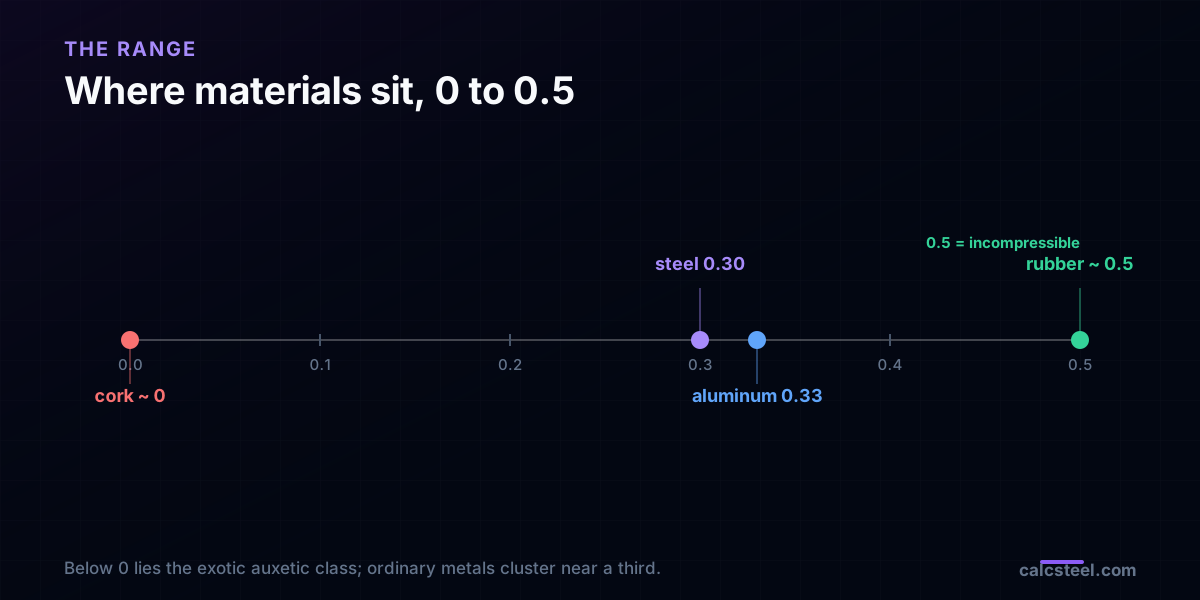
Thermodynamics bounds an isotropic material's Poisson ratio between −1 and +0.5. In practice the useful window is 0 to 0.5, and where a material falls says something physical about how it deforms.
- ν near 0 (cork): squeeze it and it barely bulges sideways. That is why a cork goes back into a bottle: compressing it lengthwise does not fatten it.
- ν = 0.20 (concrete): stiff, brittle, low lateral response.
- ν = 0.30 (steel): the structural middle of the road, and the value you will use almost every day.
- ν = 0.33 (aluminum): a touch more lateral give than steel, a difference that shows up in the shear modulus.
- ν approaching 0.5 (rubber): the incompressible limit. At exactly 0.5 the material conserves volume perfectly, so it can only change shape, never size. Rubber and water-saturated soils live here.
Below zero lies the exotic auxetic class, foams and lattices engineered to get fatter when you stretch them. They are real, but you will not meet one in a steel frame. The lesson for the designer is comforting: metals cluster tightly near a third, so for steel you can treat ν = 0.30 as a constant and be right to the third decimal.
The contraction nobody checks
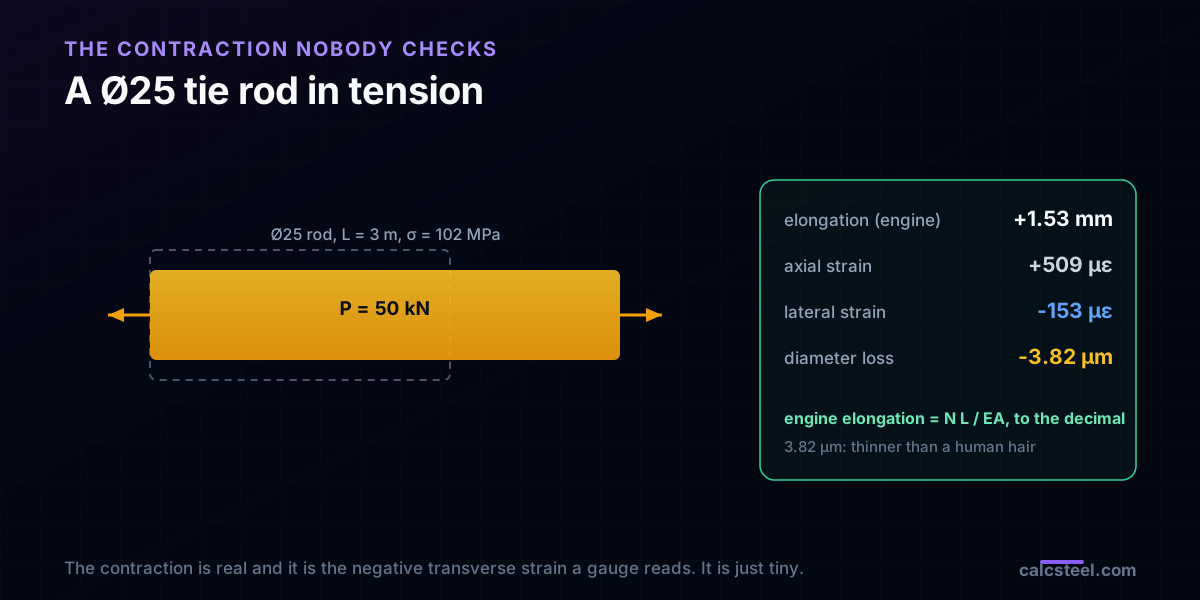
Take a plain round tie rod, Ø25 mm, 3 m long, holding a service tension of 50 kN. That is a stress of 101.9 MPa, comfortable for a mild-steel rod. Build the same member in CalcSteel and the engine returns an axial elongation of +1.53 mm, which matches the textbook N·L/EA to the decimal. That number every designer checks, because it is the elongation that shows up in a turnbuckle take-up or a bracing pre-tension.
Now the number nobody checks. The axial strain is 509 microstrain, so the lateral strain is −ν·εₐₓ = −153 microstrain, and the diameter shrinks by:
Δd = − ν · εₐₓ · d = −0.30 · 0.000509 · 25 mm = −3.82 µm.
Three point eight microns. That is thinner than a human hair, far below anything a caliper on site would resolve, and it changes no capacity check. So it is fair to ignore it, and everyone does. But keep two things in mind. First, this contraction is not a rounding artefact, it is exactly the negative transverse strain a strain gauge glued across the bar would read, which is why a strain rosette on a member in tension shows a negative reading on its transverse grid even though the steel is being pulled. Second, the same ν that makes this contraction negligible is about to make a plate stiffer and a tube's deflection larger. Same number, very different consequence.
Where it finally matters: ν moves a real deflection
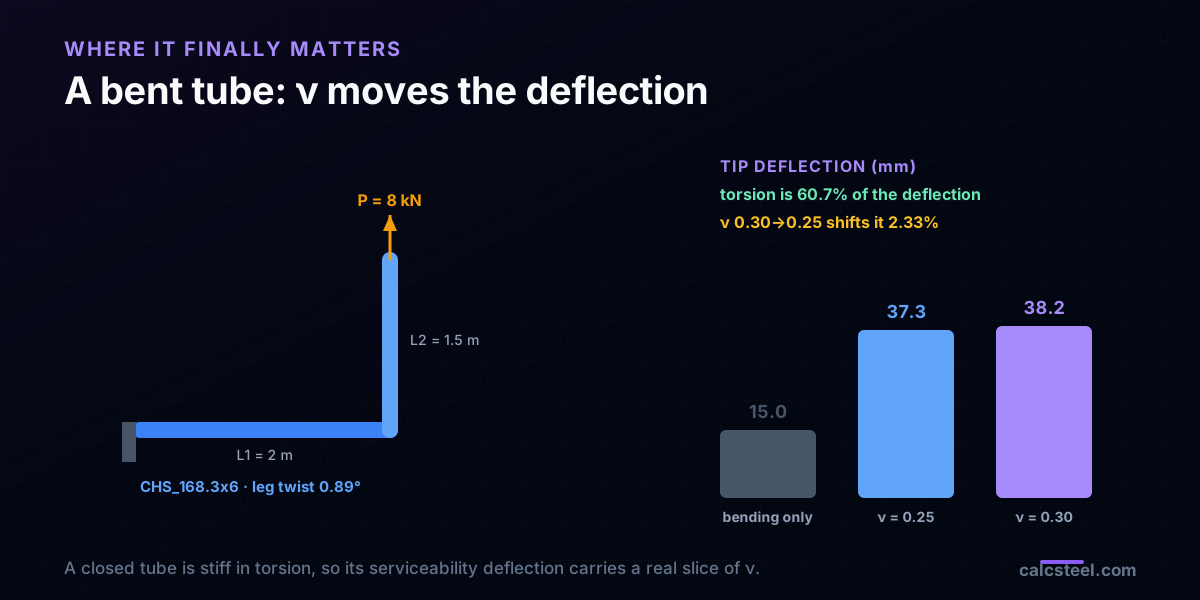
If ν only produced 3.82 µm contractions, it would be a curiosity. It is not, because it rides inside G, and G governs torsion. To make that concrete, take a member that actually twists: a bent cantilever made of a closed tube, a CHS 168.3 × 6, with a 2 m leg and a 1.5 m leg meeting at a right angle, loaded 8 kN out of its plane at the free end. This is the shape of a canopy spur, a balcony edge beam, a pipe-rack outrigger.
The out-of-plane load bends both legs and, crucially, twists the first leg with a torque of 12 kNm. Run it in CalcSteel and the free end drops 38.2 mm. Suppress the torsion and the same frame drops only 15.0 mm, so 60.7% of the serviceability deflection is torsion, and every bit of that torsion runs through G, hence through ν. A closed tube is deliberately stiff in torsion, which is exactly why the twist stays small, 0.886 degrees, while still carrying most of the deflection.
Now the payoff. Rerun the identical frame with ν assumed at 0.25 instead of 0.30. Nothing else changes, only the Poisson ratio, which raises G from 76.9 to 80.0 GPa. The tip deflection falls from 38.2 to 37.3 mm, a 2.33% shift in a number you report against an L/250 serviceability limit. That is Poisson's ratio changing a real answer, measured by the same engine that returns the elongation to the decimal. Get ν wrong by five hundredths and your deflection is off by more than two percent, on the exact quantity a client sees.
The same G runs shear deflection and torsional buckling
Torsion of a bent tube is the cleanest demonstration, but it is not the only place G, and therefore ν, controls the result. Two more show up in routine work.
Shear deflection of stubby members. The familiar 5wL⁴/384EI deflection is a bending-only formula. For short, deep members, a spandrel over a wide opening, a transfer girder, a coupling beam, the shear deformation term, proportional to 1/GA, is no longer negligible. Since G carries ν, so does the shear part of the deflection. It rarely dominates in a long beam, but in a member with a span-to-depth ratio near 5 it can add several percent, and it is Poisson's ratio that sets the size of that addition.
Torsional and torsional-flexural buckling. Singly symmetric and point-symmetric shapes, angles, tees, channels, cruciforms, can buckle by twisting rather than by simple flexure. The elastic torsional buckling stress depends on G·J and on the warping stiffness, so the governing capacity of a slender angle strut runs directly through the shear modulus. If you are designing to a limit state where torsional-flexural buckling governs, ν is quietly in the answer. This is the pattern for the whole subject: you never see Poisson's ratio in the check, but it is inside every G that the check uses.
The (1 − ν²) plate factor: why a plate beats a strip
Poisson's ratio has a second hiding place, and this one shows up whenever steel acts as a plate rather than a beam: base plates, slabs, shear walls, unstiffened webs. The bending stiffness of a plate is not E·t³/12, the value for a bare strip. It is:
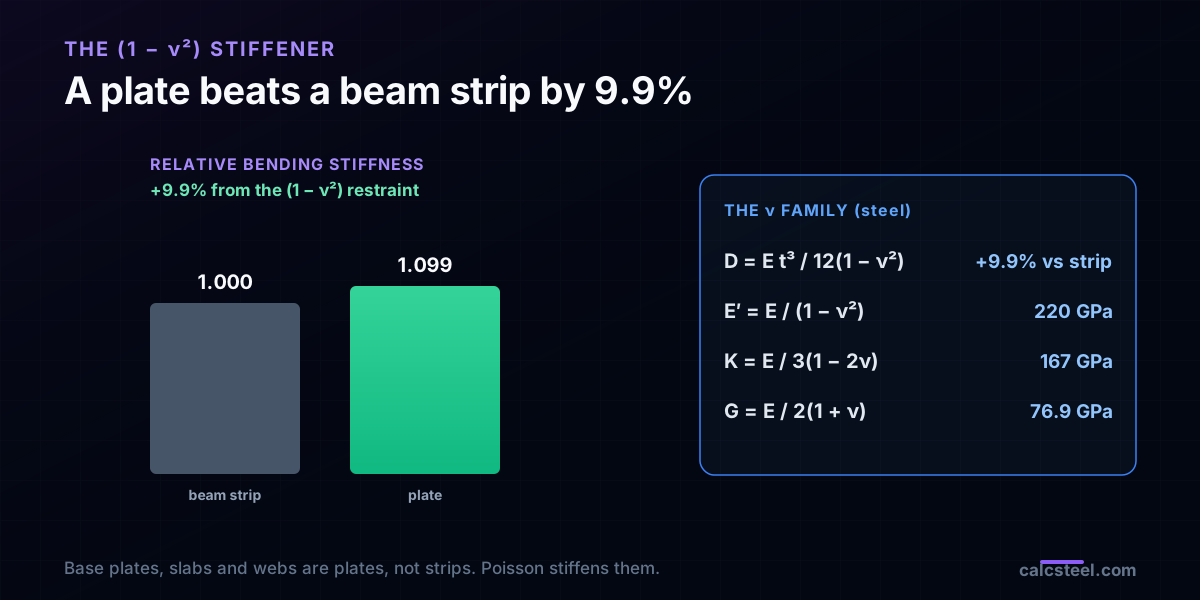
D = E · t³ / [ 12 (1 − ν²) ].
The (1 − ν²) in the denominator comes from the fact that a wide plate cannot contract freely sideways as it bends, the material on either side restrains it, and that restraint stiffens it. For steel, 1 − ν² = 1 − 0.09 = 0.91, so the plate factor 1/(1 − ν²) = 1.099. A plate is 9.9% stiffer in bending than a strip of the same thickness, purely because of Poisson restraint. That is not a rounding error, it is the difference between a base plate that passes a bearing-and-bending check and one that does not, and it is why plate formulas and beam formulas never quite agree.
The same 1/(1 − ν²) appears as an effective modulus, E' = E/(1 − ν²) = 219.8 GPa, whenever a member is in plane strain, restrained from contracting along one axis. A thick, laterally confined region behaves as if it were made of a stiffer steel, again by about 10%, and again the whole effect is Poisson's ratio.
Plane stress versus plane strain, and why confinement stiffens steel
The plate factor is really a special case of a broader idea that trips up a lot of engineers: the difference between plane stress and plane strain. In plane stress, thin members free to contract through their thickness, Hooke's law reads σ = E·ε for a uniaxial state and the material shows its plain modulus. In plane strain, thick or laterally confined members that cannot contract sideways, the same steel responds with the stiffer effective modulus E/(1 − ν²), because Poisson restraint is doing structural work.
This is not academic. A weld throat deep inside a thick connection, the core of a heavy column splice, the material ahead of a crack tip, all sit closer to plane strain than plane stress. The confinement raises the apparent stiffness, and, more importantly for safety, it raises the hydrostatic tension. That triaxial restraint is exactly why thick sections and highly restrained welds are more prone to brittle fracture: Poisson's ratio, by refusing to let the steel neck down and yield freely, keeps the stress state triaxial and suppresses the ductile relief that a thin plate would enjoy. The number is benign in a deflection check and dangerous in a fracture check, and it is the same number.
Volume change and the bulk modulus
One more place Poisson's ratio sets the physics: how much a stressed steel actually changes volume. The volumetric strain, the fractional change in volume, under a general stress state is:
e = (1 − 2ν) / E × (σₓ + σ_y + σ_z).
The factor (1 − 2ν) is the tell. For steel, 1 − 2ν = 0.40, so under a uniaxial 150 MPa a member's volume grows by about 300 microstrain. As ν rises toward 0.5, that factor drops toward zero, and the material stops changing volume at all, which is the precise meaning of incompressible. The companion constant is the bulk modulus, the resistance to uniform compression:
K = E / [ 3 (1 − 2ν) ] = 166.7 GPa for steel.
K, like G, is fixed by E and ν alone. An isotropic elastic material has exactly two independent elastic constants, and every other one, G, K, the plane-strain modulus, the plate factor, is a combination of the two you already know. Choose E and ν and you have chosen all of them. That is why ν is worth understanding even though you rarely type it: it is one of only two numbers that define how steel deforms.
When 0.30 is not the number to use
For structural steel, the honest advice is simple: trust 0.30 and move on. It does not vary enough across grades, standards or temperatures in the service range to justify a second thought, and every mainstream code, NBR 8800, AISC 360, Eurocode 3, IS 800, adopts 0.30 for structural analysis. The one common metal that differs is aluminum at 0.33, and CalcSteel already carries that value for you in the aluminum grades, so a 6061-T6 outrigger is analysed with the right G automatically.
Where ν genuinely stops being a constant is outside the steel world you may still touch. Concrete sits near 0.20, and its value creeps under sustained load. Timber is strongly anisotropic, with several different Poisson ratios depending on grain direction. Soils range from around 0.2 when drained to 0.5 when saturated and undrained, which is why geotechnical settlement analysis takes ν seriously in a way steel design does not. Elastomeric bearings are effectively incompressible at 0.5, and getting that wrong makes a bearing stiffness calculation meaningless. The rule of thumb: for the steel itself, ν = 0.30 is a fact you can lean on; for anything it bears on or connects to, check the number before you assume it.
Five ways Poisson's ratio quietly corrupts a result
- Using 0.5 for steel. A surprisingly common slip, often copied from a fluids or rubber context. It inflates G by 15% and makes K infinite. Steel is 0.30, not incompressible.
- Forgetting that G depends on ν. Treating G as a free input you can round to 80 GPa quietly resets ν to 0.25. If your torsion or torsional-buckling answer must be consistent, let G = E/2(1+ν) rather than typing a rounded G.
- Double-counting the plate factor. Using a plate formula that already contains 1/(1 − ν²) and then multiplying by it again, or the reverse, dropping it from a plate and treating it as a strip. Know which formula you are holding.
- Mixing plane stress and plane strain. Applying E for a thin free member to a thick confined one, or vice versa, is a 10% stiffness error and, near a crack, a safety-relevant one.
- Assuming ν tracks the grade. It does not. S235 and S690 share ν = 0.30. Poisson's ratio is a lattice property, not a strength property, so higher yield does not mean a different contraction.
Try it live, and see ν convert strain to stress
Poisson's ratio is the constant that connects the strain you can measure to the stress you must check. The calculator below is the CalcSteel Mohr's circle tool, free and with no login for the maths. Enter a stress state and it returns the principal stresses, the maximum shear and the von Mises value. To see ν at work, take the tie rod above: an axial stress of 101.9 MPa with zero transverse stress produces the axial strain of 509 microstrain and, through ν, the lateral strain of −153 microstrain. The tool works the stress side of that same circle.
From here, the neighbours worth reading are the strain rosette guide, where the negative transverse strain you met above is what a real gauge records, and the deflection limits article, where the serviceability numbers that ν nudges by a couple of percent are checked against code. Poisson's ratio is the quiet second constant behind all of them: you rarely type it, but it is already in every answer.
σ₁ (major)
92.4MPa
σ₂ (minor)
7.6MPa
τmax in-plane
42.4MPa
θp (to σ₁)
22.5°
τabs (3-D)
46.2MPa
von Mises
88.9MPa
η · NBR
0.28 ✓
Plane-stress state (MPa)
Tension positive. τxy positive = shear that tends to rotate the element counter-clockwise on the +x face.
Plane stress (σz = 0). Enable to inspect a genuine triaxial state — three circles, not two.
Code check — steel grade
σvM = 88.9 MPa ≤ 313.6 MPa = fy / γa1 (γa1 = 1.10)
NBR 8800:2008 §5.4.2.2 (γa1 = 1,10)
From your solved model
Solve a model in the CalcSteel 3D editor, then return here to load the real σx/σy/τxy at any member section — Mohr's circle becomes the solver's inspection lens.
Presets
Element rotation θ
0°Export (free · no watermark)
Try CalcSteel for free
Model, analyze and design steel structures in your browser. No install, no signup.
Open the 3D editor