The Three-Hinged Arch: Why the Hinge Makes It Solvable by Statics Alone
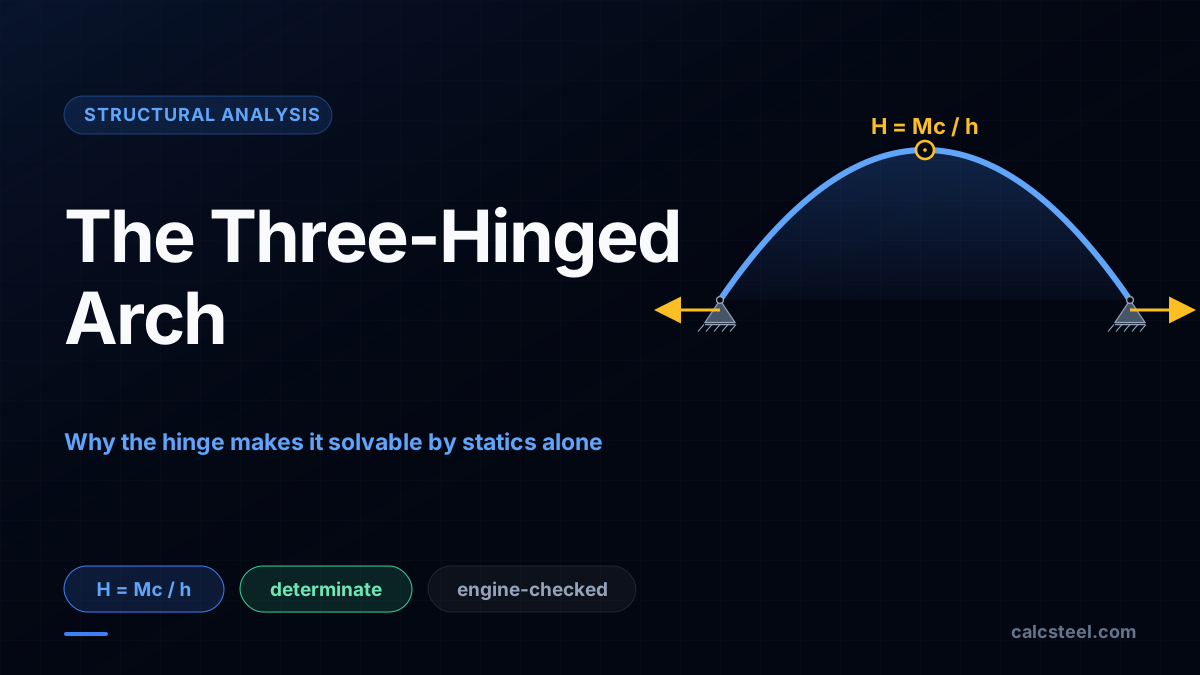
The three-hinged arch is the one curved structure you can fully solve by hand. A fixed arch is indeterminate to the third degree, and even a two-hinged arch hides one redundant, the horizontal thrust, that equilibrium cannot give you. Put a hinge at the crown and the whole thing collapses to a single formula, H = Mc / h, with every reaction checked here against the CalcSteel FEM engine.
Key takeaways
- Two pins give four reactions, and three equilibrium equations plus one equation of condition (zero moment at the crown hinge) give four equations: the three-hinged arch is statically determinate, degree 0.
- The thrust is H = Mc / h, where Mc is the bending moment a simply supported beam of the same span and load would have under the crown, not the arch's own moment.
- A parabola under uniform load is funicular: the CalcSteel engine reports essentially zero bending everywhere, and the whole arch works in pure compression, which is why arches span far with little material.
- The three-hinged thrust is stiffness-independent: the engine returns H = 40.0 kN for both a light and a heavy section, while the two-hinged thrust drifts (31.0 vs 30.9 kN), so a determinate arch is also immune to settlement and temperature self-stress.
- The thrust never vanishes: it must land on a foundation that can take it or on a tension tie between the springings, and ignoring it is the classic failure where the supports spread and the arch drops.
The one curved structure you can solve by hand
Most curved structures cannot be solved by statics alone. A fixed arch, built in solid at both springings, is statically indeterminate to the third degree: equilibrium hands you three equations and the structure hides six unknown reactions, so you cannot find the forces without bringing in the section, the material, and a compatibility calculation. Even the gentler two-hinged arch, pinned at both supports, still hides one redundant that equilibrium cannot reach, and that redundant is precisely the horizontal thrust the arch pushes out against its foundations.
The three-hinged arch is the exception, and that is exactly why it opens every Análise Estrutural and Estruturas I course. Add one more hinge, at the crown, and the curved structure becomes statically determinate. Four straightforward equilibrium ideas then give you every reaction by hand, with no reference to the section, the material, or the temperature. It is the rare case where a curved, thrusting structure is as tractable as a simply supported beam.
This article works the whole thing end to end. One formula, H = Mc / h, does the heavy lifting; three worked examples put real numbers on it, each checked against the CalcSteel finite element engine; and a short experiment proves the punchline in the title, that the third hinge converts a stiffness problem into a statics problem and the thrust stops caring what section you pick. Baseline geometry throughout: span L = 20 m, rise h = 5 m, so h/L = 1/4.
What an arch is, and the price of it: thrust
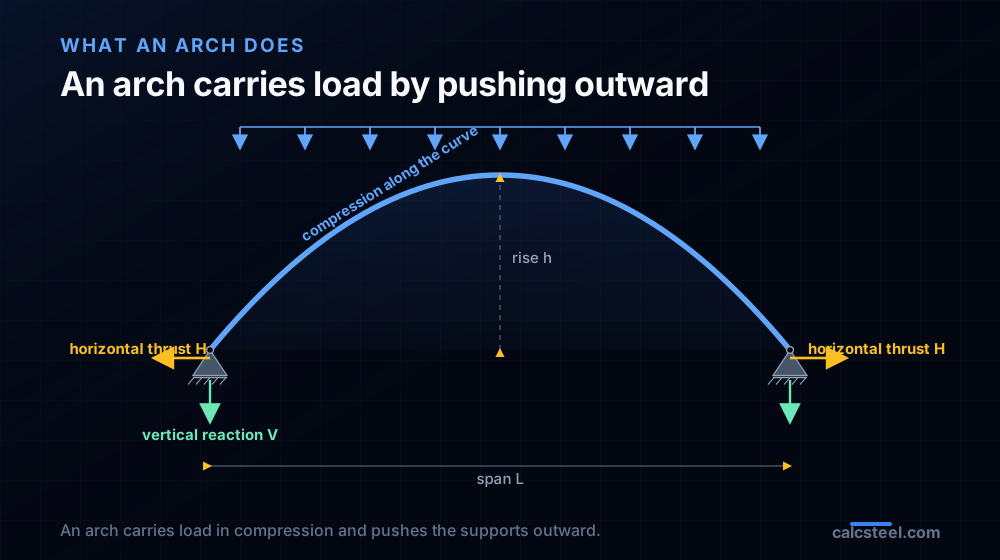
An arch is a curved member that carries transverse load mainly by axial compression along its length, rather than by bending across its depth. Because it works in compression, you can build one out of stone, brick, or unreinforced concrete, materials that are strong in compression and nearly useless in tension. That is the whole reason the arch outlived every other ancient structural form: it turns a downward load into a squeeze the material can actually take.
A beam does the opposite. It spans by bending: the top fibre shortens, the bottom fibre stretches, and the material has to be good in both compression and tension. The arch trades that bending for compression, and the price of the trade is paid at the supports. A loaded arch does not press straight down on its springings; it presses outward and down, on an inclined line. The vertical part of that reaction is V, familiar from any beam. The horizontal part is the thrust H, and it is the defining feature of arch behaviour: the supports must physically resist being pushed apart.
Name the geometry, because the rest of the article uses it. The horizontal distance between supports is the span L. The height of the crown above the springing line is the rise h. The supports are the springings; the top of the arch is the crown. The ratio h/L is what sets the thrust. Since H = Mc / h, a flatter arch (smaller h) needs a larger H to carry the same load: halve the rise and you double the thrust. A tall arch is gentle on its foundations; a flat, elegant one hammers them.
The three arches, and how each one counts
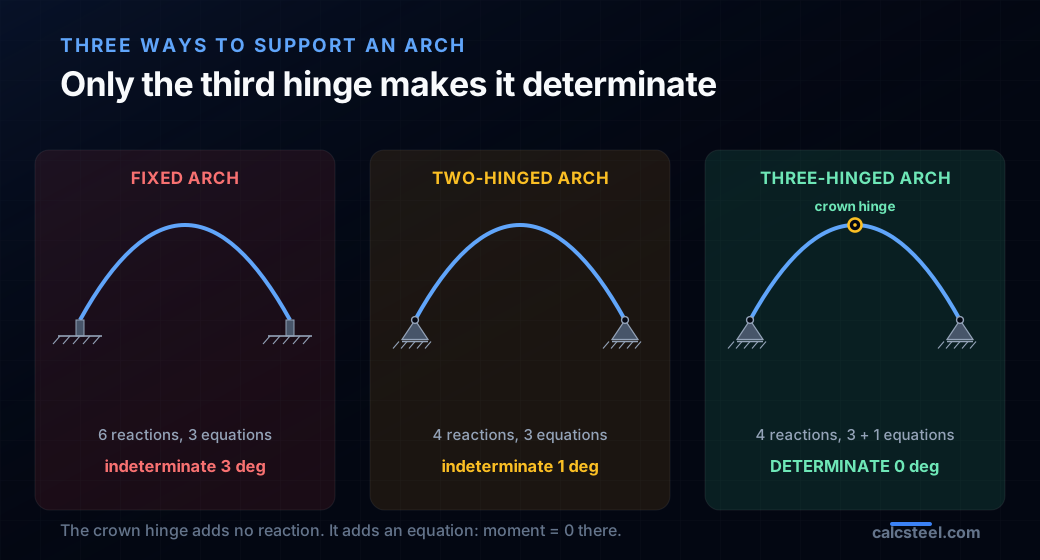
Arches come in three support arrangements, and they sit at three very different points on the determinacy scale. The difference is entirely in how many reaction components each one carries against how many equations you have to find them.
The fixed (hingeless) arch is built in at both ends. Each fixed support carries a horizontal reaction, a vertical reaction, and a moment: 6 reaction components. Against them you have only the 3 equations of global equilibrium, so the fixed arch is indeterminate to the 3rd degree. The two-hinged arch is pinned at both supports. A pin carries a horizontal and a vertical reaction but no moment, so there are 4 reaction components against 3 equilibrium equations: indeterminate to the 1st degree. The single redundant it hides is exactly the horizontal thrust H, the one number equilibrium cannot give you. The three-hinged arch keeps the two pins but adds a hinge at the crown. Still 4 reactions, but now you have a fourth equation, and it comes out determinate.
Here is the key insight, and it is easy to get backwards. The crown hinge adds no reaction: it is an internal hinge, not a support, so it introduces no new force into the count. What it adds is an equation of condition: the bending moment must be zero at a hinge, because a hinge cannot transmit moment. That one extra equation is exactly what the two-hinged arch was missing. The two-hinged arch was short by one, and the crown hinge supplies precisely one. That is the whole trick.
Why the hinge is worth a degree of indeterminacy
Run the count in full for the three-hinged arch. Two pinned supports give 4 unknown reaction components: a horizontal and a vertical at A, a horizontal and a vertical at B. To solve for four unknowns you need four independent equations. Global equilibrium supplies three of them: ΣFx = 0, ΣFy = 0, and ΣM = 0. The crown hinge supplies the fourth: the bending moment at the crown is zero. Four unknowns, four equations, so the degree of static indeterminacy is 0. The structure is exactly determinate.
The fourth equation is called an equation of condition, and the name is worth understanding. Ordinary equilibrium equations describe the structure as a whole. An equation of condition describes an internal release: it says that at a specific point, some internal force is forced to a known value by the way the structure is built. At a hinge, that force is the internal bending moment, and its known value is zero, because a hinge is free to rotate and cannot carry moment across itself. Write that condition down and you have added one equation without adding any unknown.
Each internal hinge in a structure is worth one equation of condition, and therefore reduces the degree of indeterminacy by one. The two-hinged arch was indeterminate to the first degree, short by exactly one equation. Insert one hinge, gain exactly one equation, and the deficit closes to zero. This is the general rule behind the whole arch family, and it is why the number of hinges, not the number of supports, is what makes the three-hinged arch the tractable member of the set.
The method: H equals the simple-beam moment over the rise
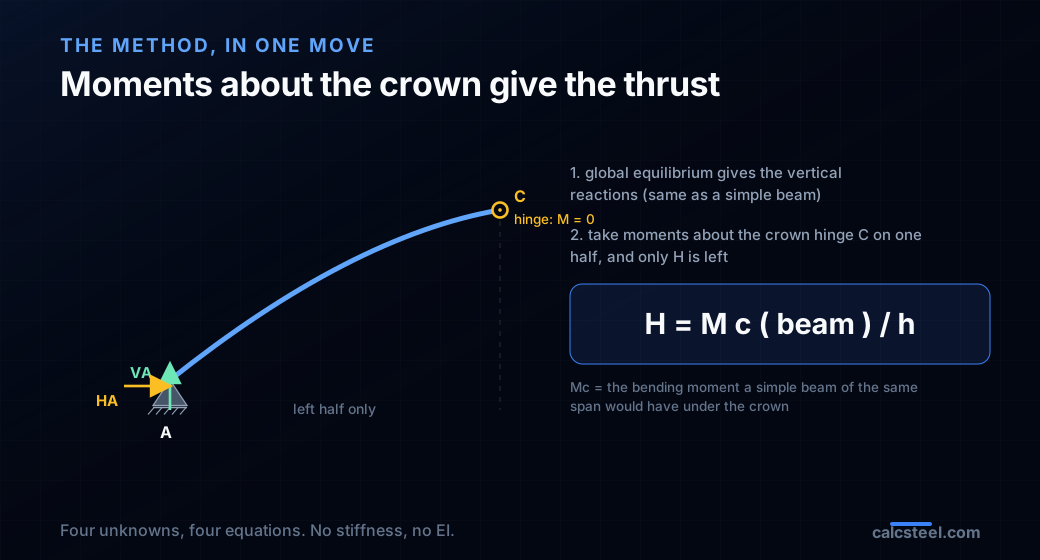
The solution reduces to two steps and one formula: H = Mc / h. The quantity Mc is not the arch's own moment. It is the bending moment that a simply supported beam of the same span, carrying the same vertical loads, would have at the horizontal position of the crown. You solve an imaginary straight beam, read one number off it, divide by the rise, and you have the thrust. The formula assumes the two springings sit at the same level.
Step 1: the vertical reactions. Apply global equilibrium to the whole arch. Because both springings are at the same level, the two horizontal reactions act along that same line and have zero moment arm about either support. Taking moments about A therefore involves only the vertical reactions and the applied loads, exactly as it would for a straight simply supported beam of span L. The result is that VA and VB come out identical to the simple-beam reactions. The arch's verticals are just the beam's verticals.
Step 2: the thrust. Cut the arch at the crown and take the left half (from A to the crown C) as a free body. The right half can only push on the left half through the hinge at C, and a hinge transmits a force but no moment. So take moments about C, and the unknown force at the hinge drops out entirely. What remains is VA·(L/2) minus HA·h minus the moment of the loads on the left half about C, all equal to zero. Now notice the group VA·(L/2) minus the load moments: that is precisely the simple-beam bending moment at the crown position, Mc. So the equation is Mc minus H·h = 0, which rearranges to H = Mc / h. One free body, one moment equation, and the thrust falls out.
Worked example 1: point load at the crown of a pointed arch
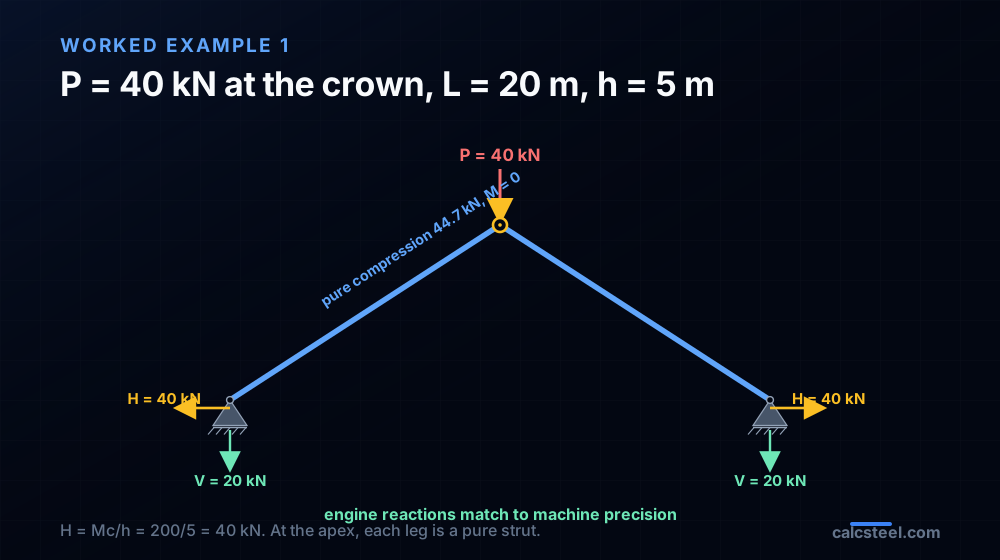
Take a pointed (triangular) three-hinged arch, span L = 20 m, rise h = 5 m, carrying a single vertical point load P = 40 kN at the crown. Run the recipe. The load sits at midspan, so by symmetry the vertical reactions split it evenly: VA = VB = P/2 = 20 kN.
Now the thrust. The simple-beam moment at midspan under a central point load is the standard Mc = PL/4 = 40 × 20 / 4 = 200 kN·m. Divide by the rise: H = Mc / h = 200 / 5 = 40 kN. That is the entire solution by hand. Every reaction: A carries H = 40 kN and V = 20 kN, and B carries H = 40 kN and V = 20 kN.
The CalcSteel engine, with the crown modeled as a member-end moment release and both supports pinned, returns A (H = 40 kN, V = 20 kN) and B (H = 40 kN, V = 20 kN), matching the hand values to machine precision, with zero moment at both pins. There is a bonus in the geometry: because each straight leg of a pointed arch runs from a support to the apex and the only load is at the apex, each half is a two-force member. It carries pure axial compression of magnitude √(20² + 40²) = 44.7 kN, with zero bending anywhere along the leg. A point load at the apex of a pointed arch is funicular: the shape follows the load exactly, so nothing bends.
Try it: read Mc off a simple beam, then divide by the rise
The whole method reduces to one lookup: find the simple-beam bending moment at the crown position, then divide by the rise. Everything else is arithmetic. The free CalcSteel shear and moment calculator below gives you that moment directly. Set the span, drop the same vertical loads the arch carries, and read Mc straight off the bending moment diagram at the crown's horizontal position. Then H = Mc / h.
Reproduce example 1 to get the feel: a 20 m simply supported span with a 40 kN load at midspan gives Mc = 200 kN·m, and 200 / 5 = 40 kN of thrust. Or reproduce example 3 below: put a 60 kN load at the quarter point of a 20 m span, read the moment under midspan, and you will get 150 kN·m, so H = 30 kN. The calculator is the real solver, not a preview, and it runs in your browser with no login for the math.
When you want the arch itself rather than the equivalent beam, model it in the full CalcSteel editor: put a moment release at the crown node, pin both supports, and read the reactions. The same finite element engine that produced every number in this article runs on the whole structure there.
|V| max
30 kN
@ x = 6 m
M max (sagging)
45 kN·m
@ x = 3 m
M min (hogging)
-0 kN·m
@ x = 6 m
Reactions (kN)
R_A 30 · R_B 30
Simply supported beam — uniformly distributed load
Segment equations — x in m, from the left end
0 m ≤ x ≤ 6 m
V(x) = 30 − 10·x [kN]
M(x) = 30·x − 5·x² [kN·m]
Profiles that resist this moment
Md = 45 kN·m → required Wx = Md / (fy/γa1) = 45 kN·m / (250/1.1) = 198 cm³
Bending screen (Wx ≥ Md/(fy/γa1), NBR 8800 γa1 = 1.10 — AISC 360 φb = 0.90 is nearly identical); plastic Zx is valid for compact sections only. δ is the elastic deflection of THIS loading with E = 200 GPa and the section's Ix (loads taken at service value). LTB, shear, compactness and code deflection limits are verified on the profile page and in the 3D editor. "Open in 3D editor" recreates THIS beam — span, supports and every load — with the profile already assigned.
Worked example 2: uniform load on a parabola, and bending disappears
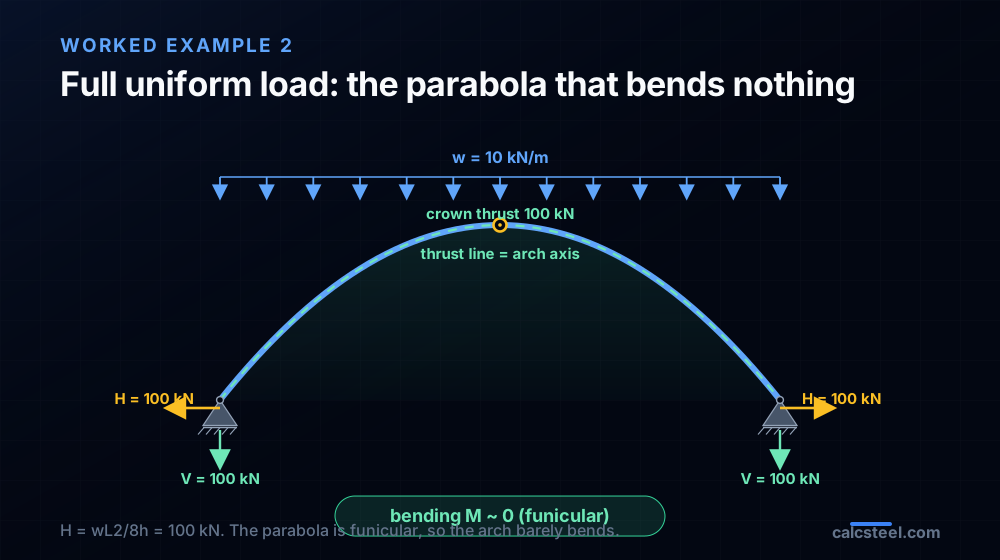
Now a parabolic three-hinged arch, same L = 20 m and h = 5 m, carrying a uniform load w = 10 kN/m over the full span, measured per unit of horizontal length. The vertical reactions are the simple-beam reactions for a full uniform load: VA = VB = wL/2 = 100 kN. The simple-beam moment at midspan is the standard Mc = wL²/8 = 10 × 20² / 8 = 500 kN·m, so the thrust is H = Mc / h = 500 / 5 = 100 kN.
The engine confirms the reactions, 100 kN vertical and H = 100 kN at each springing. But the striking result is the bending. Modeled as 16 segments, the engine reports essentially zero bending moment at every point of the arch. Nothing bends, anywhere. The parabola is the funicular shape for a uniform horizontal load: the line of thrust, the path the compression naturally wants to follow, coincides exactly with the arch axis. When the axis and the line of thrust are the same curve, there is no eccentricity to bend the section, and the whole arch works in pure compression.
The compression is not constant along the arch. It equals the thrust H = 100 kN at the crown, where the axis is horizontal, and grows toward the springings where the axis is steep, reaching the resultant of the support reactions, √(100² + 100²) = 141.4 kN. This is the reason arches span so far on so little material: match the arch shape to the load and bending disappears, leaving only the compression the material is good at. Get the shape wrong, as the next example shows, and the bending comes back.
The proof: the thrust does not know what section you picked
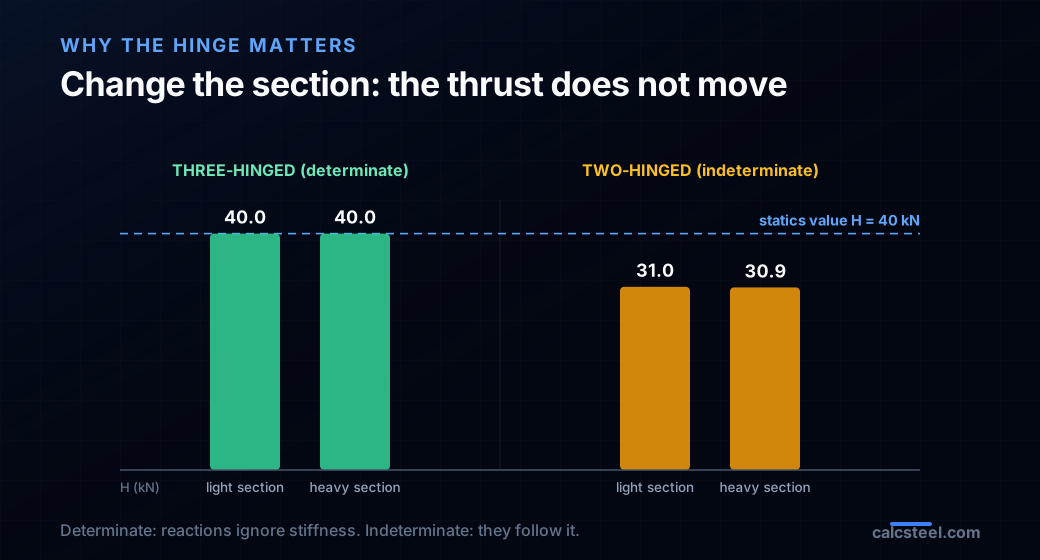
This is the section that literally answers the title. Take the pointed arch from example 1 with its central P = 40 kN and solve it twice in the engine, changing nothing but the section. First with a light member, about an IPE 400. Then with a much heavier, stiffer member, about a W 600. The thrust comes back H = 40.0 kN in both cases, identical to four or more significant figures. The reactions of a determinate structure do not depend on stiffness EI at all, because equilibrium alone fixes them, and equilibrium never mentions the section.
Now remove the crown hinge to make it a two-hinged arch, indeterminate to the first degree, and repeat. The thrust is now H = 31.0 kN with the light section and 30.9 kN with the heavy one. Two things changed at once, and both matter. The value is no longer the clean 40 kN statics gave, because equilibrium alone can no longer find it; and it moves with the section, because the forces in an indeterminate structure follow the relative stiffness of the members. You cannot solve the two-hinged arch without knowing EI, and the answer you get is tied to it.
That contrast is the entire point. The third hinge converts a stiffness problem into a statics problem. For a three-hinged arch you never need EI, a computer, or an assumption about the section to get the reactions; a pencil and equilibrium are enough. There is a corollary that reaches beyond convenience. A determinate structure develops no self-stress from an imposed movement: a support that settles, or a uniform temperature rise that wants to expand the arch, is simply accommodated by the free rotation at the hinges. So a three-hinged arch tolerates a sinking abutment or a hot summer with zero invented force, where a two-hinged or fixed arch would build real bending to fight the movement. This is the same lesson our companion note on support settlement draws on a continuous beam, seen from the other side: determinacy is what buys immunity.
Worked example 3: solvable does not mean bending-free
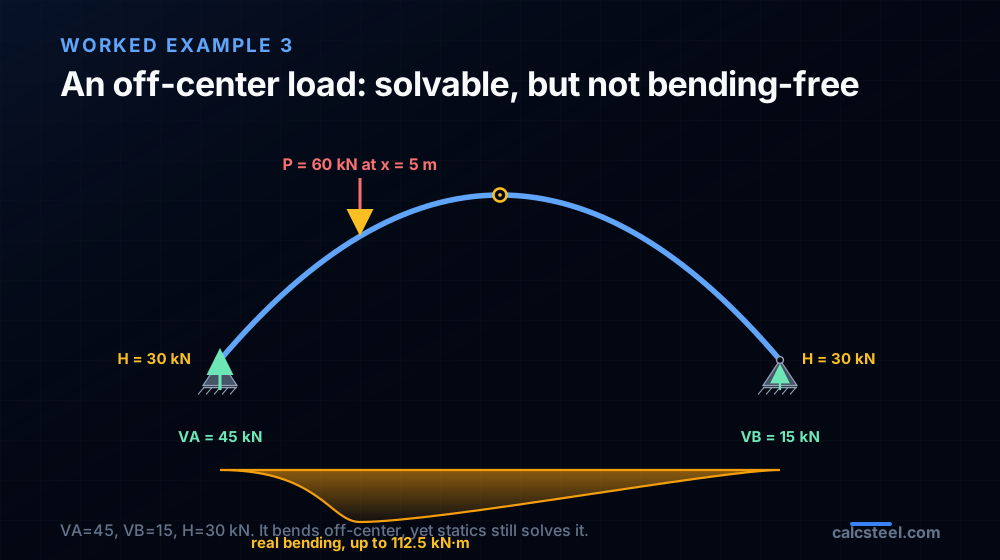
The determinacy of the three-hinged arch makes the reactions solvable by hand. It does not make the arch bending-free. Only a matched, funicular load does that. Here is the counterexample. Take the parabolic arch, same L = 20 m and h = 5 m, but load it with a single point load P = 60 kN at x = 5 m from the left support, the quarter point.
The reactions still come straight from the equivalent simple beam. Taking moments, the far reaction is VB = P·a/L = 60 × 5 / 20 = 15 kN, and the near one is VA = 60 − 15 = 45 kN. The simple-beam moment at the crown, which sits at midspan, is Mc = VA × 10 − P × (10 − 5) = 450 − 300 = 150 kN·m. Check it from the right side: VB × 10 = 150 kN·m, the same. So the thrust is H = Mc / h = 150 / 5 = 30 kN. The engine confirms VA = 45 kN, VB = 15 kN, H = 30 kN.
But now the arch bends. A single off-centre point load is not funicular for a parabola: the line of thrust for this load is not the parabola the arch was built to, so the two curves separate, and the gap between them is eccentricity, and eccentricity is moment. The engine reports a real bending moment developing along the arch, peaking at about 112.5 kN·m. The teaching point is worth stating plainly: the three hinges make the reactions solvable by statics, but they do not make the arch bending-free. Whether the arch bends depends on whether the load matches the shape, not on how many hinges it has.
Where three-hinged arches earn their keep
The three-hinged arch shows up wherever its two virtues, determinacy and easy erection, are worth more than raw stiffness. You find it in long-span roofs: gymnasiums, aircraft hangars, exhibition halls, and warehouses, where a clear span and a light structure matter. It is common in short-span and pedestrian bridges, in glulam and steel portal frames detailed with a pin at the ridge, and in precast concrete arches that arrive on site as two halves and are pinned together at the crown.
The advantages follow directly from everything above. It is determinate, so the analysis is by hand and beyond argument. It is robust to settlement and temperature, inventing no self-stress when an abutment sinks or the steel heats. And it is easy to build: two halves are lifted, met at the top, and pinned, with no heavy moment splice to fabricate and align at the crown. The disadvantages are the other side of the same coin. The crown hinge is a real detail that has to be built, protected, and maintained. And a three-hinged arch is more flexible than a two-hinged or fixed arch, so it deflects more, especially under unsymmetrical load, where the two halves can see-saw about the crown. For very long or heavily loaded spans, designers often accept the indeterminate analysis of a two-hinged or fixed arch precisely to buy that extra stiffness.
One caution outranks all the others: the thrust has to go somewhere. It must be delivered into a foundation stiff and strong enough to resist being pushed outward, or it must be caught by a tension tie running between the two springings, which turns the assembly into a tied arch and lets the tie, rather than the ground, close the horizontal force. Ignoring H is the classic arch failure: the supports spread, the span opens, and the arch drops. An arch is not a curved beam, and its foundations are not a beam's.
Common mistakes and quick answers
The three-hinged arch is simple to solve and easy to misread. These are the traps that catch students and practising engineers most often.
- Forgetting the thrust. The single most expensive mistake. An arch is not a curved beam: it pushes outward on its supports, and that horizontal thrust H is real, large, and permanent. If your model or your foundation ignores it, the supports spread and the arch fails.
- Using the arch's own moment in H = Mc / h. Mc is the simple-beam bending moment at the crown position, computed on an imaginary straight beam of the same span and load. It is not the moment in the arch itself (which, at the crown hinge, is zero anyway). Solve the equivalent beam, not the arch, to get Mc.
- Does the crown hinge have to be exactly central? No. The compact formula H = Mc / h assumes the crown sits over the reference and the springings are level, but the method is general: take moments about the actual hinge location on the half that contains it, and the thrust falls out wherever the hinge is.
- Parabola, circle, or catenary, which shape? The funicular shape depends on the load. A parabola is funicular for a uniform load per horizontal length (like our example 2). A catenary is funicular for load distributed along the arch's own length, such as self-weight. A circular arch is funicular for neither, so it always carries some bending, even under its own weight.
- Is a three-hinged arch weaker? It is more flexible, and it sees larger peak moments under unsymmetrical load. But it is far easier to analyze and it is immune to settlement and temperature self-stress. It trades stiffness for determinacy, and for many structures that is the right trade.
- How do I model it? Put a moment release at the crown node, pin both supports, and read the reactions. A good sanity check is built in: change the section and the reactions should not move. If they do, you have not actually released the crown.
Key takeaways
- Two pins give 4 reactions; three equilibrium equations plus one equation of condition (zero moment at the crown hinge) give 4 equations, so the three-hinged arch is statically determinate, degree 0. The crown hinge adds an equation, not a reaction.
- The thrust is H = Mc / h, where Mc is the simple-beam moment at the crown position, and a flatter arch (smaller h) draws a larger thrust.
- A parabola under uniform load is funicular: the line of thrust lands on the arch axis, bending is essentially zero, and the arch works in pure compression, which is why it spans far on little material.
- The three-hinged thrust is stiffness-independent (H = 40.0 kN for both a light and a heavy section), while the two-hinged thrust drifts (31.0 vs 30.9 kN). Determinacy also makes the arch immune to settlement and temperature self-stress.
- Solvable does not mean bending-free: an off-centre point load on a parabola still develops real bending (up to about 112.5 kN·m), because only a matched, funicular load cancels it.
- The thrust never disappears: it must land on a capable foundation or a tension tie between the springings. Ignoring it spreads the supports and drops the arch.
Sources
Try CalcSteel for free
Model, analyze and design steel structures in your browser. No install, no signup.
Open the 3D editor