Units in Structural Engineering: kN, kgf, MPa and the Conversion That Ruins Calculations

A practical guide to the units structural engineers actually use, kN, kgf, tf, MPa, kgf/cm2, ksi and kip, with the exact conversion factors and two engine-verified examples where a single unit slip turns a beam that fails into one that looks safe.
Key takeaways
- Structural work runs on three unit families: SI (kN, MPa), the legacy metric or technical system (kgf, tf, kgf/cm2), and US customary (kip, ksi, kip.ft). Mixing them is the most common silent error in a calculation.
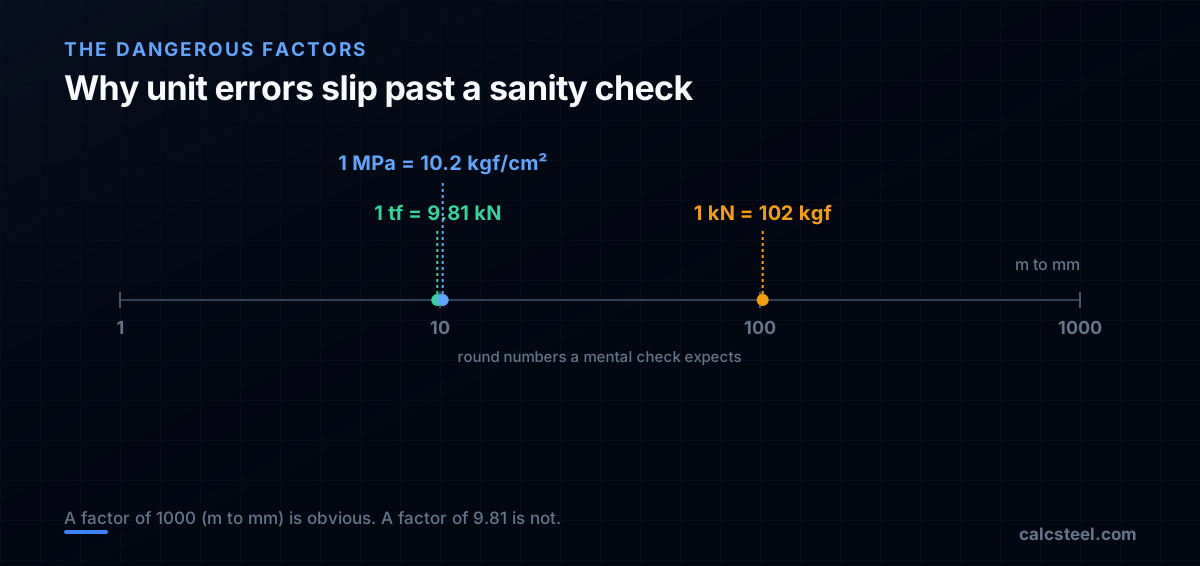
- The conversions that cause real damage all sit near a factor of ten: 1 tf = 9.81 kN, 1 MPa = 10.2 kgf/cm2, 1 kN = 102 kgf. Close enough to a round number to pass a mental sanity check, wrong enough to collapse a member.
- kgf is a force, kg is a mass. One kilogram weighs 9.80665 N = 1 kgf, so treating a mass in kg as a force, or a load in kgf as if it were kN, is off by g every time.
- N/mm2 and MPa are identical, exactly. It is the one pair you can swap without a factor; every other swap needs one.
- The same grade reads differently per system: MR250 is fy = 250 MPa = 2549 kgf/cm2 = 36.3 ksi; A36 is 36 ksi = 248 MPa; A572 Gr.50 is 50 ksi = 345 MPa.
- A unit slip is directional and dangerous: understating a load or overstating a strength both make an overstressed member look safe. Our engine example drops utilization from 1.27 (fails) to 0.13 (looks fine) from one factor-of-g error.
- The fix is discipline, not memory: one unit system per project, a unit label on every number, and software that stores in SI and converts at the edge so you never apply g by hand.
Why units quietly ruin more calculations than the math ever does
Ask any reviewer where structural calculations go wrong and very few will say the algebra. The equilibrium is usually right, the section formula is right, the load path is right. What fails is the units. A wrong conversion never throws an error. It hands you a clean, plausible number that is off by a factor you did not notice, and that number flows straight into a member size, a base plate, a foundation.
The reason units are so dangerous in this field is that structural engineering never settled on one system. In the same week you can open a European section table in kN and MPa, a legacy Brazilian or Latin American spreadsheet in kgf and kgf/cm2, and an AISC design guide in kip and ksi. Each is internally consistent. The damage happens at the seams, when a value crosses from one system into another and the factor gets dropped, rounded, or applied twice.
This guide covers the units a structural engineer actually meets, the exact factors that link them, and the one family of conversions that ruins calculations more than any other. Every conversion below is computed with the same factors as the CalcSteel steel unit converter, and the two worked examples are run through the real analysis engine, so the numbers match the tool to the digit.
The three unit systems you actually meet
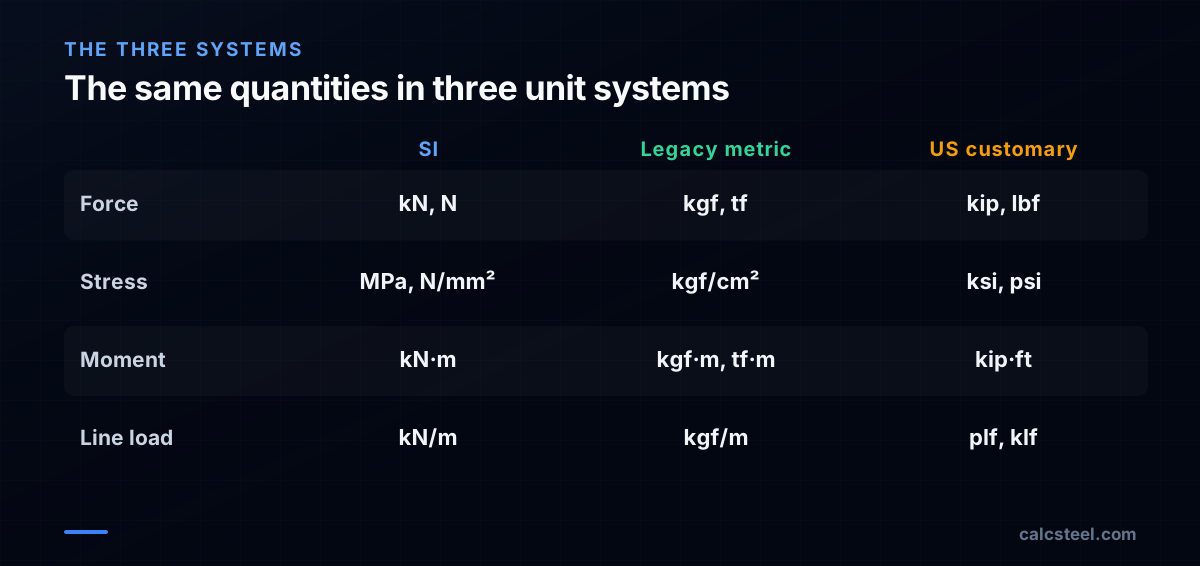
There are three unit families in day to day structural work. Knowing which one a document speaks is the first defence against a bad conversion.
SI (the modern default)
- Force in newtons (N) and kilonewtons (kN)
- Stress in pascals (Pa) and megapascals (MPa)
- Moment in kN·m, distributed load in kN/m
- Used by Eurocode, most of the world outside the United States, and every modern analysis package internally
Legacy metric (the technical or MKS system)
- Force in kilogram-force (kgf) and tonne-force (tf)
- Stress in kgf/cm2
- Still alive in older Brazilian and Latin American offices, mill certificates, crane charts, and any spreadsheet older than about 2000
- This is the system where the word behind a number is most often lost, because kgf looks like the everyday kilogram
US customary (imperial engineering)
- Force in pounds-force (lbf) and kips (1 kip = 1000 lbf)
- Stress in psi and ksi (kips per square inch)
- Moment in kip·ft for members and kip·in for connections
- Used by AISC, ASCE 7, and US and Canadian practice
Within one system nothing goes wrong. Trouble starts when a beam sized from an AISC guide in kip·ft is checked in a model that expects kN·m, or when a mill cert in kgf/cm2 is typed into a field labelled MPa. The rest of this guide is about those crossings.
Force: kN, kgf, tf and kip (and the kg trap)
Force is where the most quietly dangerous mistake lives, because the legacy metric unit of force, the kilogram-force, shares its name and its number with the kilogram of mass.
The exact factors
- 1 kgf = 9.80665 N (the weight of one kilogram under standard gravity g)
- 1 tf = 1000 kgf = 9.80665 kN (metric tonne-force)
- 1 kN = 101.97 kgf ≈ 102 kgf
- 1 kN = 0.10197 tf
- 1 kip = 1000 lbf = 4.448 kN
The kg versus kgf trap
A mass of 2000 kg is not a force of 2000 of anything. Under gravity it weighs 2000 kgf, which is 2000 × 9.80665 = 19.6 kN. Engineers who carry the mass straight into a force field, or who read 2000 kgf and enter 2000 kN, are wrong by exactly g. That is the single most common load error in practice, and because g is close to 10 the result looks like it could be right.
The number to burn into memory
One tonne-force is about ten kilonewtons (9.81, to be exact). A truck wheel load of 8 tf is roughly 80 kN. A column carrying 150 tf carries about 1470 kN. If you remember only one force conversion, remember 1 tf ≈ 9.81 kN, and remember that it is not exactly 10.
Stress and strength: MPa, kgf/cm2, ksi, and why N/mm2 is free
Stress carries the yield strength fy, the bending stress, and the bearing pressure. It is also where the one truly free conversion lives, and one factor-of-ten trap that has failed real members.
The one pair you can swap without thinking
1 N/mm2 = 1 MPa, exactly. A megapascal is a newton per square millimetre by definition, so European tables in N/mm2 and SI tables in MPa are the same number. This is the only stress pair with a factor of 1.
The factors that are not free
- 1 MPa = 10.197 kgf/cm2 ≈ 10.2
- 1 kgf/cm2 = 0.09807 MPa
- 1 ksi = 6.895 MPa
- 1 MPa = 0.14504 ksi
The same steel in three systems
Yield strength is where these units meet head on. The same grade reads completely differently depending on the document:
- ASTM A36: fy = 36 ksi = 248 MPa ≈ 2531 kgf/cm2
- MR250 (and S250): fy = 250 MPa = 36.3 ksi = 2549 kgf/cm2
- S275: fy = 275 MPa = 39.9 ksi = 2804 kgf/cm2
- ASTM A572 Gr.50: fy = 50 ksi = 345 MPa = 3517 kgf/cm2
- S355: fy = 355 MPa = 51.5 ksi = 3620 kgf/cm2
Young's modulus travels the same way: E = 200 GPa = 200000 MPa = 2.04 million kgf/cm2 = 29000 ksi. If you want to see what happens when you change the grade rather than the units, our post on MR250 or A572 walks through it, and the steel stress-strain curve explains what fy physically means.
Moment, line load and inertia: kN·m, kN/m, cm4
The remaining quantities inherit the same factors as force, because a moment is a force times a length and a line load is a force per length.
Moment and torque
- 1 kN·m = 101.97 kgf·m
- 1 kN·m = 0.10197 tf·m
- 1 kN·m = 0.7376 kip·ft
- 1 kip·ft = 1.356 kN·m
AISC quotes member bending in kip·ft and connection demand in kip·in, so a single AISC problem can carry two moment units at once. Keep the member and the connection in the same unit until the very last step.
Distributed (line) load
- 1 kN/m = 101.97 kgf/m
- 1 kN/m = 0.10197 tf/m
- 1 kN/m = 68.52 plf (pounds per linear foot)
- 1 kN/m = 0.06852 klf (kips per linear foot)
Line load is the input that most often gets mis-typed, because floor loads are frequently computed in kgf/m2 then multiplied by a tributary width. A service load of 1500 kgf/m is 14.71 kN/m, not 1500 and not 15.
Second moment of area
- 1 in4 = 41.62 cm4
- IPE 300: Ix = 8356 cm4 = 200.75 in4
Inertia and section modulus rarely get mixed up across systems because the numbers are so different in magnitude that a wrong unit is obvious. The dangerous conversions are the ones near a factor of ten, which is the next section.
The one conversion that ruins calculations
Go back through the factors above and notice a pattern. The conversions that link the legacy metric system to SI all orbit the same number:
- 1 tf = 9.81 kN (a factor of g)
- 1 kgf = 9.81 N (a factor of g)
- 1 MPa = 10.2 kgf/cm2 (a factor of g times a unit-area rescale)
- 1 kN = 102 kgf (a factor of 100/g)
Every one of them lands within a whisker of 10, or 100. That is exactly what makes them lethal. A conversion of 1 to 1000, like metres to millimetres, produces a number so obviously different that a wrong one screams at you. A conversion of 1 to 9.81 produces a number that looks like it belongs. If you drop the factor entirely, or apply the lazy shortcut of 10 instead of 9.81, or apply it in the wrong direction, the result still passes a mental sniff test. It sits in the plausible range and moves on to the next line of the calculation.
There are two ways this single family of errors reaches a member, and both are shown below with the real engine. The first understates a load. The second overstates a strength. They are mirror images, and they push utilization in the same direction: a member that is actually overstressed comes out looking safe.
Worked example 1: the tonne-force load slip
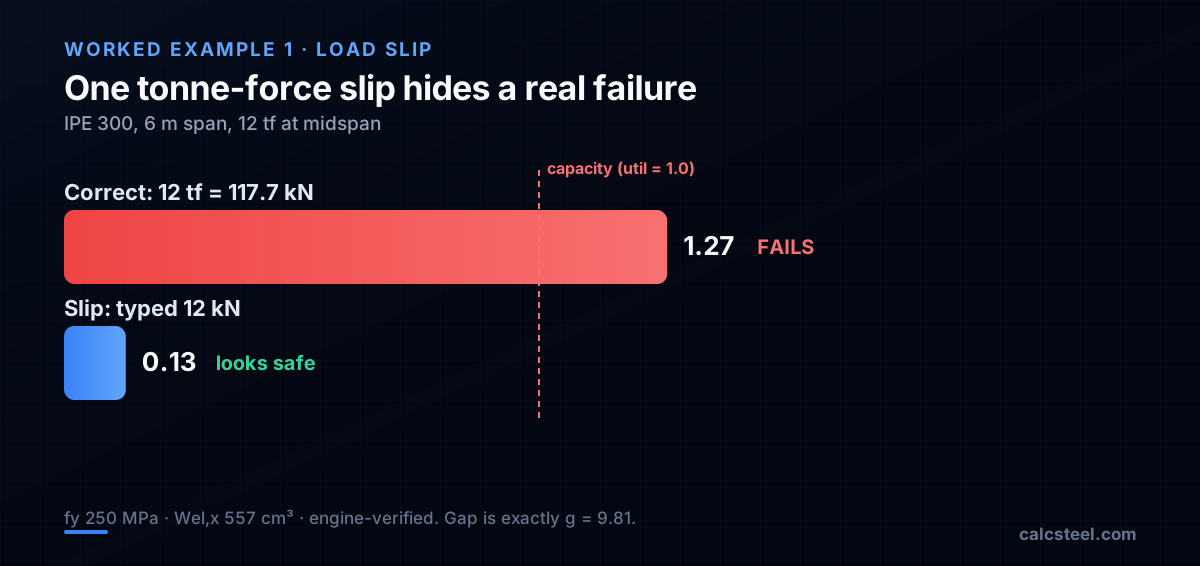
A monorail hoist beam is an IPE 300 in grade MR250 (fy = 250 MPa), simply supported over a clear span of 6 m. A rigger will hang a 12 tf load at midspan.
The correct conversion
Twelve tonne-force is 12 × 9.80665 = 117.68 kN. Feeding that point load to the CalcSteel analysis engine gives a maximum moment at midspan of:
M = PL/4 = 117.68 × 6 / 4 = 176.5 kN·m (engine: 176.52 kN·m)
The elastic bending stress on the IPE 300 (Wel,x = 557 cm3) is σ = M / Wel = 176.5 / 557, which works out to 316.9 MPa. Against fy = 250 MPa that is a utilization of 1.27. The beam fails. It needs a heavier section.
The slip
Now suppose the load arrives from the mechanical team as "12 t" and someone types 12 into a field labelled kN, treating the tonne-force as if it were kilonewtons. The engine now sees a 12 kN load and returns:
M = 12 × 6 / 4 = 18.0 kN·m, σ = 32.3 MPa, utilization = 0.13
The beam looks comfortably safe, with 87% of its capacity to spare. A designer working from that number might even downsize it. The real load is 9.81 times larger than the model believes, the exact factor g, and the true utilization is 1.27, not 0.13. There is a telling coincidence here: the correct moment written in tonne-force units is 18.0 tf·m, the same digits as the wrong 18.0 kN·m. The physics did not change, only the label, and the label is what failed.
Worked example 2: the yield strength slip
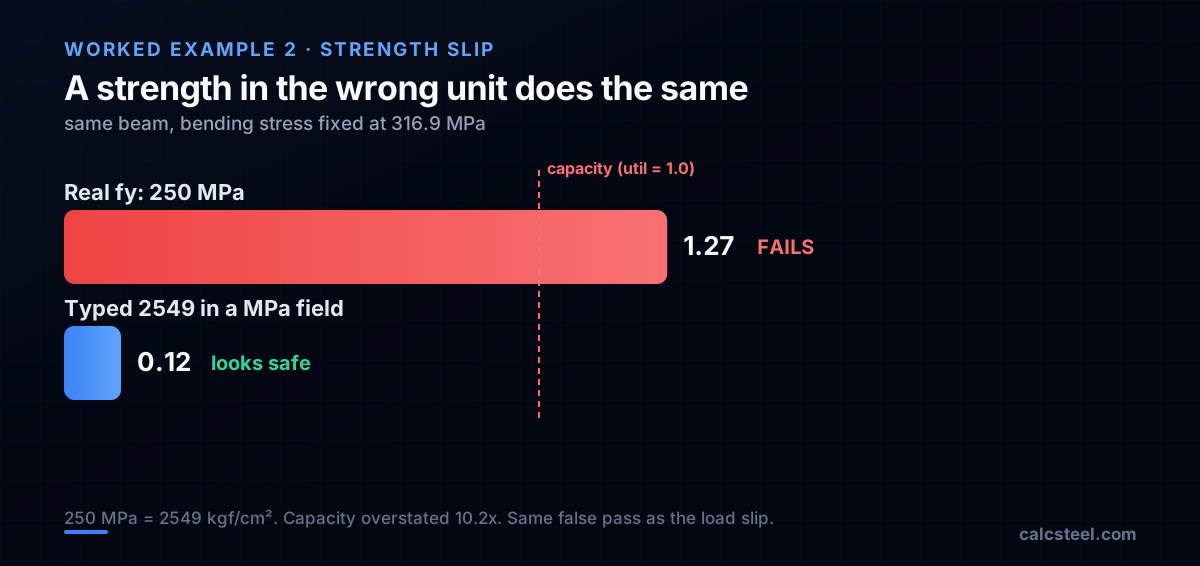
Take the same IPE 300 and the same, correctly entered, 117.68 kN load. The moment is 176.5 kN·m and the bending stress is 316.9 MPa, both from the engine. This time the load is right and the strength is wrong.
The mill certificate is in kgf/cm2
The steel is MR250. Its yield strength is fy = 250 MPa, which on a legacy mill certificate reads 2549 kgf/cm2. A designer copying the number off the certificate types 2549 into a field that expects MPa. The model now believes the steel is more than ten times stronger than it is.
Real: utilization = 316.9 / 250 = 1.27 (fails). Slip: utilization = 316.9 / 2549 = 0.12 (looks fine).
The capacity has been overstated by a factor of 10.2, the MPa to kgf/cm2 factor, and the beam that genuinely fails now shows 88% margin. Notice that this is the same false result as the load slip in example 1: an overstressed member reported as safe. One error was on the load side, one on the strength side, and both moved utilization the same dangerous way.
This is why a unit slip is worse than an arithmetic slip. An arithmetic error is as likely to be conservative as unconservative. A dropped g on a load or a mis-read strength is systematically unconservative when it makes the demand smaller or the capacity larger, which is precisely the direction nobody checks.
Why factor-of-ten errors survive review
If the error is so dangerous, why does it get through? Three reasons, and each has a countermeasure.
1. The result stays plausible
A 9.81x error keeps the answer in the right order of magnitude. A moment of 18 kN·m and a moment of 176 kN·m are both numbers a 6 m beam could plausibly carry. The sanity check that catches a factor of 1000 does not fire for a factor of 10. Countermeasure: sanity-check against a known unit anchor, not just a magnitude. For steel, fy is 250 to 355 MPa, never 2500. A service floor load is 3 to 10 kN/m2, never 30. If a value is ten times outside its usual band, the unit is the first suspect.
2. The unit label travels separately from the number
Spreadsheets, mill certs and hand notes carry the number in a cell and the unit in a header, a footnote, or nowhere. When the number is copied, the unit is left behind. Countermeasure: write the unit next to every value, in every cell, every time. A number without a unit is not a result, it is a rumour.
3. Dimensional analysis is skipped
The classic engineering check, cancelling units through an equation, is exactly what catches a kgf entered as kN. It is skipped under deadline because it feels like overhead. Countermeasure: carry units through at least the governing equation. If kN/m times m2 does not cancel to kN, stop. See our post on load combinations for where a unit error compounds across factored cases.
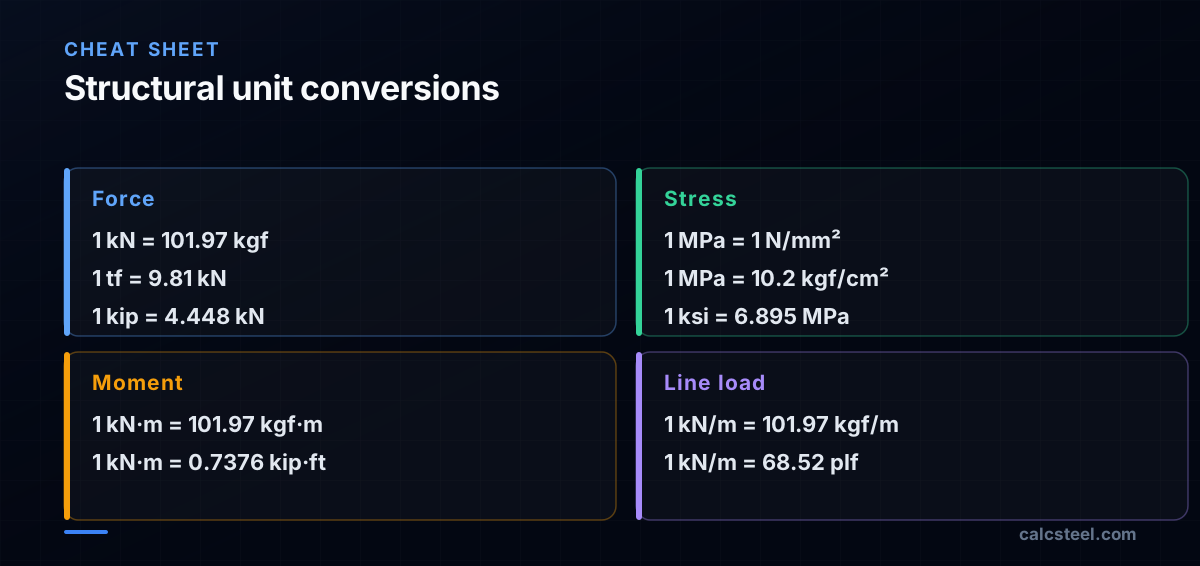
The structural units cheat sheet
One reference card for the conversions above. Every factor is full precision from the same model the steel unit converter uses, rounded here for reading.
Force
- 1 kN = 101.97 kgf = 0.10197 tf = 0.2248 kip
- 1 tf = 9.807 kN ≈ 9.81 kN, 1 kgf = 9.807 N, 1 kip = 4.448 kN
Stress
- 1 MPa = 1 N/mm2 = 10.197 kgf/cm2 = 0.14504 ksi
- 1 kgf/cm2 = 0.09807 MPa, 1 ksi = 6.895 MPa
Moment
- 1 kN·m = 101.97 kgf·m = 0.10197 tf·m = 0.7376 kip·ft
- 1 kip·ft = 1.356 kN·m
Line load
- 1 kN/m = 101.97 kgf/m = 68.52 plf = 0.06852 klf
Inertia and modulus
- 1 in4 = 41.62 cm4, 1 in3 = 16.39 cm3
Print it, tape it to the monitor, and reach for the converter for anything not on it. But a card still asks you to convert by hand, and the next section is how to stop doing that at all.
How to stop converting by hand
The most reliable fix for unit errors is to remove the hand conversion. A short discipline plus one tool does it:
- Pick one unit system per project and state it on the cover sheet. Every input, every output, one system. Mixed systems inside one model is where slips breed.
- Label every number with its unit, in the model, the spreadsheet and the notes. No bare numbers.
- Convert once, at the boundary. When data crosses from a supplier document into your model, convert it there, write down both values, and never convert the same number twice.
- Let the software carry the units. A tool that stores everything in SI and displays in your chosen system means you type kgf/cm2 if that is what the cert says, and it becomes MPa internally without you touching g.
The converter below is the same one CalcSteel ships. Pick a quantity, type a value in any unit, and read it in all the others at once. Use it to turn that 12 tf into kN, or that 2549 kgf/cm2 back into the 250 MPa it really is, before it reaches a model.
Convert from
kN — kilonewton — the structural default
| Unit | Value | System | |
|---|---|---|---|
| kN | 100 | SI | |
| N | 100,000 | SI | |
| kgf | 10,197.16 | SI | |
| tf | 10.1972 | SI | |
| kip | 22.4809 | US | |
| lbf | 22,480.89 | US |
Click any row to make it the input (same physical quantity). Every value derives from the SI base N; factors are exact standard definitions (g = 9.80665 m/s², 1 lbf = 4.4482216 N, 1 in = 25.4 mm).
Force
100 kN=22.4809kip
Drive a real FEM beam — your span, your section
Mmax ≈ 150 kN·m (P·a·b/L · fy 250 MPa · NBR 8800)
Drop 100 kN at 3 m on IPE 300How CalcSteel handles units
CalcSteel is built around the idea that you should never convert a load by hand. The analysis engine works entirely in a single consistent SI base internally (kN, cm, and kN·cm for moments), so equilibrium and stiffness are always solved in one system. The interface then lets you enter and read values in the units you actually work in.
- Enter in your units. Type a load in kN, kgf, tf or kip and the model converts it to its SI base for you, applying g where it belongs.
- Read in your units. Reactions, moments and stresses display in the system you chose, so a US office reads kip·ft and a Brazilian office reads kN·m or tf·m from the same solved model.
- One source of truth. Because the conversion happens at the edge and the solve happens in SI, the two unit slips in this article simply cannot occur: there is no field where a kgf value is silently read as kN.
You can see it directly in the free calculators: run the exact hoist beam from example 1 in the beam calculator, switch the units, and watch the reactions and moment restate themselves while the physics holds. For sizing against a real load, our guide on steel beam load capacity takes it from moment to the five checks that decide the section.
Common unit mistakes, in one place
1. Treating kgf as kN (or kg as kgf)
Off by g = 9.81 every time. A 12 tf load is 117.7 kN, not 12. A 2000 kg mass weighs 19.6 kN, not 2000.
2. Typing a kgf/cm2 strength into a MPa field
Off by 10.2. fy 250 MPa is 2549 kgf/cm2. The number 2549 in a MPa field is not steel, it is a fantasy.
3. Rounding g to 10
Using 10 instead of 9.81 is a 2% error, usually unconservative on the load side. Fine for a back-of-envelope estimate, never for a final check.
4. Mixing kip·ft and kip·in in the same AISC problem
A factor of 12 hides between member moments and connection moments. Keep one unit until the last step.
5. Forgetting that N/mm2 equals MPa
This one is harmless, but engineers waste time converting between two identical units. They are the same number.
6. Not writing the unit next to the number
The root cause of the first four. A value without its unit is the single most reliable way to lose a factor of ten.
Sources
- 1.BIPM, The International System of Units (SI Brochure, 9th edition)
- 2.AISC Steel Construction Manual, 16th Edition (US customary units and design values)
- 3.NIST Special Publication 811, Guide for the Use of the International System of Units
- 4.ASTM A36 / A572 structural steel specifications (yield and tensile strength)
Try CalcSteel for free
Model, analyze and design steel structures in your browser. No install, no signup.
Open the 3D editor