Notional Loads: Catching Frame Instability Without a Full P-Delta Run
A notional load is a small fictitious horizontal force that stands in for the frame's real out-of-plumbness. It is the cheapest way to expose sway instability, and the drift it produces tells you whether you even need a full second-order P-Delta analysis. Three FEM-verified portal frames and a free portal-frame calculator, no login.
Key takeaways
- A notional load is a fictitious horizontal force equal to a small fraction of the gravity load, applied to represent the frame's initial out-of-plumbness. AISC 360 uses Ni = 0.002 Yi, Eurocode 3 uses an equivalent force phi times the vertical load with phi0 = 1/200, and NBR 8800 uses 0.2% to 0.3% of the gravity load.
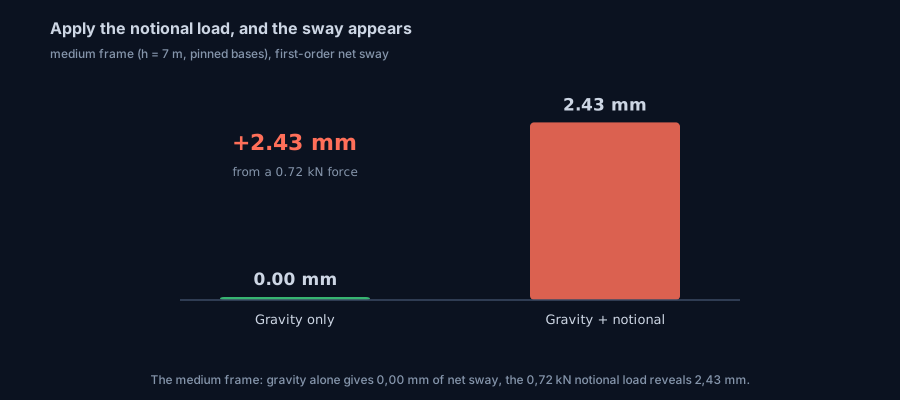
- A plumb, symmetric frame under symmetric gravity sways exactly zero in a first-order analysis. Our three FEM frames all returned 0.0000 mm of net sway under gravity alone, so a gravity-only run gives no instability warning at all. The notional load is what makes the sway visible.
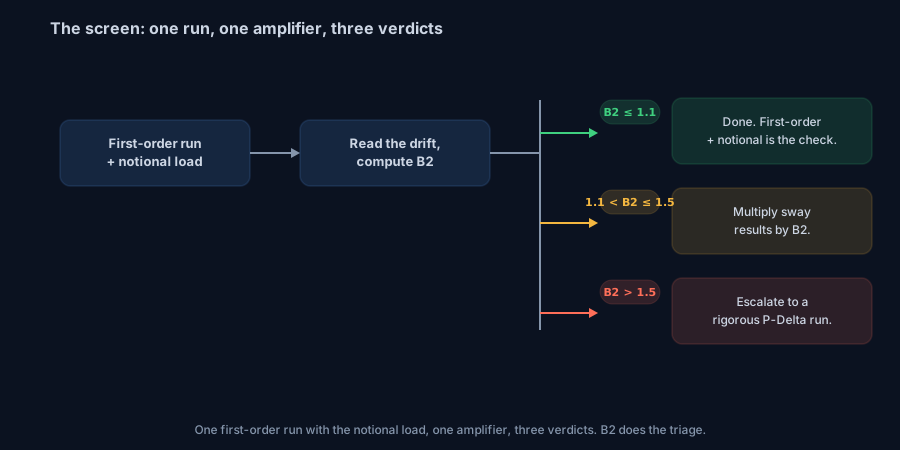
- Apply the notional load in a first-order analysis and read the sway. The story amplifier B2 = 1/(1 minus P/Pe,story) is built directly from that first-order drift, and it equals the ratio of second-order to first-order drift.
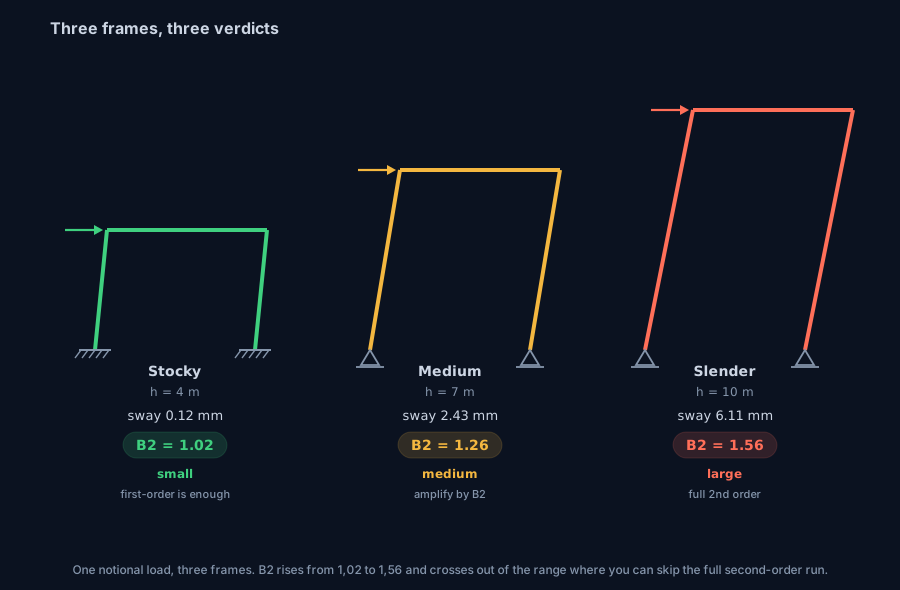
- That amplifier is a screen for whether you need a rigorous P-Delta run. Our stocky frame gave B2 = 1.02 (first-order plus notional is enough), the medium frame gave B2 = 1.26 (just multiply by B2), and the slender frame gave B2 = 1.56 (escalate to a full second-order analysis).
- The engine numbers are trustworthy: a cantilever column and a simply supported beam matched their closed-form deflections to 22.89 mm and 10.73 mm exactly, so the frame sways that drive B2 rest on a verified stiffness.
The frame that passes every member check and still leans over
You can size every beam and every column in a steel frame, confirm that not one of them exceeds a utilization of 1.0, and still have a structure that is not safe. Member strength is a local property. Stability is a property of the whole frame, and it depends on things that a member-by-member strength check never sees: how far out of plumb the frame was erected, how much it leans under load, and how that lean feeds back into the columns as extra moment.
The rigorous way to capture this is a full second-order analysis, the P-Delta run, which re-solves the frame on its deformed geometry until the deflections stop growing. It is the correct tool, and for a genuinely sway-sensitive frame it is the only tool. But it is also the expensive tool, and for a large fraction of real frames it is overkill.
The notional load is the cheap device that sits in front of it. It is a small, fictitious horizontal force that you add to a plain first-order analysis to represent the imperfection the frame really has. It does two jobs at once: it satisfies the code requirement to account for out-of-plumbness, and the drift it produces tells you whether you can stop there or whether the frame is sway-sensitive enough to deserve the full P-Delta treatment. This article puts three portal frames through the CalcSteel FEM engine to show exactly where that line falls.
What a notional load actually is
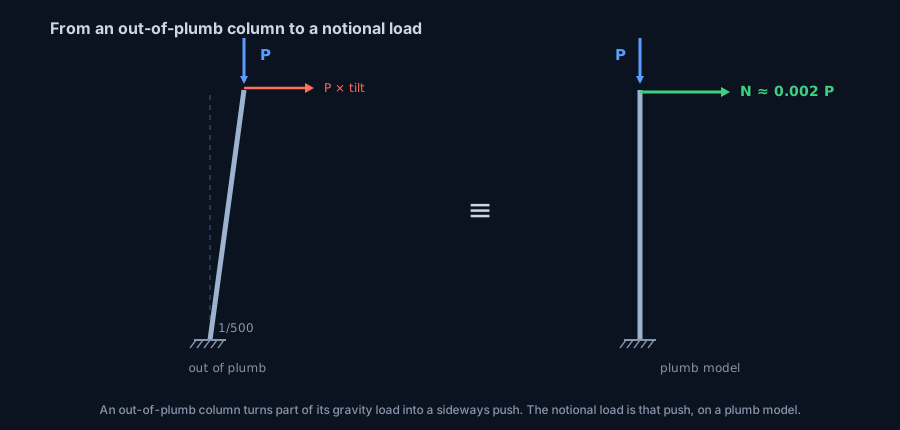
No frame is erected perfectly plumb. Columns lean by a fraction of their height, within the erection tolerance, and that initial lean means the gravity loads do not run straight down the column axis. They arrive slightly offset, and the offset load pushes the frame sideways. A perfectly plumb model never feels that push.
Rather than model the tilt geometrically, the codes let you replace it with an equivalent horizontal force: a notional load. Picture a column carrying an axial load P, tilted by a small angle. The horizontal component of that tilted load is P times the angle. If the assumed out-of-plumb is 1/500 of the height, the equivalent sideways force is P/500 = 0.002 P. That is precisely where the AISC coefficient comes from, and it is why the notional load is always a small percentage of the gravity load rather than a wind-like external action.
The notional load is fictitious. It does not exist in the real building, and it is not a load case you combine with wind by chance. It is a stand-in for a geometric imperfection, applied at every floor level, in whichever horizontal direction is most unfavourable for the frame.
The trap: a symmetric frame sways exactly zero under gravity
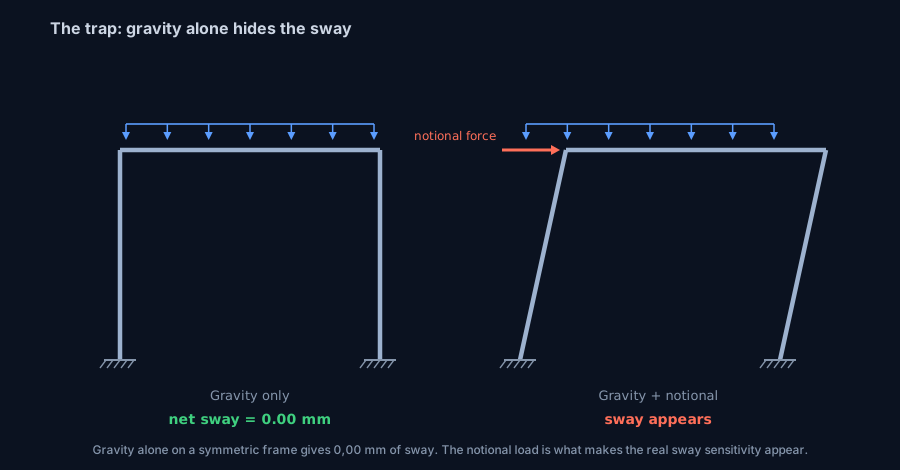
Here is the reason a notional load is mandatory and not optional. Take a single-bay portal frame, a 12 m span carrying a factored gravity load of 30 kN/m on the rafter, built from a 360 mm deep I-section (the engine reports a strong-axis moment of inertia of 15,728 cm⁴). Run it in a first-order analysis under gravity alone.
The CalcSteel engine returns a net sway of 0.0000 mm. Not approximately zero, exactly zero. A symmetric frame under a symmetric load has a symmetric response, and symmetry forbids any sideways lean: the two columns spread apart equally and the roof stays put. We ran this for all three frames in this article, stocky, medium and slender, and every one of them returned the same 0.0000 mm of gravity sway.
That is the trap. If you only ever run the plumb frame under its real loads, the analysis tells you the frame does not sway, so it never warns you about sway instability. The instability is real, but it is hiding behind the model's perfect symmetry. You have to inject the imperfection yourself to make it appear, and the notional load is how you inject it.
What the three codes actually ask for
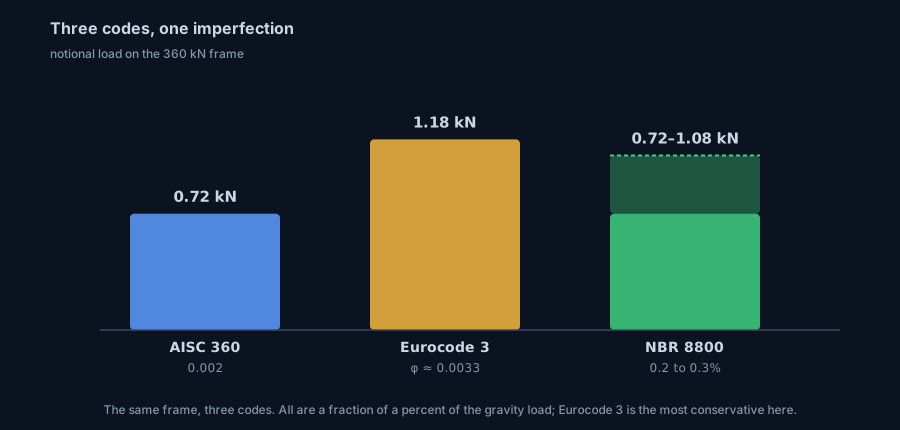
The three major steel codes all use a notional or equivalent horizontal force, and they land in the same ballpark by slightly different routes. On our frame, the total factored gravity reaction is about 360 kN, and each column carries roughly half.
- AISC 360 (Direct Analysis Method). Ni = 0.002 times alpha times Yi, where Yi is the gravity load at the level and alpha = 1.0 for LRFD. The 0.002 is a 1/500 out-of-plumb. On 360 kN that is a notional load of 0.72 kN. Notional loads are applied at all levels and are additive to the other lateral loads in the combination.
- Eurocode 3 (EN 1993-1-1, 5.3.2). An initial sway imperfection phi = phi0 times alpha_h times alpha_m, with the base value phi0 = 1/200. The reduction factors are alpha_h = 2 over the square root of h (bounded to between 2/3 and 1.0) and alpha_m = the square root of 0.5 times (1 + 1/m) for m columns. The equivalent horizontal force is phi times the vertical load. For our medium frame (h = 7 m, two columns) phi works out to 0.00327, giving 1.18 kN, noticeably larger than the AISC figure because phi0 = 1/200 is more onerous than 1/500.
- NBR 8800. A notional force of 0.2% of the design gravity loads for frames of small lateral displaceability, raised to 0.3% (or an out-of-plumb of h/333) for medium and large displaceability. That is 0.72 kN or 1.08 kN on our frame.
The headline is that all three are a fraction of a percent of the gravity load, all three are applied at every level, and Eurocode 3 tends to be the most conservative of the three. Which one you use is set by your governing code, not by preference.
Apply it, and the sway appears
Now add the notional load to the first-order run. Take the medium frame, a 12 m span on 7 m pinned-base columns, and apply the AISC notional load of 0.72 kN at the eaves on top of the gravity. The net sway that was 0.0000 mm under gravity alone becomes 2.43 mm. The frame that looked rigid now leans, and that lean is the physical thing a stability check has to bound.
Notice the scale. A 0.72 kN horizontal force, less than a fifth of one percent of the gravity load, is enough to reveal millimetres of drift, because a sway frame is far more flexible sideways than it is vertically. That sensitivity is exactly the point. The notional load is small, but the frame's response to it is the honest measure of how close the frame is to a sway mechanism.
This is still an ordinary first-order analysis, the same linear solve CalcSteel runs for any frame. Nothing here required an iterative second-order routine. We simply added one small horizontal force and read the drift. The next step turns that drift into a number that decides everything.
Try it: put a notional load on a live portal frame
Before we turn the drift into a verdict, build the intuition yourself. The calculator below is the CalcSteel portal-frame tool. Set a span and an eaves height, choose pinned or fixed bases, and give it a gravity load. Then set a small horizontal force at the eaves, on the order of 0.2% of the total vertical load, and watch the lateral drift and the base and knee moments update.
Try this: keep the gravity load fixed and stretch the columns taller, or switch the bases from fixed to pinned. The same tiny horizontal force now produces much more drift, and the base moments climb with it. You are watching a frame move from sway-insensitive to sway-sensitive in real time, which is the crossover the rest of the article pins down with the amplification factor.
Diagrams plotted on the deformed-free frame geometry. N, V, M recovered from the element end-forces of the direct-stiffness solve (12 elements / member). Moment drawn offset to each member's centreline.
First-order STRENGTH screening at the governing section of the NBR 8800 (BR) ULS envelope (governing CB2): N,d = 73.9 kN, M,d = 109 kN·m. Member buckling and lateral-torsional buckling are NOT included — see the stability flags below and run the full verification in the 3D editor. Click a card to make that resistance code govern the ranking.
ULS load combinations — NBR 8800 (BR)
G + W superposed · 3 combinations| Combination | Factors | Utilization |
|---|---|---|
| CB1 | 1.4 G | 69% |
| CB2governs | 1.4 G + 1.4 W | 76% |
| CB3 | 1 G + 1.4 W | 57% |
Combinations generated by the CalcSteel combinations engine (the same v4 engine the 3D editor uses, 6 codes). Gravity is treated as a single permanent action G; the wind action W is the eaves load. Each combination's γ factors are applied by superposition to the isolated gravity and wind solves, then every section is screened — the worst point of the worst combination governs.
Stability screening (buckling caveats)
not in the strength checkScreening indicators only — assumed sway effective length (K = 1.5) and the full member length as the unbraced length (no intermediate purlin/girt restraint). The strength check above deliberately excludes these; the real member verification (effective lengths from the alignment chart / notional loads, χ and Cb reduction factors, purlin bracing) runs in the 3D editor.
Lightest sections that pass (NBR)
screened 974 profiles| Profile | Mass | Frame steel | Utilization | |
|---|---|---|---|---|
| VS 400x32 | 31.9 kg/m | 723 kg | 82% | |
| VS 350x33 | 33.2 kg/m | 752 kg | 86% | |
| VS 400x34 | 34.4 kg/m | 779 kg | 75% | |
| VS 350x35 | 35.1 kg/m | 795 kg | 80% | |
| VS 400x35 | 35.1 kg/m | 795 kg | 73% |
The screen: turn the first-order drift into an amplifier
The drift under the notional load is not just a number to check against a limit. It is the raw material for the one factor that decides whether you need a full P-Delta run: the story amplifier B2.
The idea behind B2 is that the sideways lean puts every gravity load slightly off its column, which adds moment, which adds more lean, and so on. That feedback either converges to a modest amplification or, if the frame is too flexible, runs away. AISC writes it as
B2 = 1 / (1 minus P_story / Pe_story),
where P_story is the total gravity on the level and Pe_story is the story's elastic sidesway buckling strength, which you get straight from the first-order drift: Pe_story = R_M times H times L / drift_H. In words, the stiffer the frame (the less it drifts under a given horizontal force), the larger Pe_story, and the closer B2 sits to 1.0. The crucial fact is that B2 is also the ratio of second-order drift to first-order drift. It is the exact multiplier a full P-Delta run would apply, obtained without running one.
So the workflow is: apply the notional load, run first-order, read the drift, compute B2. If B2 is close to 1.0, the P-Delta run would barely change anything and you are done. If B2 is large, the frame is sway-sensitive and the first-order result is not the whole story.
Three frames, three verdicts
Same 12 m span, same 360 kN of gravity, same section. The only differences are the column height and the base fixity, and they are enough to move the frame across the whole stability spectrum. Every sway below is the real first-order response to the AISC notional load, straight from the engine.
| Frame | Geometry | Notional sway | B2 | Verdict |
|---|---|---|---|---|
| Stocky | h = 4 m, fixed bases | 0.12 mm | 1.02 | Small sway. First-order plus notional is enough. |
| Medium | h = 7 m, pinned bases | 2.43 mm | 1.26 | Multiply the sway results by B2. No P-Delta run. |
| Slender | h = 10 m, pinned bases | 6.11 mm | 1.56 | Sway-sensitive. Escalate to a rigorous second-order analysis. |
The stocky frame amplifies its sway by 2%. A full P-Delta analysis would move its moments by essentially nothing, so running one is wasted effort: the notional load in a first-order analysis is the complete stability check. The medium frame amplifies by 26%, which matters, but you capture all of it by multiplying the first-order sway results by 1.26, still no iterative analysis needed. The slender frame amplifies by 56% and sits in the range where the simple amplifier starts to lose accuracy, so here, and only here, you spend the P-Delta run.
This maps directly onto the NBR 8800 classification by the ratio of second-order to first-order drift: at or below 1.1 is small displaceability, 1.1 to 1.5 is medium, and above 1.5 is large. B2 is that ratio, so the same single number classifies the frame and picks the method.
When the notional load lets you skip the P-Delta run
Put the pieces together and the promise in the title becomes concrete. A first-order analysis with the notional load added is a complete, code-compliant stability design on its own, as long as the amplification is small enough to either ignore or capture with the B2 multiplier. That covers the stocky and medium frames above, and in practice a large share of ordinary low-rise steel frames.
The escalation triggers are worth memorising, because they are where the cheap route stops being valid:
- AISC 360. The B2 amplifier is intended for B2 up to about 1.5. Past that, use a rigorous second-order analysis rather than the amplifier.
- Eurocode 3. Second-order effects may be neglected when the elastic critical ratio alpha_cr = Fcr / FEd is at least 10. Below 10, they must be included, by amplification or by a full analysis.
- NBR 8800. Large displaceability, the drift ratio above 1.5, requires a rigorous second-order analysis with the imperfections modelled directly.
Notional loads do not replace the P-Delta analysis. They tell you when you need it. For a frame that is stiff against sway, they let you deliver a defensible stability check with a single linear solve, and for a frame that is not, they hand you the number that proves you must go further. If your frame lands in that further category, the mechanics of the full run are covered in our companion article on second-order P-Delta effects.
Applying notional loads without tripping over the details
The concept is simple; the application has a few edges that catch people.
- Both directions, every level. The frame can lean either way, so the notional load is applied in the direction that is most unfavourable for each check, and at every floor in a multi-storey frame, proportional to the gravity at that floor.
- Additive to real lateral loads. In AISC, notional loads are added to wind or seismic in the combinations, not compared against them. There is one relief: when the second-order to first-order drift ratio is 1.7 or less, the notional loads may be applied in the gravity-only combinations rather than added to every lateral combination.
- Reduced stiffness (AISC). The Direct Analysis Method pairs the notional load with a stiffness reduction, 0.8 on axial and flexural stiffness (with a further factor on columns near yield). The softer frame drifts more, which is the method's way of accounting for residual stresses and partial yielding, so do not forget it when you compute the drift that feeds B2.
- When Eurocode lets you drop the sway imperfection. EN 1993-1-1 allows neglecting the sway imperfection where the real horizontal load is already large, specifically when HEd is at least 15% of the vertical load VEd. A frame with substantial wind may not need the notional sway force at all.
Common mistakes and FAQ
"A notional load is just a small wind load." No. Wind is a real external action with its own magnitude and combination factors. A notional load is a stand-in for a geometric imperfection and scales with the gravity load, not with the exposure. They are added together, but they are not the same thing.
"My frame is braced, so I can skip notional loads." A braced frame is still erected out of plumb. The notional load still applies; it just gets resisted by the bracing instead of by frame action, and it is exactly how you size that bracing for the destabilising push.
"0.002 is the universal number." It is the AISC value, from a 1/500 out-of-plumb. Eurocode 3 starts from 1/200 and then reduces for height and column count, and NBR 8800 uses 0.2% to 0.3%. On the same frame these can differ by a factor of nearly two, so use your governing code's rule.
"If the frame sways under the notional load, it fails." Not by itself. Every real frame sways under a notional load; a symmetric one just could not show it under gravity alone. What matters is the amplifier B2 that the sway implies, and whether the amplified member forces still pass. The sway is the diagnostic, not the verdict.
"Notional loads mean I never need a second-order analysis." Only up to the escalation triggers. Once B2 exceeds about 1.5, or alpha_cr drops below 10, the notional load has done its real job: it has told you to run the full P-Delta analysis.
From imperfection to a stable frame
A notional load is a fictitious horizontal force, a fraction of a percent of the gravity load, that carries the frame's real out-of-plumbness into an otherwise plumb model. It is mandatory because a symmetric frame under gravity sways exactly zero and would otherwise hide its own sway sensitivity. And it is efficient because the first-order drift it produces yields the amplifier B2, the same second-order multiplier a P-Delta run would compute, without running one.
Read B2 and the frame tells you what it needs: at 1.02 you are finished, at 1.26 you multiply and finish, at 1.56 you escalate. CalcSteel runs the first-order analysis with the notional load, reports the drift and the base and knee moments the imperfection produces, and checks the amplified member forces against AISC 360, Eurocode 3 and NBR 8800, on the same FEM engine whose cantilever and beam deflections matched closed-form theory to the digit. You get the cheap stability screen and the escalation flag from a single run, before you ever commit to the expensive one.
Sources
- 1.ANSI/AISC 360-22, Specification for Structural Steel Buildings (Ch. C, Design for Stability; App. 8, Approximate Second-Order Analysis)
- 2.EN 1993-1-1, Eurocode 3: Design of steel structures, Part 1-1 (5.3.2, Imperfections)
- 3.ABNT NBR 8800:2008, Projeto de estruturas de aco e de estruturas mistas de aco e concreto de edificios (imperfeicoes geometricas, forcas nocionais)
- 4.AISC, Direct Analysis Method continuing-education handout (notional loads, stiffness reduction, B2)
- 5.SteelConstruction.info, Allowing for the effects of deformed frame geometry (equivalent horizontal forces)
Try CalcSteel for free
Model, analyze and design steel structures in your browser. No install, no signup.
Open the 3D editor