8mm MS Plate Weight: Sizing a Steel Base Plate End to End, with the Governing Load Case
An 8mm MS plate weighs 62.8 kg/m2, and a standard 2500 x 1250 sheet is 196.3 kg, which is the easy half of the question. The hard half is whether 8 mm is strong enough when the plate does a structural job, and that depends entirely on the load case that governs. This guide answers the weight in one line, then sizes a real 8 mm plate end to end as a column base plate on the CalcSteel FEM engine, dead, snow and wind, and finds the combination that decides the thickness. Free, no login.
Key takeaways
- An 8mm MS (mild steel) plate weighs 62.8 kg/m2: the unit weight is just density times thickness, 7.85 x t kg/m2, and the mass of any plate is length x width x thickness in mm x 7.85. A standard 2500 x 1250 sheet is 196.3 kg.
- Weight is the take-off number, not the design. A structural plate is sized by the force it carries and the way it bends, so knowing if 8 mm holds means sizing it end to end for its role and its governing load case.
- On a two-span continuous roof beam the CalcSteel engine returns the interior reaction that matches the closed-form rule interior = 1.25 w L to the exact decimal, and the governing combination 1.2D + 1.6S puts Pu = 156.0 kN into the column base plate.
- The base-plate check to AISC Design Guide 1 needs t_req = 9.15 mm from cantilever bending of the overhang, so the 8 mm plate sits at utilisation 1.31 and fails. The weight, 62.8 kg/m2, said nothing about this.
- Two cheap fixes hold the weight almost flat: step to a 9.5 mm plate (utilisation 0.93, only +0.49 kg) or keep 8 mm in ASTM A572 Gr.50 (utilisation 0.95, identical 2.60 kg). And beware the footprint trap: enlarging the plate to 250 x 300 mm grows the overhang to 85 mm and forces a thicker 12.5 mm plate, heavier and thicker at once.
The weight is the easy half of the question
Type 8mm ms plate weight into any search box and you want one number. Here it is in the first line: a mild-steel plate 8 mm thick weighs 62.8 kg/m2, so a standard 2500 x 1250 sheet is 196.3 kg. That settles the take-off, the truck load and the dead load you feed back into analysis, and the next section derives it so you never trust a table blindly again.
But weight is the easy half of the question. The moment the plate stops being a slab on a pallet and starts doing a structural job, as a column base plate, a gusset, a bearing plate or a shear tab, its mass tells you nothing about whether 8 mm is strong enough. That answer comes from the force the plate carries, the way it bends, and the one governing load case that decides the thickness.
So this article does both. It answers the 8mm ms plate weight in one line, then sizes a real 8 mm plate end to end as a column base plate: geometry, three load cases on the CalcSteel finite element engine, the governing combination, and the base-plate check. The gap between the trivial weight and the failing check is the whole point.
Where the 8mm MS plate weight of 62.8 kg/m2 comes from
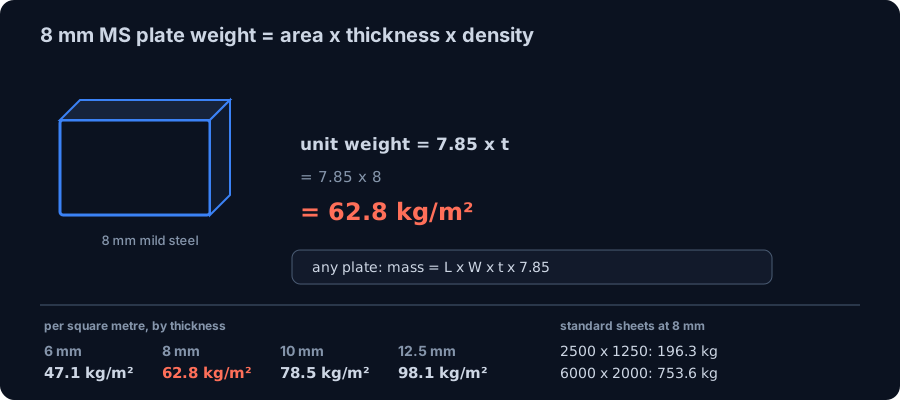
A plate's weight has no shape magic in it. It is the face area times the thickness times the density of steel, nothing more:
unit weight (kg/m2) = rho x t = 7850 kg/m3 x t = 7.85 x t, with t in millimetres.
For t = 8 mm that is 7.85 x 8 = 62.8 kg/m2. To get the mass of an actual plate, multiply by its area, or use the pocket rule straight from length and width:
mass (kg) = length (m) x width (m) x thickness (mm) x 7.85
MS means mild steel, plain carbon steel, at a density of 7850 kg/m3. Stainless is a touch denser, about 8000 kg/m3, so a stainless plate of the same thickness weighs slightly more; the arithmetic is identical, only the density changes. Here is every common thickness, its unit weight, and the mass of a standard 2500 x 1250 sheet (3.125 m2):
| Thickness | Unit weight | Standard sheet 2500 x 1250 |
|---|---|---|
| 6 mm | 47.10 kg/m2 | 147.2 kg |
| 8 mm | 62.8 kg/m2 | 196.3 kg |
| 10 mm | 78.50 kg/m2 | 245.3 kg |
| 12.5 mm | 98.13 kg/m2 | 306.6 kg |
The pattern is linear because weight is linear in thickness: double the thickness, double the weight. A large 6000 x 2000 mm sheet (12 m2) at 8 mm is 753.6 kg, and a 6000 x 1500 sheet (9 m2) is 565.2 kg. Whatever the format, it is only area times thickness times density.
Weigh any plate: the live calculator
Before we turn the plate into a structural element, get the weight under your fingers. The CalcSteel steel plate weight calculator is embedded right here, free and with no login: pick a rectangular sheet, a disc or a ring, set the dimensions and the thickness, and read the mass in kg and the unit weight in kg/m2. Enter 8 mm and watch 62.8 kg/m2 appear, and note that it even pre-sizes a base plate to code, which is exactly the second half of this article. If it opens in its own tab, here is the direct steel weight calculator. Now we make the plate carry something.
Commercial thickness — tap to set
Live derivation — W = ρ · A · t with your numbers
A = L · W (kg/m² = 7.85 · t for steel)
A = 2 m² (2,000,000 mm²)
W₁ = ρ · A · t = 7,850 · 2 · 0.0095 = 149.15 kg
W = W₁ × n = 149.15 × 1 = 149.15 kg
Total weight
149.15 kg
Plate unit weight
74.58 kg/m²
Every input above — shape, dimensions, thickness, plate list, price — travels in the link.
A plate is sized by force and bending, not by weight
A structural plate almost never sits in a building as dead weight to be counted. It works as a base plate spreading a column load into concrete, a gusset collecting bracing forces, a cap or end plate, a bearing plate under a beam, a stiffener, or a shear tab hanging off a web. Each of those is sized by the force it carries and the way it bends or tears, not by its mass.
For a base plate the governing action is bending of the plate overhang under the bearing pressure the column presses into the concrete. The plate cantilevers past the column, the pressure underneath tries to curl those overhangs up, and the plate has to be thick enough not to yield in bending. That check comes from AISC Design Guide 1 and AISC 360-J8, and the demand that feeds it comes from the governing load combination, not from any single load and certainly not from the plate's weight. The round-bar sibling to this post sizes a tension tie the same way; see the 8 mm bar weight guide. Here the member is a plate, and the check is bending.
The worked plate: an 8 mm base plate under a light column
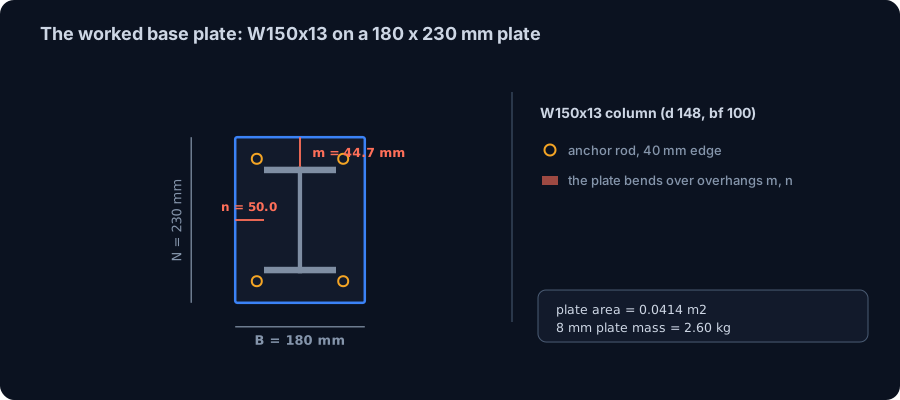
Here is the plate we carry through the rest of the article. It is the base plate of a light canopy or mezzanine column, a Gerdau W150x13.0 (depth d = 148 mm, flange width bf = 100 mm, mass 13.0 kg/m) landing on an 8 mm plate that bolts down to a concrete pier. The footprint is 180 x 230 mm (B x N): the column outline plus a 40 mm anchor edge distance on every side, which sets the room for the anchor rods and the size of the overhangs the plate has to bend over.
Two cantilever overhangs decide everything. Across the plate width the overhang past the flange is n = (B - 0.8 bf) / 2 = 50.0 mm; along the length the overhang past the column depth is m = (N - 0.95 d) / 2 = 44.7 mm. The plate area is 0.0414 m2, so at 8 mm the plate weighs just 2.60 kg. Hold that mass in mind: it barely moves in anything that follows. What moves is whether 8 mm can bend over a 50 mm overhang without yielding, and that depends on the pressure underneath, which depends on the load.
Three load cases reach the column
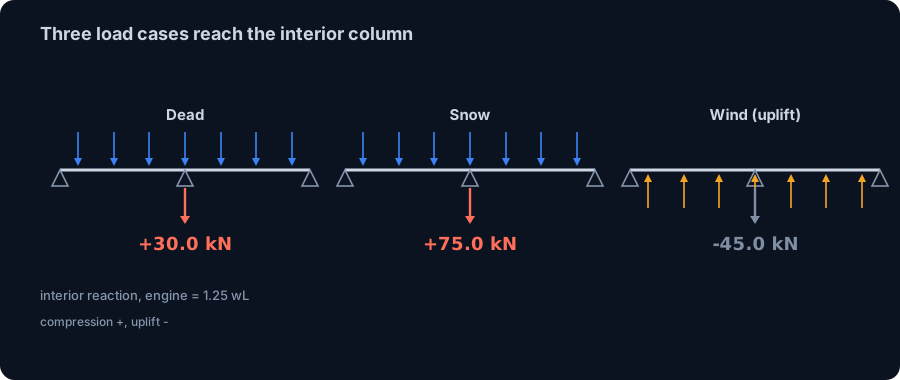
This column is the interior support of a two-span continuous roof beam, each span 6.0 m. Three actions arrive down the beam and into the column: dead, snow and wind. Drop the beam into the CalcSteel engine, run each case, and read the interior reaction, which is the axial the base plate has to spread:
| Load case | Column axial (interior) | End support | Closed form 1.25 w L |
|---|---|---|---|
| Dead D | +30.0 kN | 9.0 kN | 30.0 kN |
| Snow S | +75.0 kN | 22.5 kN | 75.0 kN |
| Wind W | -45.0 kN (uplift) | -13.5 kN | -45.0 kN |
The engine matches the closed-form continuous-beam rule to the exact decimal: interior support = 1.25 w L, end supports = 0.375 w L, with a difference of 0.00000 kN. So the demand is trustworthy before any plate check runs. Note the sign of wind: it is a net uplift of 45.0 kN, which reverses the column axial and, at the plate, lifts the column rather than pressing it down. That reversal is why the combinations, not the single cases, decide the plate.
The combination that governs the base plate
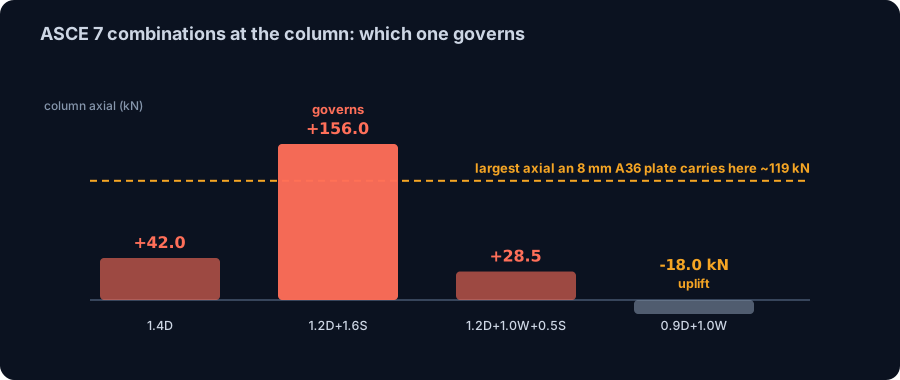
Single load cases never size anything; the factored ASCE 7 LRFD combinations do. Mixing dead, snow and wind at their code factors gives four demands at the column:
| Combination | Column axial Pu |
|---|---|
| 1.4D | 42.0 kN |
| 1.2D + 1.6S | 156.0 kN (governs) |
| 1.2D + 1.0W + 0.5S | 28.5 kN |
| 0.9D + 1.0W | -18.0 kN (net uplift) |
The maximum compression, 1.2D + 1.6S = 156.0 kN, governs the base plate: this is the axial that presses the column into the concrete and bends the overhangs. The uplift case, 0.9D + 1.0W = -18.0 kN, is real but it pulls the column off the pier, so it is carried by the anchor rods in tension, not by bearing and bending of the plate. The number that sizes the plate is Pu = 156.0 kN.
Does the 8mm MS plate pass? The base-plate check
Now run AISC Design Guide 1 and AISC 360-J8 on Pu = 156.0 kN, plate 180 x 230, Fy = 250 MPa (MR250 / A36), concrete f'c = 25 MPa, and a bearing area ratio A2/A1 = 1.
Bearing on concrete first. The pressure under the plate is fp = 156000 N / 41400 mm2 = 3.77 MPa, which is only 27% of the concrete bearing resistance phi Pp. Bearing is fine, so the concrete is not the problem, and it is not what sets the thickness.
Cantilever flexural yielding next. The plate has to bend over its overhangs under that 3.77 MPa. The governing cantilever is the larger overhang, ell = max(m, n, lambda n') = 50.0 mm (the n overhang governs; m is 44.7 mm and lambda n' is about 16.8 mm). The thickness that just avoids yielding is:
t_req = ell x sqrt(2 fp / (phi_b Fy)) = 50 x sqrt(2 x 3.77 / (0.9 x 250)) = 9.15 mm
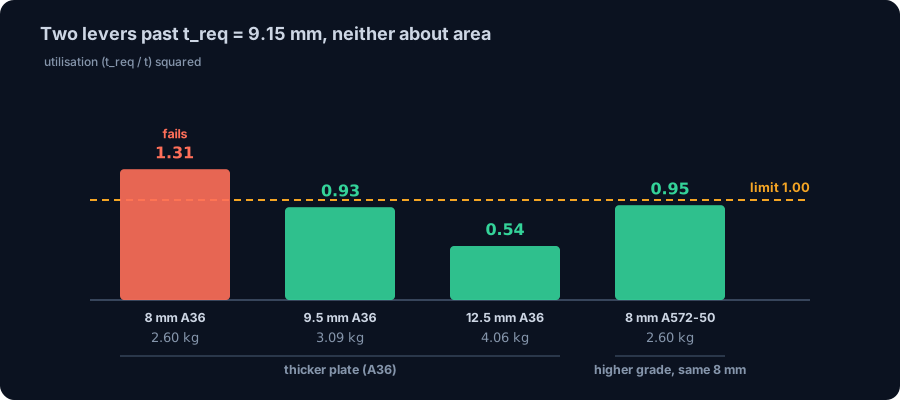
The plate on the drawing is 8 mm. Because required thickness enters the check squared, its utilisation is (t_req / t) squared = (9.15 / 8) squared = 1.31, so the 8 mm plate fails. Read that against the top of the article: the weight, 62.8 kg/m2, told you nothing about this. The governing load case and the cantilever bending did.
Two ways to fix it, neither about area
Two levers close the gap, and the striking thing is that neither costs meaningful weight.
Lever 1, thickness. Step from 8 mm to the next commercial plate at or above 9.15 mm, which is 9.5 mm. Utilisation drops from 1.31 to 0.93 and the plate now passes. The mass goes from 2.60 kg to 3.09 kg, a rise of only 0.49 kg, or 19%, on this footprint. If you want more margin, a 12.5 mm plate sits at utilisation 0.54.
Lever 2, grade. Keep the 8 mm plate but roll it in ASTM A572 Gr.50 (Fy = 345 MPa) instead of A36. Higher yield means less thickness is needed: t_req falls to 7.79 mm, so the 8 mm plate now sits at utilisation 0.95 and passes at the identical 2.60 kg. Same weight, different steel. Whichever lever you pull, the plate's mass barely changes; the fix was never about area.
The plate-specific catch: a bigger plate is not a thicker-proof plate
Here is the trap that catches people who reach for area to feel safe. Suppose you enlarge the footprint from 180 x 230 to 250 x 300 mm, reasoning that more plate under the column must be stronger. The bearing pressure does fall, from 3.77 MPa to 2.08 MPa, and bearing drops to 15%. But bearing was never the problem.
The overhang grows with the plate. The n overhang jumps from 50 mm to 85 mm, so the governing cantilever is now ell = 85 mm, and the required thickness climbs to t_req = 11.56 mm, which forces you up to a 12.5 mm plate. A bigger plate is both heavier and thicker: you spent steel in two directions and made the thickness problem worse. Thickness is set by the cantilever overhang, not by the area. The levers that actually help are a tighter footprint or a stiffener that shortens the overhang, never more steel underfoot.
Same 8mm MS plate, different job, different governing case
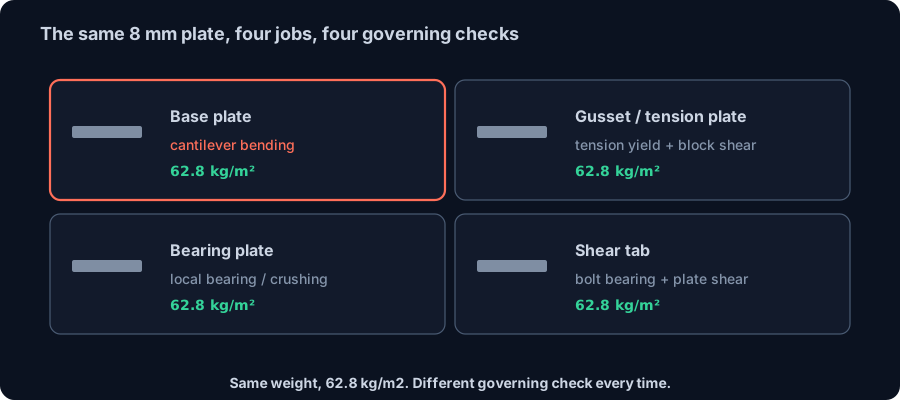
The very same 8 mm plate, at the very same 62.8 kg/m2, is governed by a completely different check depending on the job it does:
- Base plate: cantilever flexural yielding of the overhang governs, exactly the check in this article.
- Gusset or tension plate: tension yielding on the gross area and block shear or net-section rupture govern.
- Bearing plate under a beam: local bearing and crushing of the concrete govern.
- Shear tab or fin plate: bolt bearing and plate shear govern.
The weight is identical in all four. The check, the governing load case and the thickness you end up with are not. Weight never told you which role you were in, let alone which limit state would decide the plate.
What the codes ask, on three continents
The same plate, the same physics, three code wrappers:
- United States: AISC 360-J8 for bearing on concrete plus AISC Design Guide 1 for base plates, with the load combinations from ASCE 7.
- Europe: EN 1993-1-8 for joints and column bases (an effective-bearing-area, T-stub formulation) together with EN 1993-1-1, and combinations from EN 1990.
- Brazil: ABNT NBR 8800 for the base-plate provisions with NBR 8681 for actions and combinations.
AISC and NBR share the same cantilever closed form used above, so the arithmetic carries across almost unchanged. EN 1993-1-8 casts the identical bearing-plus-bending idea as an effective area under the column flanges rather than a rectangular overhang, so do not expect the formula to be byte for byte the same: it is the same physics in a different wrapper, and it lands in the same place.
Common mistakes and FAQ
- Reading the weight as the design. Finding the 8mm ms plate weight, 62.8 kg/m2, and concluding an 8 mm plate is enough. The weight is a take-off; the strength is a separate check.
- Using the gross area for a bolted gusset. A plate with bolt holes tears on the net section or by block shear well before the gross area yields; size it on the reduced section.
- Forgetting wind uplift. The 0.9D + 1.0W = -18.0 kN case lifts the column and loads the anchor rods in tension; ignore it and the anchors, not the plate, are what fails.
- Believing a bigger plate is always safer. Enlarging the footprint grows the overhang and can force a thicker plate, the footprint trap above.
- Confusing kg/m2 with kg per sheet. 62.8 kg/m2 is the unit weight, while a full 2500 x 1250 sheet is 196.3 kg. Quote the wrong one on an order and the tonnage is off.
- Treating thickness as the only lever. Grade is a lever too: an 8 mm A572 Gr.50 plate passes at the same 2.60 kg where an A36 plate fails.
From a weight to a sized plate
The 8mm ms plate weight is settled in one line: 62.8 kg/m2, a 2500 x 1250 sheet at 196.3 kg, straight from area times thickness times density. Whether 8 mm actually holds is a different question, and this plate answered it with a failure: as the base plate of a W150x13.0 column under a governing 1.2D + 1.6S = 156.0 kN, the cantilever check needs 9.15 mm, so the 8 mm plate is at utilisation 1.31. The fix was a 9.5 mm plate or a change of grade, not a heavier plate, and enlarging the footprint would only have made it worse.
Weigh your plate and pre-size the base in the calculator embedded above, then model the frame in CalcSteel to get the real governing reaction rather than a guessed load. The weight is the easy half. The governing load case is the half that decides the steel.
Sources
- 1.AISC Design Guide 1, Base Plate and Anchor Rod Design (2nd ed.), cantilever-overhang plate thickness
- 2.ANSI/AISC 360, Specification for Structural Steel Buildings (Section J8, bearing on concrete)
- 3.ASCE/SEI 7, Minimum Design Loads and Associated Criteria for Buildings and Other Structures (LRFD load combinations)
- 4.EN 1993-1-8, Eurocode 3: Design of joints, and EN 1990, Basis of structural design
- 5.ABNT NBR 8800, Projeto de estruturas de aco de edificios, and NBR 8681, Acoes e seguranca nas estruturas
Try CalcSteel for free
Model, analyze and design steel structures in your browser. No install, no signup.
Open the 3D editor