ISMB vs ISMC vs HEB vs IPE: Profile Families
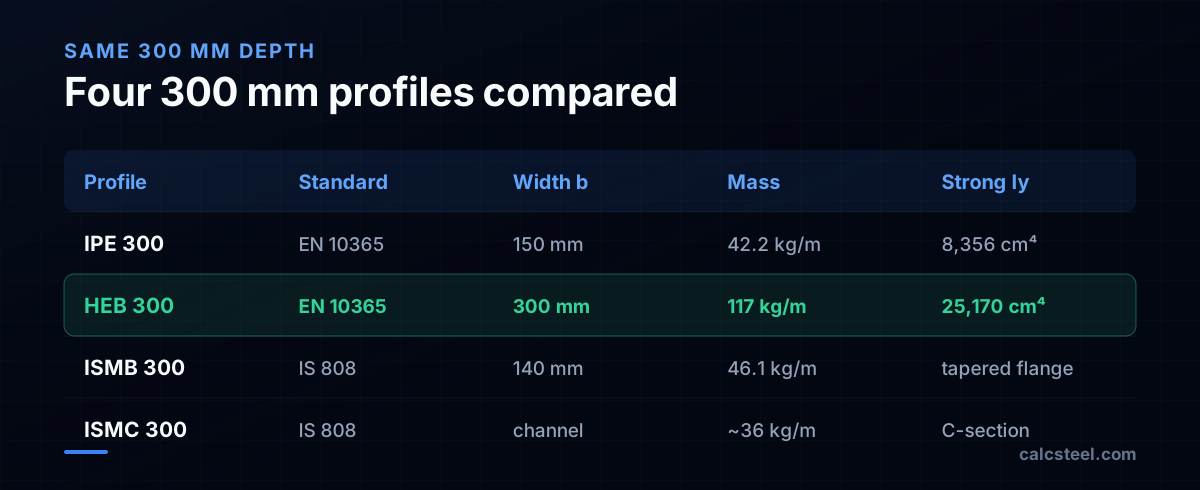
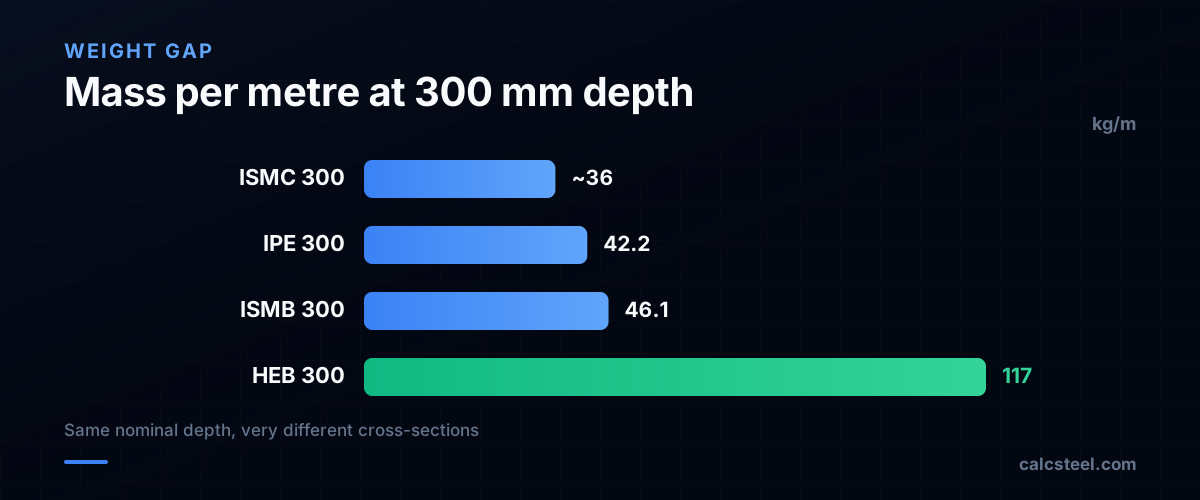
ISMB, ISMC, HEB and IPE look like jargon, but each label encodes three things at once: the cross-section shape, the standards body that fixed its dimensions, and the country where it became the default. Decode the letters and the differences stop being arbitrary. This deep-dive traces where these section tables actually come from, how their geometry is standardized, and why a 300 mm HEB weighs nearly three times a 300 mm channel.
Key takeaways
- IPE and HEB are European (EN 10365, formerly Euronorm 19-57 and Euronorm 53-62); ISMB and ISMC are Indian (IS 808).
- IPE/ISMB are I-beams optimized for bending; HEB is a square-ish wide-flange H ideal for columns; ISMC is a C-channel.
- European IPE/HE flanges are parallel; classic Indian ISMB/ISMC flanges are tapered at a 1:6 inner-flange slope.
- Section tables are not measured per beam — properties are computed from the standard's nominal dimensions and rounded.
What the letters actually encode
Every one of these designations is a compact code. IPE means I-Profile, European — a parallel-flange I-beam. HEB means H-section, European, series B (the medium-weight wide-flange family, alongside the lighter HEA and heavier HEM). On the Indian side, ISMB reads Indian Standard Medium-weight Beam and ISMC is the Indian Standard Medium-weight Channel.
The trailing number is almost always the nominal section depth in millimetres: IPE 300, HEB 300 and ISMB 300 are all roughly 300 mm tall. The shape and the standard live in the letters; the size lives in the number. So the first split is not technical at all — it is geographic. IPE and HE are the European catalogue; ISMB, ISMC, ISLB, ISWB and ISA are the Indian catalogue defined by IS 808.
Where the families came from
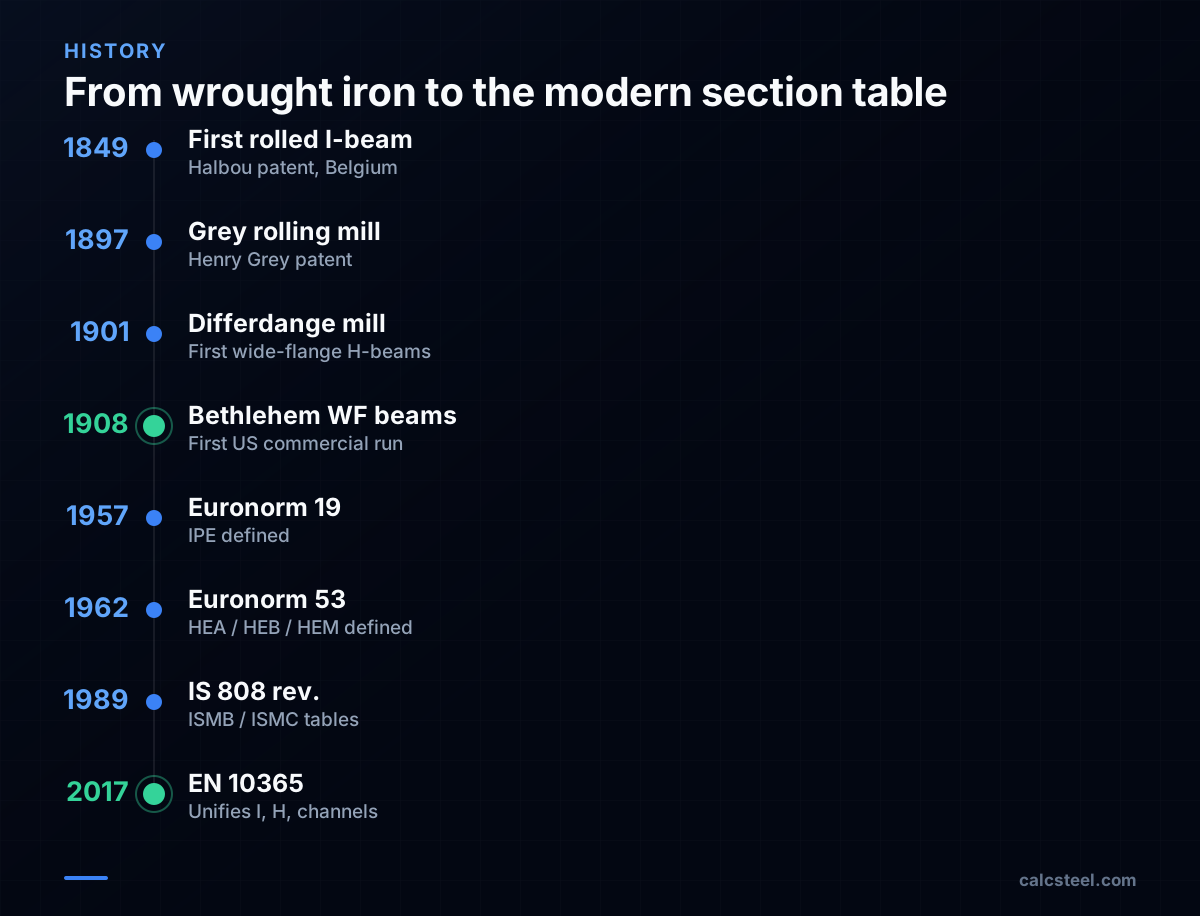
The rolled I-beam itself dates to 1849, when Alphonse Halbou of Forges de la Providence in Marchienne-au-Pont, Belgium patented rolling the shape from a single piece of wrought iron. The real leap came with the wide-flange beam: American engineer Henry Grey patented a rolling mill (1897) that used paired horizontal and vertical rolls to form a beam whose flanges were as wide as it was deep. The first hot-rolled wide-flange H-beams to Grey's design were produced at the Differdange mill in Luxembourg in 1901, and Bethlehem Steel, after Charles Schwab acquired the rights, began America's first commercially successful wide-flange production in 1908 — the section family that made the steel skyscraper practical.
Europe later codified its sections as Euronorms: Euronorm 19-57 fixed the IPE series and Euronorm 53-62 the HEA/HEB/HEM series (with parallel DIN 1025 standards). India developed its own catalogue under the Bureau of Indian Standards in IS 808, which to this day lists ISMB, ISMC, ISA and the rest with their mass per metre and section properties.
I-beam vs wide-flange: the geometry that drives choice
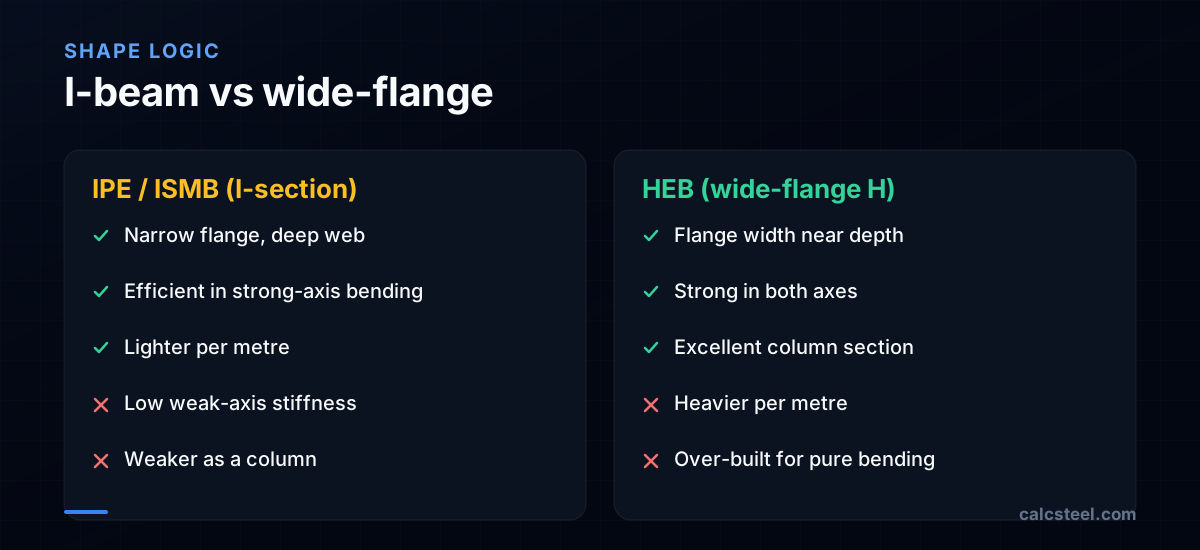
The deepest engineering distinction is not country, it is shape proportion. An IPE or ISMB is a true I-beam: a deep web with relatively narrow flanges, geometry that concentrates material far from the neutral axis to maximize strong-axis bending stiffness for the least weight. That makes them the natural choice for beams spanning floors and roofs.
An HEB is a wide-flange H: its flange width is roughly equal to its depth, so the cross-section is nearly square. That balances stiffness about both axes and resists buckling, which is exactly what a column needs. The trade-off is mass — you pay for that two-axis strength in steel. ISMC, the channel, is a different animal entirely: an open C-shape used for purlins, bracing, runways and built-up members rather than primary bending.
Parallel vs tapered flanges
A subtle but practical difference separates the European and the classic Indian sections: flange shape across its width. Modern European IPE and HE sections have parallel flanges — the inner and outer faces are flat and parallel. That flat surface makes bolting, plate connections and bearing far simpler.
The traditional Indian ISMB and ISMC sections inherit a tapered (sloping) flange, with an inner-flange slope of about 1:6 (an angle of roughly 9.5°), a holdover from older rolling practice that European IPN beams also share. Tapered flanges complicate connection detailing because washers and plates sit on an angled face. India's IS 808:2021 revision did introduce parallel-flange IPE/HE-style sections (designated NPB and WPB), but these are reported to be largely imported rather than rolled domestically at scale, so most Indian projects still specify the tapered ISMB/ISMC produced by local mills.
Where the section tables come from
A steel table looks like measured data, but the numbers are derived, not weighed off the mill floor. Each standard fixes a small set of nominal dimensions — depth, flange width, web thickness, flange thickness and root radius — and every other property is computed from that idealized geometry: cross-sectional area, moments of inertia (I), elastic and plastic section moduli (W and Z), and radii of gyration. Producers must then roll to those nominal sizes within tolerance windows — in Europe, EN 10034 for I and H sections.
Concretely, at the same 300 mm depth an IPE 300 has a 150 mm flange and a strong-axis moment of inertia of about 8,356 cm⁴, while an HEB 300's full 300 mm flange pushes it to about 25,170 cm⁴ — roughly three times stiffer in bending, and far stiffer about the weak axis too. The mass per metre rises in step. In 2017, EN 10365 consolidated the previously separate beam and channel norms into one document, deliberately dropping fixed internal radii because they vary by producer.
The verdict — and how software handles it
So the four-way confusion resolves cleanly. IPE and ISMB are I-beams for bending; HEB is a wide-flange H for columns and heavy two-axis loads; ISMC is a channel for secondary framing. The split between the IPE/HEB pair and the ISMB/ISMC pair is which standard your project is governed by — EN 10365 in Europe, IS 808 in India — and that choice also flips you between parallel and tapered flanges.
This is exactly the bookkeeping that structural software should remove from your head. CalcSteel is a browser-native structural app (React/TypeScript with a Three.js 3D viewer) that ships these section catalogues built in: pick IPE, HEB, ISMB or ISMC from the profile library and every geometric property — area, Iy, Iz, section moduli — is loaded straight from the standard table, so you model in the right shape for the right role without ever transcribing a section table by hand.
Sources
- 1.I-beam — Wikipedia (Halbou 1849, Grey 1897, Differdange 1901, Bethlehem 1908)
- 2.EN 10365: The European norm replacing DIN 1025 — Montanstahl (Euronorm 19-57, 53-62; EN 10365 Jan 2017)
- 3.Table of properties for IPE, HEA, HEB, HEM profiles — Eurocode Applied (IPE 300 / HEB 300 Iy, mass, dimensions)
- 4.IS 808:1989 — Dimensions for Hot Rolled Steel Beam, Column, Channel and Angle Sections (ISMB/ISMC tapered tables)
- 5.IS 808:2021 — Hot Rolled Steel Sections (parallel-flange NPB/WPB additions)
- 6.A Brief History of the Wide Flange Beam — Informed Infrastructure
- 7.Image: Miscellaneous Items in High Demand, PPOC, Library of Congress — Public domain (Wikimedia Commons)
Try CalcSteel for free
Model, analyze and design steel structures in your browser. No install, no signup.
Open the 3D editor