Hollow Sections vs I-Beams: When Each Wins

Hollow sections (RHS, SHS, CHS) and I-beams solve the same problem with opposite geometries — and the section tables you pull them from carry a century of standardization history. This deep-dive traces where those numbers come from, how properties like the torsion constant are derived and standardized, and exactly when a closed tube beats an open beam.
Key takeaways
- Closed sections (RHS/SHS/CHS) crush open I-beams in torsion and weak-axis stability because shear flows around an enclosed perimeter instead of warping the walls.
- I-beams stay the efficient, cheaper choice for pure strong-axis bending and bolted connections — hollow sections often cost more to join.
- Section tables are not arbitrary: AISC computes A500 HSS properties on a design wall of 0.93x nominal, while Europe splits hot-finished EN 10210 from cold-formed EN 10219.
- Rectangular hollow sections are surprisingly young — Stewarts & Lloyds developed them in 1952, and the CIDECT research association (1962) wrote much of the design rulebook.
Two geometries, one decision
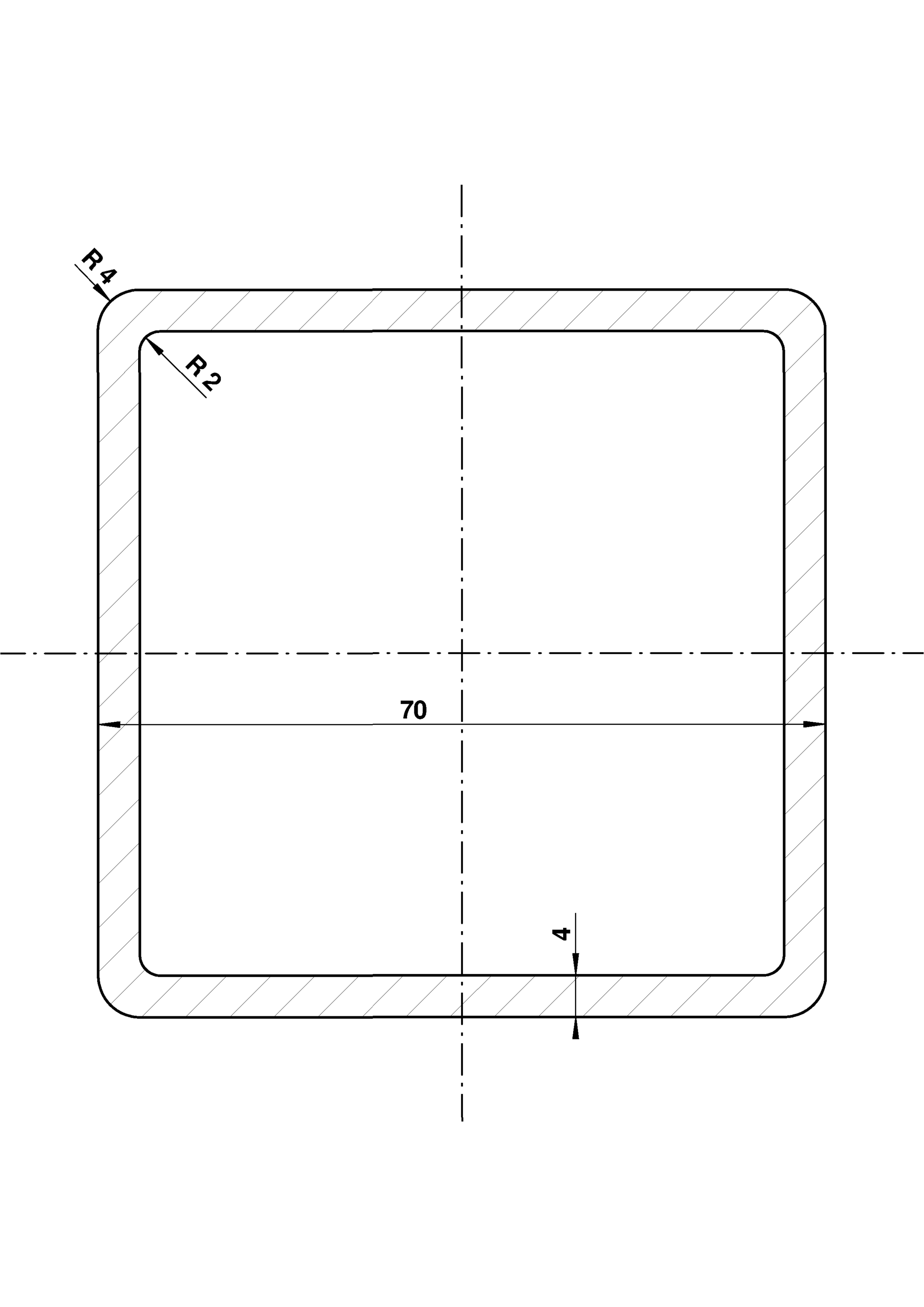
Every steel beam is a bet about how the load will try to deform it. An I-beam (wide-flange) concentrates material in two flanges far from the neutral axis — brilliant for bending about its strong axis, where that lever arm does the most work. A hollow section wraps the same steel into a closed loop: a square (SHS), rectangle (RHS), or circle (CHS).
The consequence is geometric, not metallurgical. An open section is efficient in one plane and exposed everywhere else — it is prone to lateral-torsional buckling and weak in twist. A closed section distributes stiffness around its whole perimeter, so it resists torsion and weak-axis buckling far better. The classic rule of thumb: hollow sections win wherever loads twist, where columns can buckle either way, or where the member is simply on display.
Why closed beats open in torsion
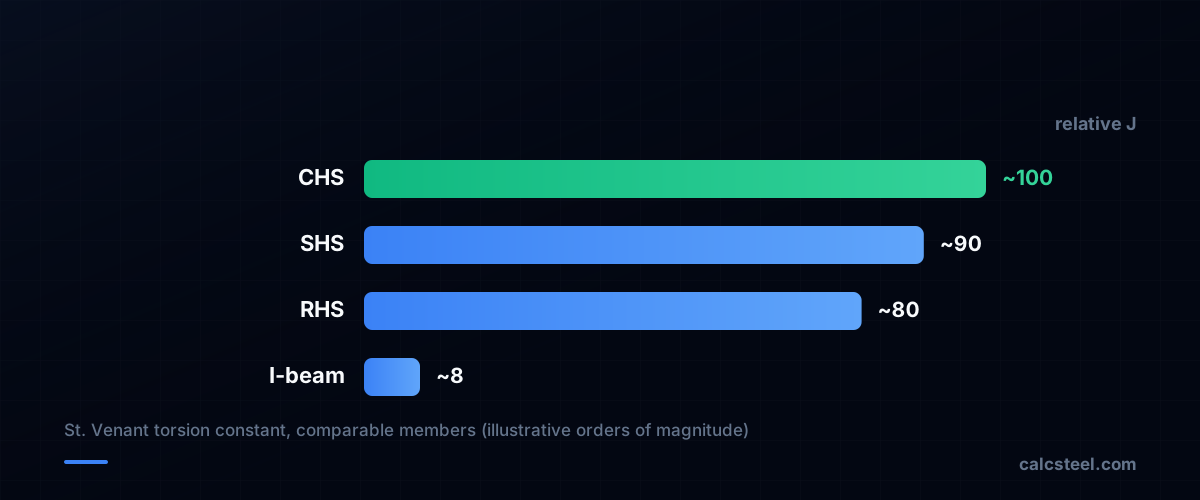
The decisive number is the St. Venant torsion constant, J — the geometric term in torsional stiffness GJ, analogous to EI in bending. For a thin-walled closed tube, J follows Bredt's formula and scales with the square of the enclosed area: shear flows continuously around the loop, so the whole cross-section fights the twist.
An open I-section has no closed loop. Its walls instead warp, and its St. Venant J is tiny — engineering references note the torsion constant of an RHS is roughly an order of magnitude higher than a comparable I-section. That is why a tube carries a sign cantilever or an eccentric crane load with almost no twist, while an I-beam in the same role needs bracing or stiffeners. The flip side: for pure strong-axis bending, the I-beam's deep flanges are usually the more material-efficient shape.
Where the section tables actually come from
When you select an HSS6x6x1/4 or a RHS 150x100x6 in any tool, you are reading a standardized table — and those tables encode real manufacturing rules. In North America, hollow sections are governed by ASTM A500 (cold-formed) and the newer ASTM A1085, with the AISC Shapes Database publishing the listed properties.
A crucial subtlety lives in that table: AISC computes section properties from a design wall thickness equal to 0.93x the nominal for ASTM A500 tubing, because A500 allows a minus-10% tolerance on wall thickness. Per AISC 360-16 Section B4.2, calculations involving HSS wall thickness use 0.93 times the nominal. So an HSS6x6x1/4 — nominally 0.250 in — is calculated on roughly a 0.233 in wall. Ignore that factor and your capacity is optimistic by several percent. ASTM A1085 tightened the wall tolerance to minus-5%, which lets designers use the full nominal wall. You can pull the same I, S and r values for any tube or beam in our free moment of inertia calculator — no signup required.

Hot-finished vs cold-formed: the EN split
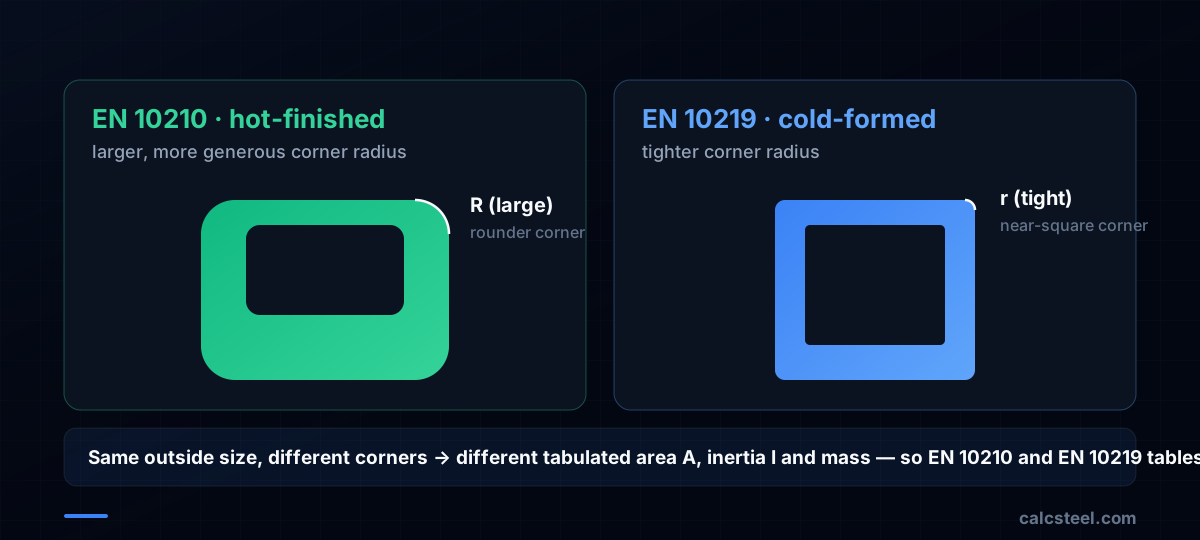
Europe organizes the same family by how the tube was made. EN 10210 covers hot-finished structural hollow sections, while EN 10219 covers cold-formed welded sections shaped at ambient temperature. They are not interchangeable on paper.
- Corner radii: EN 10210 hot-finished sections have larger, more generous corners; EN 10219 cold-formed corners are tighter — which changes the cross-sectional area and properties printed in the table.
- Residual stress & ductility: hot-finishing relieves internal stress and is favored for fatigue and harsh environments; cold-forming work-hardens the corners, raising local yield strength.
- Tolerances: cold-formed EN 10219 typically holds tighter outside-dimension tolerances, which is why it dominates cost-driven fabrication.
The takeaway for a designer: the letters CHS/SHS/RHS describe the shape, but the EN number behind them describes the steel — and the properties table is built from that distinction, not just the outside dimensions.
A young profile with a research pedigree
Tubes are ancient; rectangular structural tubes are not. Circular hollow sections grew out of 19th-century tube-making, but the rectangular hollow section was not developed until 1952, by Stewarts & Lloyds in the United Kingdom — the Glasgow-headquartered tube maker itself formed by a 1903 merger of A. & J. Stewart & Menzies and Lloyd & Lloyd. RHS is, in structural terms, a post-war profile; it only became widely available in the early 1970s.
That youth is why an entire research body exists to back it. CIDECT — the international association of structural-hollow-section manufacturers — was founded in 1962 and has since funded 200+ research projects and a celebrated series of Design Guides (CHS joints, RHS joints, fire, concrete-filled columns, fatigue). Those guides are the source code behind the hollow-section joint rules that later flowed into Eurocode 3, AISC 360 and other national codes.

The verdict — and where the numbers live
Use a hollow section when the member twists, when a column must resist buckling in both directions, when the steel is architecturally exposed, or when you want clean lines and lower drag. Stick with an I-beam for heavy strong-axis bending, long-span floor beams, and anywhere you rely on cheap bolted connections — because joining tubes from a single side, with no internal access, is the genuine cost penalty of going hollow.
Whichever you choose, the decision is only as good as the table behind it: the right design wall thickness, the right EN or ASTM family, the correct torsion and warping constants. CalcSteel is a browser-native structural app (React/TypeScript front end, Python finite-element backend) with 1,140+ steel profiles — RHS, SHS, CHS and I-sections alike — and code checks for NBR 8800, AISC 360, Eurocode 3 and IS 800. It is free to start, with paid Starter and Pro plans, monthly or annual, and prices for your country on the pricing page. The honest pitch: it won't make the geometry choice for you, but it will run the buckling, torsion and connection checks on the standardized numbers so you can compare a tube against a beam in minutes. Try it in the editor.

Sources
- 1.Application of hollow sections in steel structures — ArcelorMittal Constructalia
- 2.CIDECT — research association for structural hollow sections
- 3.Stewarts & Lloyds — Wikipedia
- 4.Understanding HSS Material Specifications (A500 0.93 factor vs A1085) — Steel Tube Institute
- 5.EN 10210 vs EN 10219 — hot-finished vs cold-formed (corner radii) — BCSA
- 6.Hollow structural section — Wikipedia
- 7.Image: Wikimedia Commons — CC BY-SA 3.0 (Wikimedia Commons)
Try CalcSteel for free
Model, analyze and design steel structures in your browser. No install, no signup.
Open the 3D editor