MR250 or A572? What Changing the Steel Grade Does to Your Design
Upgrading the steel grade from MR250 to A572 raises the yield strength, not the stiffness. See exactly where a higher grade pays off and where it buys nothing, with three FEM-verified worked examples and a free column-buckling calculator, no login.
Key takeaways
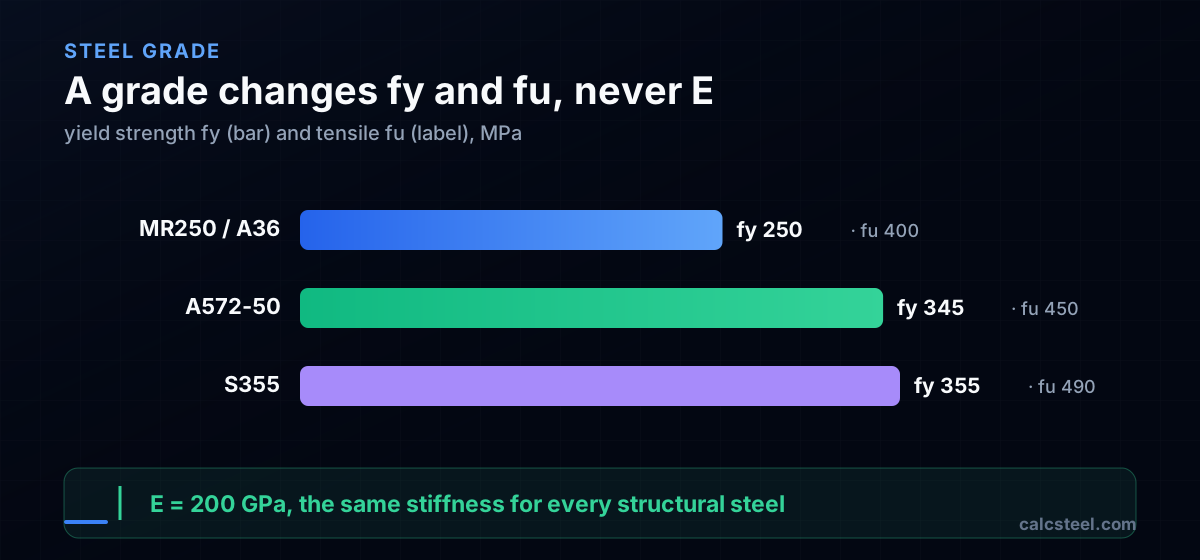
- A steel grade sets the yield strength fy and the tensile strength fu. It does not change the modulus of elasticity E, which is about 200 GPa for every structural steel, from MR250 to A572 to S355.
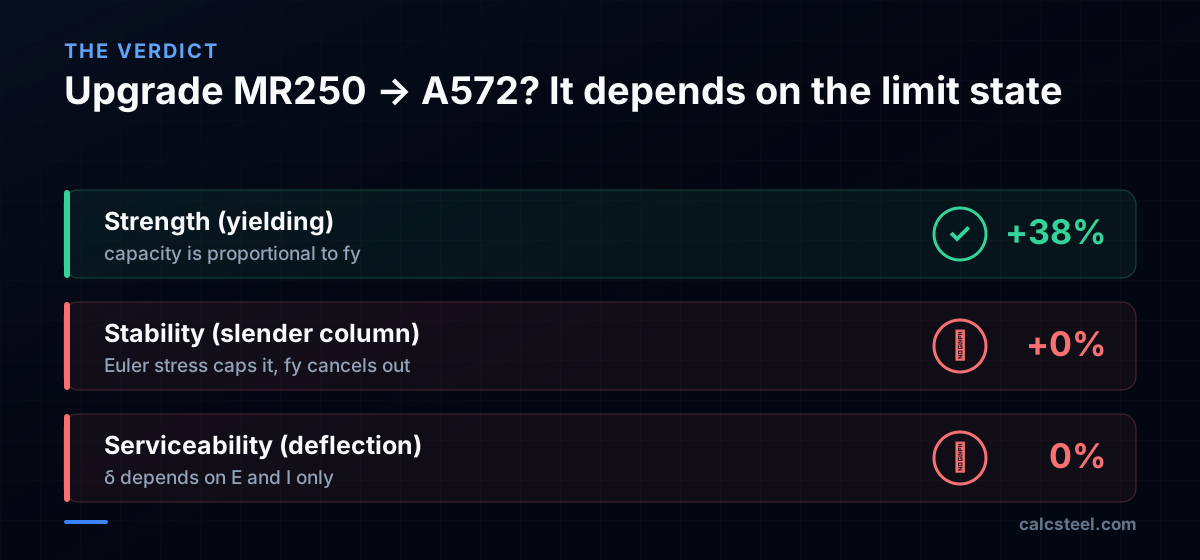
- For a strength-governed member, capacity is proportional to fy. On the same IPE 300 beam under the same 76.5 kN·m, MR250 was overloaded at util 1.07 while A572-50 passed at 0.78, a 38% jump that matches the 345/250 grade ratio exactly.
- For a slender column, buckling capacity is capped by the Euler stress, which does not contain fy. The FEM gave the identical 379.5 kN capacity for both grades at slenderness 149, so the grade upgrade bought precisely 0%.
- For a deflection-governed beam, the grade is irrelevant: the FEM returned 18.76 mm for both grades because deflection depends only on E and I. Chasing the grade with a lighter section made the deflection worse, 27.2 mm on an IPE 270.
- Before you pay for a higher grade, find out which limit state governs. The gain runs from +38% to 0% depending on it, and CalcSteel checks all three limit states against AISC 360, Eurocode 3 and NBR 8800 in one run.
Two identical frames, two different steels
Picture two structural drawings that are line for line the same: the same warehouse, the same spans, the same purlin spacing, the same loads. The only difference lives in the material call-out on the drawing. One says MR250, the everyday hot-rolled carbon steel that a Brazilian mill keeps in stock. The other says ASTM A572 Grade 50, a high-strength low-alloy steel that costs more per kilo and often has to be ordered.
The natural instinct is that the A572 frame must be the better building: stronger steel, safer structure, or the same safety with less steel and a lighter bill. Sometimes that instinct is exactly right and the higher grade saves real tonnage. Just as often it changes nothing at all, and you have paid a premium for a number your design never uses.
The reason is a single fact that decides this whole question, and it is worth stating up front: changing the steel grade changes the yield strength, and almost nothing else. To see where the grade helps and where it is wasted, we will put one real section, an IPE 300, through three limit states in the CalcSteel FEM engine, swap the grade on each, and read the numbers.
What a steel grade actually is
A steel grade is, at heart, two numbers. The yield strength fy is the stress at which the steel stops springing back and starts to deform permanently. The tensile strength fu is the stress at which it finally pulls apart. Every capacity check in a steel code, bending, axial, shear, bearing, weld and bolt, is built on one or both of these.
MR250, the Brazilian NBR 7007 workhorse, has fy = 250 MPa and fu = 400 MPa. It is the strength twin of ASTM A36. A572 Grade 50 raises the bar to fy = 345 MPa and fu = 450 MPa. The European S355 sits just above it at fy = 355 MPa. Going from MR250 to A572 lifts the yield strength by 38% (345 / 250 = 1.38), and that ratio is going to reappear again and again.
| Grade | Standard | fy (MPa) | fu (MPa) | E (GPa) |
|---|---|---|---|---|
| MR250 / A36 | NBR 7007 / ASTM A36 | 250 | 400 | 200 |
| A572-50 | ASTM A572 Gr. 50 | 345 | 450 | 200 |
| S355 | EN 10025 | 355 | 490 | 200 |
Look at the last column, because it is the whole article in one number. The modulus of elasticity E is about 200 GPa for every structural steel, mild or high-strength, cheap or expensive. Stiffness is a property of the iron lattice itself, and the alloying that raises the yield strength barely touches it. A grade upgrade buys you strength. It never buys you stiffness. Everything that follows is a consequence of that one line.
Three limit states, three different answers
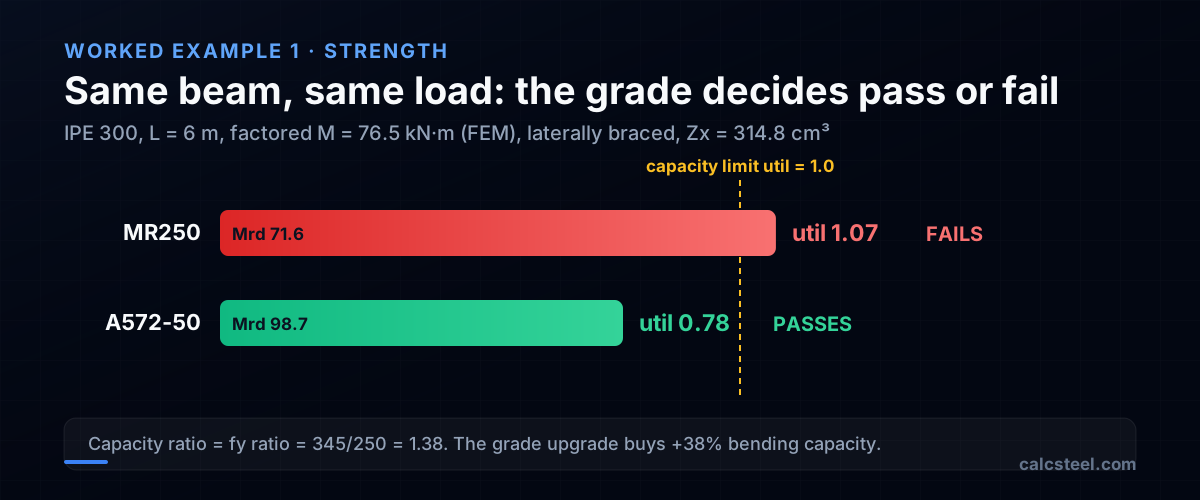
A steel member can reach its limit in three broad ways, and the steel grade lands very differently on each one.
- Strength (yielding). A short tension member, or a compact beam that is held against lateral buckling, fails when the stress reaches fy. Capacity is directly proportional to fy, so a higher grade pays off almost dollar for dollar.
- Stability (buckling). A slender column fails by buckling long before the material yields. The buckling stress comes from the Euler formula, which contains E and the slenderness but not fy. Raise the grade and the buckling capacity hardly moves.
- Serviceability (deflection). A beam that has to stay below a deflection limit like L/360 is governed by how much it sags under service load. Deflection depends on E and the second moment of area I, and on nothing about the grade at all.
So the honest answer to 'should I upgrade to A572?' is: it depends entirely on which of these three is deciding your section. The rest of the article walks one IPE 300 through all three, with the CalcSteel engine doing the arithmetic.
Worked example 1: the grade decides pass or fail
Start with the case where the grade earns its keep. Take a simply supported IPE 300 beam spanning 6 m, held against lateral-torsional buckling, carrying a factored uniform load of 17 kN/m. The demand is the design bending moment, and it does not care about the grade at all: geometry and load fix it. The CalcSteel FEM engine returns M = 76.5 kN·m, matching the textbook wL²/8 = 17 × 6² / 8 to the fourth decimal.
The capacity is where the grade enters. For a compact, laterally braced section the design bending resistance is MRd = Zx · fy / γ, with the plastic modulus Zx = 314.8 cm³ and γ = 1.10 (NBR 8800). Run the two grades:
- MR250: MRd = 314.8 × 250 / 1.10 = 71.6 kN·m. Utilization = 76.5 / 71.6 = 1.07. It fails.
- A572-50: MRd = 314.8 × 345 / 1.10 = 98.7 kN·m. Utilization = 76.5 / 98.7 = 0.78. It passes, with 22% to spare.
Same beam, same span, same load. The only thing that changed was the material call-out, and it moved the member from overloaded to comfortable. Notice the capacity ratio: 98.7 / 71.6 = 1.38, exactly the ratio of the yield strengths. When strength governs, the grade upgrade converts one-for-one into capacity, and that is the case where paying for A572 is the right engineering call.
Try it: toggle the grade on a live column
Before the next example, get your hands on the effect yourself. The calculator below is the CalcSteel column-buckling tool, and it has a grade toggle built in: A36 · 250, A572-50 · 345 and S355 · 355. Pick a section, set a length, and watch the capacity.
Try this: choose a short column and flip from 250 to 345. The capacity jumps. Now stretch the same column out to 5 or 6 m and flip the grade again. This time the capacity barely twitches. You are watching the crossover that the next section pins down with numbers. The grade helps the stocky column and abandons the slender one, and the calculator lets you find the exact length where the payoff disappears for your own section.
End conditions (buckling case)
Pinned – Pinned
Cross-section
Slenderness KL/r
134.7
limit 200 · OK
Euler Pcr (elastic)
310.7 kN
Fe = 108.9 MPa
AISC 360 φcPn
245.2 kN
Fcr = 95.5 MPa · elastic
NBR 8800 Nc,Rd
247.7 kN
χ = 0.382 · λ₀ = 1.52
Code vs code — same column
Nc,Rd / φcPn = 1.010
Both codes share the 0.658 / 0.877 buckling curve — the ~1% gap is purely φc = 0.90 (AISC) vs 1/γa1 = 0.909 (NBR).
Demand check — Nd = 150 kN
Step-by-step derivation — live for YOUR column
IPE 200 · L = 3 m · K = 1 · fy = 250 MPa
- 1
Slenderness ratio
λ = K·L/r = 1 × 3000 / 22.28 mm
λ = 134.7 (≤ 200 ✓)
- 2
Euler elastic buckling stress and load
Fe = π²E/λ² = π² × 200,000 / 134.7² · Pcr = Fe·A = Fe × 2854 mm²
Fe = 108.9 MPa · Pcr = 310.7 kN
- 3
Buckling regime (AISC E3)
4.71·√(E/fy) = 4.71·√(200,000/250) = 133.2 < λ = 134.7
elastic buckling → use E3-3 (0.877·Fe)
Elastic range: capacity no longer depends on fy — only geometry (r, K, L) helps.
- 4
AISC 360 critical stress and design capacity
Fcr = 0.877 · Fe = 0.877 × 108.9 = 95.5 MPa · φcPn = 0.9 × Fcr × A
Pn = 272.5 kN · φcPn = 245.2 kN
- 5
NBR 8800 reduction factor and design capacity
λ₀ = √(fy/Fe) = 1.515 > 1.5 → χ = 0.877/λ₀² = 0.382 · Nc,Rd = χ·A·fy/1.1
Nc,Rk = 272.5 kN · Nc,Rd = 247.7 kN
Same 0.658/0.877 curve as AISC — the ~1% difference is φc = 0.90 vs 1/γa1 = 0.909.
Sections that work — 3 lightest of 612 catalog profiles carrying Nd = 150 kN at L = 3 m, K = 1
| Section | kg/m | φcPn (kN) | Nc,Rd (kN) | Util. | |
|---|---|---|---|---|---|
| lightestSHS 80x4 | 9.2 | 164 | 166 | 91% | |
| HSS 76x76x4.8 | 9.9 | 165 | 167 | 91% | |
| CHS 88.9x5 | 10.3 | 172 | 174 | 87% |
Pass criterion: φcPn ≥ Nd (AISC 360 LRFD) AND Nc,Rd ≥ Nd (NBR 8800) AND KL/r ≤ 200, using each section's tabulated-mass area and minimum radius of gyration.
Buckling curve — IPE 200, fy = 250 MPa
Capacity of IPE 200 by unbraced length — K = 1, fy = 250 MPa
| L (m) | KL/r | Pcr Euler (kN) | φcPn AISC (kN) | Nc,Rd NBR (kN) | Regime |
|---|---|---|---|---|---|
| 1 | 45 | 2,796 | 577 | 583 | inelastic |
| 2 | 90 | 699 | 419 | 423 | inelastic |
| 3◀ yours | 135 | 311 | 245 | 248 | elastic |
| 4 | 180 | 175 | 138 | 139 | elastic |
| 5 | 224 ⚠ | 112 | 88 | 89 | elastic |
| 6 | 269 ⚠ | 78 | 61 | 62 | elastic |
| 7 | 314 ⚠ | 57 | 45 | 45 | elastic |
| 8 | 359 ⚠ | 44 | 34 | 35 | elastic |
| 9 | 404 ⚠ | 35 | 27 | 28 | elastic |
| 10 | 449 ⚠ | 28 | 22 | 22 | elastic |
Worked example 2: the slender column that ignores the grade
Now the case that surprises people. Take the same IPE 300, stand it up as a pinned-pinned column buckling about its weak axis (radius of gyration ry = 3.35 cm), and load it with 300 kN. We will solve it at two lengths.
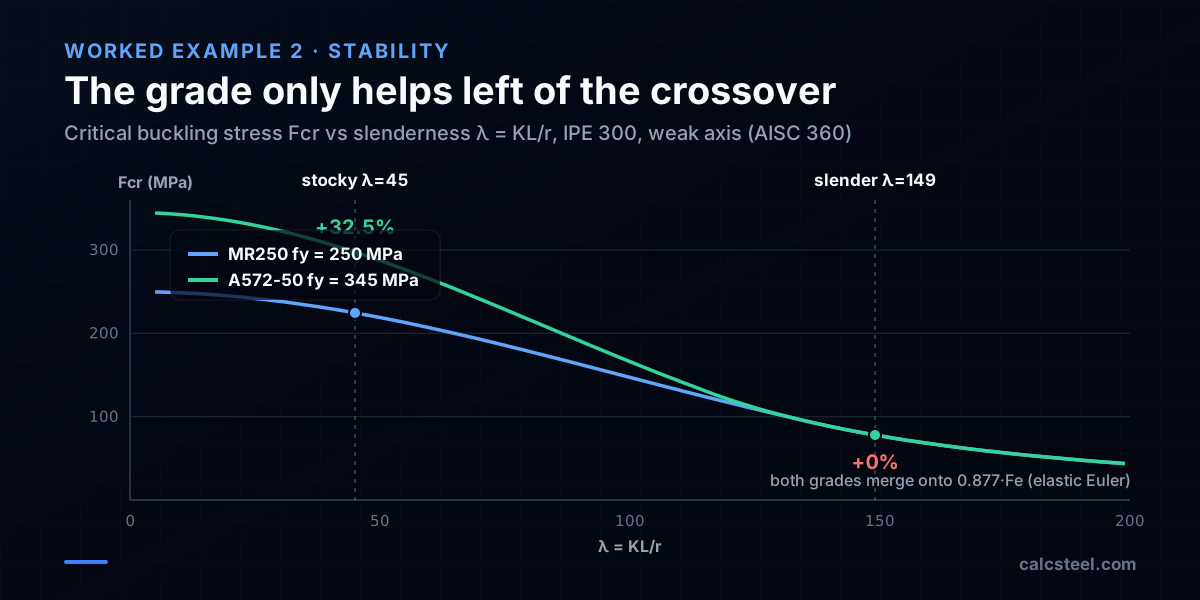
Slender, at 5 m. The slenderness is λ = KL / r = 500 / 3.35 = 149. The Euler stress is Fe = π²E / λ² = 88.5 MPa, and it contains E but no fy. Both grades sit past the elastic-buckling threshold λlim = 4.71·√(E/fy), so the AISC 360 critical stress collapses to Fcr = 0.877·Fe, in which fy has cancelled out entirely. The engine returns the identical design capacity for both grades: NRd = 379.5 kN, utilization 0.79, whether the steel is MR250 or A572. The 38% stronger steel bought exactly 0%.
Stocky, at 1.5 m. Shorten the same column to λ = 45. Now Fe = 983 MPa, the column is in the inelastic range where fy does matter, and the capacities separate: 1099 kN on MR250 against 1457 kN on A572, a +32.5% gain that nearly recovers the full grade ratio.
Same section, same axial load, same grade upgrade. Worth a third more when the column is stocky, worth nothing when it is slender. Stiffness governs buckling, and you cannot buy stiffness with a grade.
Worked example 3: deflection does not read the grade
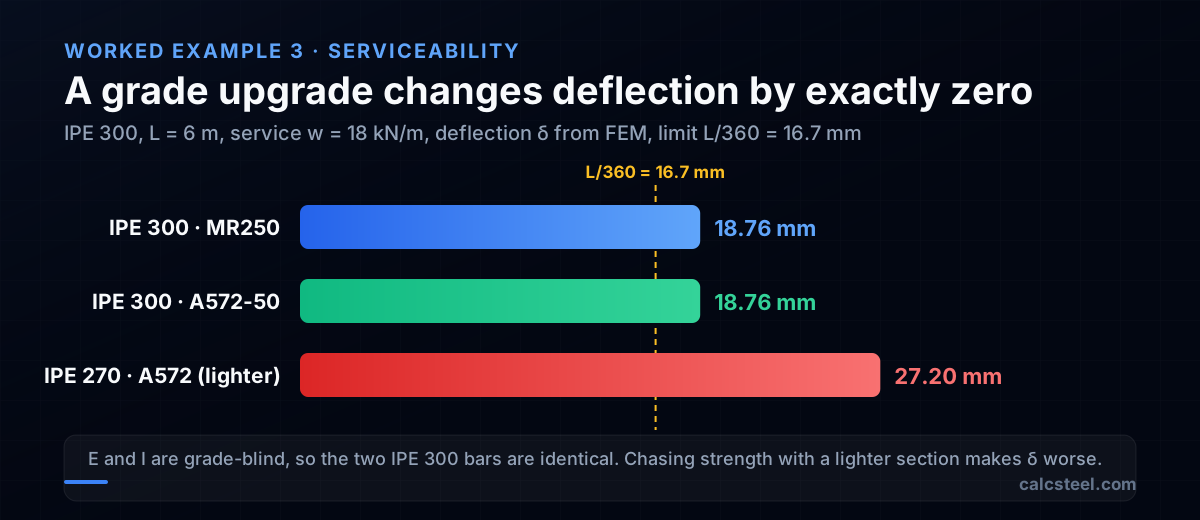
The third limit state is the one where the grade is most completely irrelevant. Put the IPE 300 back down as a 6 m simply supported beam and apply a service load of 18 kN/m. The deflection follows δ = 5wL⁴ / (384·E·I), and the CalcSteel engine returns δ = 18.76 mm, against a common limit of L/360 = 16.7 mm. The beam is over the limit at utilization 1.13.
Now upgrade the steel to A572 and re-run. The deflection is 18.76 mm. Identical, to the last digit, because the formula contains E and I and nothing else, and both are grade-blind. There is no grade you can specify that will make this beam sag less. If deflection is your problem, a stronger steel is not the answer; a stiffer section is.
It gets sharper. Suppose you had used A572's extra strength to drop to a lighter IPE 270, whose bending capacity on A572 sits right at the design moment. The second moment of area falls from 8097 to 5584 cm⁴, and the engine returns δ = 27.2 mm, utilization 1.63. The weight you saved on strength came straight back as deflection. The grade did not just fail to help the serviceability check, chasing it actively made the check worse.
The crossover: where the grade stops paying
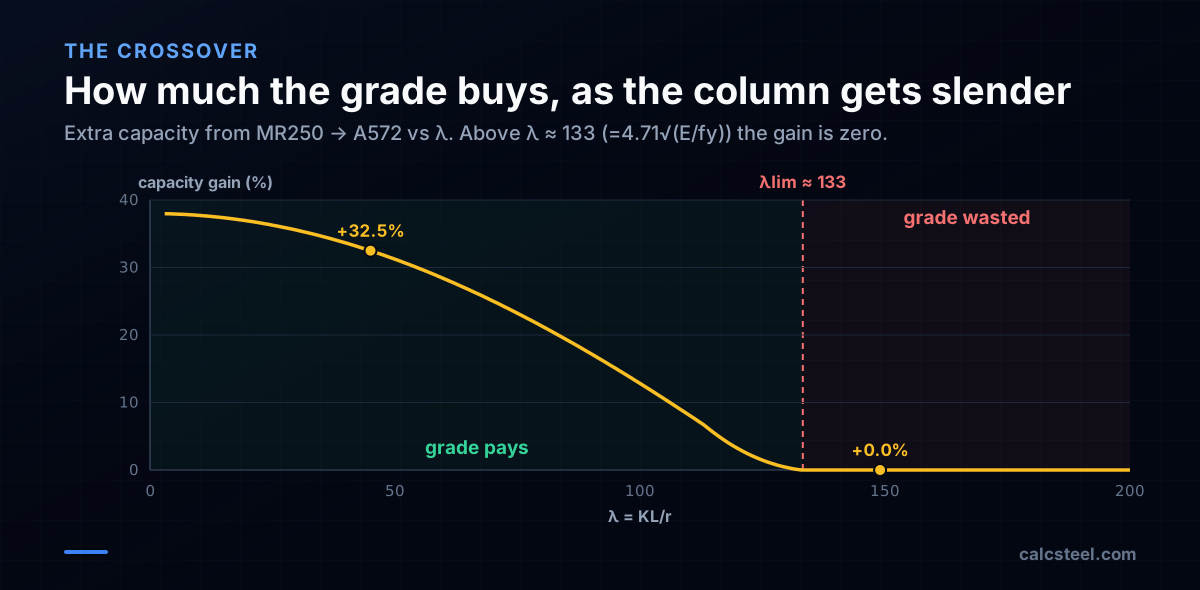
The stability example had a hard boundary hiding in it, and it is worth naming because it lets you predict the answer before you run anything. AISC 360 splits column behaviour at the slenderness
λlim = 4.71·√(E / fy).
Below λlim the column yields inelastically and fy is in the capacity formula, so the grade pays. Above it the column buckles elastically at 0.877·Fe, fy has dropped out, and the grade is dead weight. For MR250 the threshold is λlim = 133; for A572 it is 113 (higher fy actually lowers the threshold). Past a slenderness of about 133, both grades are on the same elastic curve and the upgrade returns nothing.
Plot the capacity gained by going from MR250 to A572 against slenderness and you get a clean picture of diminishing returns: about +38% for a very stocky column, sliding down to zero as it crosses λlim, then flat at zero for everything slender. If you know roughly where your column sits on this axis, you already know whether the grade is worth buying.
Does the higher grade pay for itself?
The grade only converts into money when it converts into a lighter section, and it only converts into a lighter section when strength governs. In worked example 1, A572 let the IPE 300 pass with 22% to spare, and that margin invites a step down toward a lighter IPE 270: 36.1 kg/m instead of 42.2 kg/m, a 14% saving in steel weight on that member.
But A572 costs more per kilo than MR250, so the sum only closes if the lighter section actually survives every other check. As example 3 showed, the IPE 270 blows the deflection limit, which claws the saving right back. This is the trap: a grade upgrade justified on a strength spreadsheet, undone by a serviceability limit nobody re-ran. In a strength-governed member, high roof beams and short braced columns being the classic winners, the higher grade is genuinely economical. In a member fighting slenderness or deflection, you are paying a premium for a property the design discards.
There is also availability. In Brazil, MR250 (and A572 in the common Gerdau and ArcelorMittal profiles) are stocked; exotic higher grades may carry lead time and minimum-order pain that swamp the material saving on a small job.
What a higher grade does not do
Strength is only one column of the checklist, and several of the others are indifferent or even hostile to a grade upgrade.
- Stiffness and stability, as we saw, run on E. Slender columns, thin flanges prone to local buckling, and unbraced beams prone to lateral-torsional buckling all live in the elastic world where the grade barely registers.
- Fatigue is almost purely a function of the weld or connection detail geometry, not the base-metal grade. The detail categories in EN 1993-1-9 and AASHTO are the same S-N curve whether the plate is 250 or 355 MPa. A crane runway that is fatigue-governed gains nothing from a stronger steel.
- Ductility and weldability. A572-50 is a well-behaved, weldable steel, but as grades climb the carbon equivalent tends to rise, preheat requirements appear, and elongation at rupture drops. More strength can mean a little less warning before failure, which is exactly the property you do not want to trade away casually.
- Connection capacity often hinges on fu (bolt bearing, block shear, net-section rupture) and on the bolt and weld grades, not the member's fy. Upgrading the member steel without touching the connection can leave the joint as the real governing element.
A note for cold-formed and light steel framing
Everything above is written for hot-rolled sections, but the logic bites even harder in cold-formed and light steel framing (LSF). Thin-gauge sections are dominated by local and distortional buckling of their slender plate elements, and plate buckling, like column buckling, is an elastic phenomenon governed by E and the width-to-thickness ratio, not by fy. A higher-grade coil raises the yield you are allowed to reach in theory, but the effective width the section can actually mobilise is capped by buckling long before that yield arrives.
The practical result: in a wall stud or a purlin governed by distortional buckling or by deflection, moving to a stronger grade often changes the design capacity by only a few percent, because the section reaches its buckling limit first. The money in LSF is usually in the geometry, the gauge, the lip, the stiffeners, far more than in the grade of the steel.
Common mistakes and FAQ
"My beam deflects too much, so I will specify a stronger steel." This is the single most common grade mistake. Deflection depends on E and I, both grade-blind. Change the section or reduce the span; the grade will do nothing.
"A572 is always the better choice." Only when strength governs. For a slender column or a deflection-limited beam it is a premium for nothing, and occasionally worse if it tempts you into a lighter, more flexible section.
"Higher grade means I can use smaller everything." Only the strength-governed members shrink. Stability and serviceability members keep the same size regardless of grade, so a blanket grade upgrade across a whole structure rarely delivers the tonnage saving people expect.
"Does the grade change my connections?" The member's fy usually does not drive the bolts and welds; fu and the fastener grades do. Re-check the connections against the real governing strength, not the member grade.
"Is E really the same for all steels?" Yes, to engineering accuracy: about 200 GPa in AISC and NBR (Eurocode uses 210 GPa as a code convention). The alloying that lifts fy leaves the elastic stiffness essentially untouched.
From grade to a sized member
The steel grade is a lever that only moves one of the three things that can govern your section. It lifts strength in direct proportion to fy, it leaves buckling capacity nearly untouched for slender members, and it does nothing for deflection. So the grade decision is really a question about your structure, not about steel: which limit state is deciding this member?
That is exactly what a design check tells you. Run the member, read whether strength, stability or serviceability is at 1.0, and only then decide whether a higher grade earns its premium. CalcSteel computes all three against AISC 360, Eurocode 3 and NBR 8800 in a single run, with the same FEM engine that produced every number in this article, so you can see the grade's effect on your own frame before you commit a single kilo of the more expensive steel.
Sources
- 1.ANSI/AISC 360-22, Specification for Structural Steel Buildings (Ch. E, Compression; Ch. F, Flexure)
- 2.ABNT NBR 8800:2008, Projeto de estruturas de aço e de estruturas mistas de aço e concreto de edifícios
- 3.ASTM A572/A572M, Standard Specification for High-Strength Low-Alloy Columbium-Vanadium Structural Steel
- 4.ABNT NBR 7007, Aço para perfis laminados a quente para uso estrutural
- 5.EN 1993-1-1, Eurocode 3: Design of steel structures, Part 1-1: General rules and rules for buildings
Try CalcSteel for free
Model, analyze and design steel structures in your browser. No install, no signup.
Open the 3D editor