The Weight Per Metre of a Steel Profile
Every steel beam carries a number that looks deceptively simple: its weight per metre. That figure decides the bill, the crane plan, and the dead load you feed into analysis. But where does it come from, why is it baked into the section's very name, and why do published tables disagree slightly with a hand calculation? This deep-dive traces the weight-per-metre figure from 1872 mill catalogues to today's browser-native databases.
Key takeaways
- Weight per metre is just density times cross-sectional area: for carbon steel, mass (kg/m) = area (mm2) x 0.00785, using the standard 7850 kg/m3 density specified in Eurocode (EN 1991-1-1 / EN 1993).
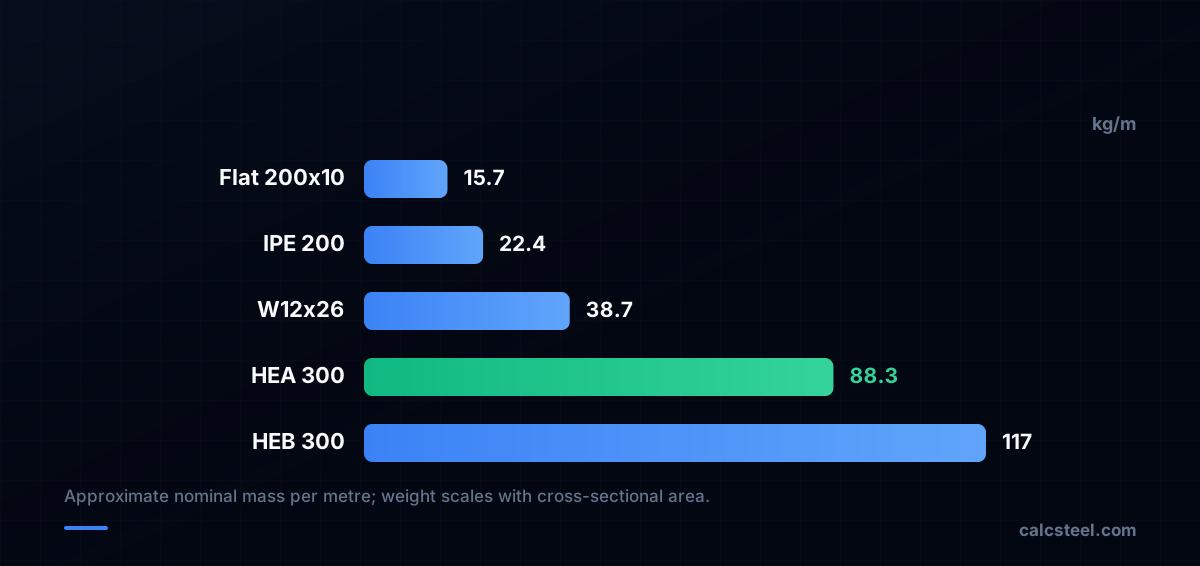
- The figure is so fundamental that AISC bakes it into the section name itself: a W12x26 is a 12-inch-deep wide flange weighing 26 lb/ft.
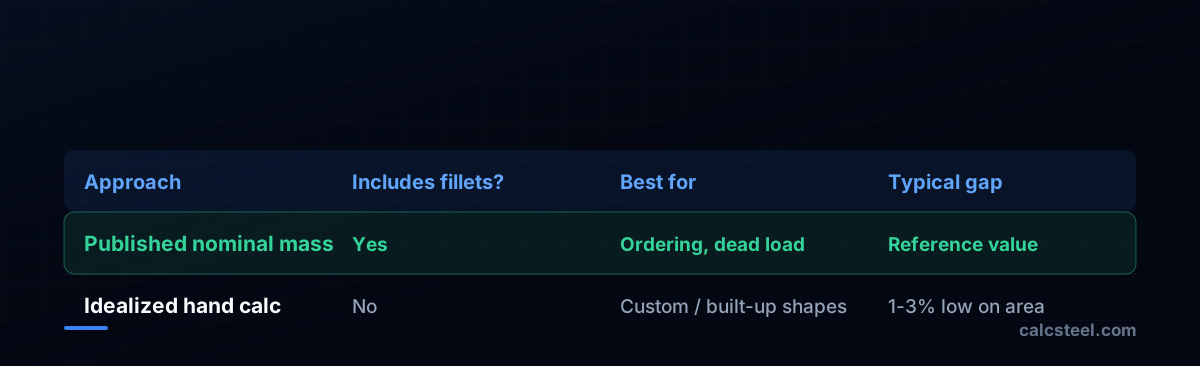
- Published table values include root fillets and rounding, so an idealized sharp-corner calculation typically lands within 1-3% of the catalogue value.
- Section tables descend from physical mill catalogues like the 1872 Carnegie Pocket Companion, now digitized into databases such as the 1,140+ profiles inside CalcSteel.
Why one number rules the whole project
Ask a fabricator for a price and the first thing they reach for is weight per metre. Steel is bought, shipped, and billed by mass, so the kg/m figure of every member directly drives material cost. It is also the member's own self-weight, the dead load that any honest structural analysis must carry before a single live load is applied.
That is why the figure appears everywhere: in the quantity take-off, in the crane and transport plan, and as a line in the load combinations checked against NBR 8800, AISC 360, Eurocode 3 or IS 800. Get it wrong by a few percent across a few hundred tonnes and the error is measured in real money. Understanding where the number comes from is the difference between trusting a table blindly and knowing exactly what it represents.
The physics: density times area, nothing more
Beneath the catalogue, the calculation is elementary. Weight per length is volume per length times density, and volume per length of a prismatic member is simply its cross-sectional area. So:
- Mass per metre = cross-sectional area x density.
- For common carbon steels the density is taken as 7850 kg/m3 (equivalently a unit weight of about 78.5 kN/m3, or 0.2836 lb/in3), the value used for structural design in Eurocode (EN 1991-1-1 / EN 1993).
- With area in mm2 this collapses to a handy factor: mass (kg/m) = area (mm2) x 7850 x 10-6, i.e. area x 0.00785.
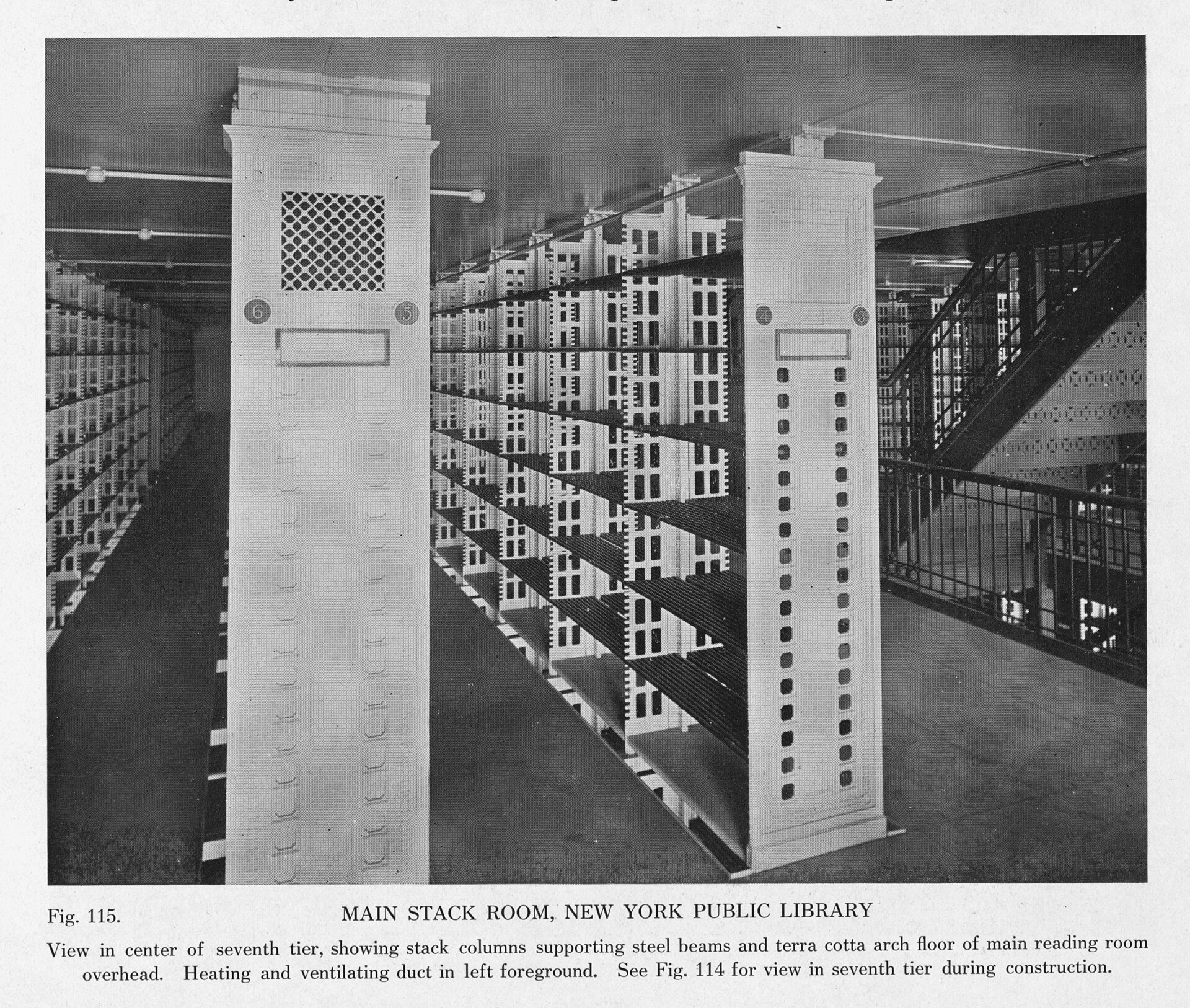
A worked example makes it concrete: a 200 mm x 10 mm flat bar has an area of 2000 mm2, so 2000 x 0.00785 = 15.7 kg/m. The same 7850 kg/m3 figure is the agreed basis across ASTM, EN 10025 and their international equivalents, which is why a profile weighs essentially the same number whether it is rolled as A992 in the US or S355 in Europe.
When the weight becomes the name
The weight figure is so central that American practice writes it straight into the section designation. A W12x26 is a wide-flange ("W") shape with a nominal depth of 12 inches weighing 26 lb/ft. The clever part: within a given depth group, the weight per foot uniquely identifies one exact cross-section, so once you know the W-size and its weight you can look up every other property.
Europe took a different route. IPE means "I-Profile European" and HEA / HEB / HEM are the H-section A (light), B (standard) and M (heavy) series, with the number giving the depth in millimetres rather than the weight. Both philosophies are encoded today in machine-readable form: the AISC Shapes Database with its EDI naming convention on the American side, and EN 10365 on the European side, the standardized descriptions that let CAD, estimating and analysis software exchange section identities without ambiguity.
From the Carnegie Pocket Companion to the database
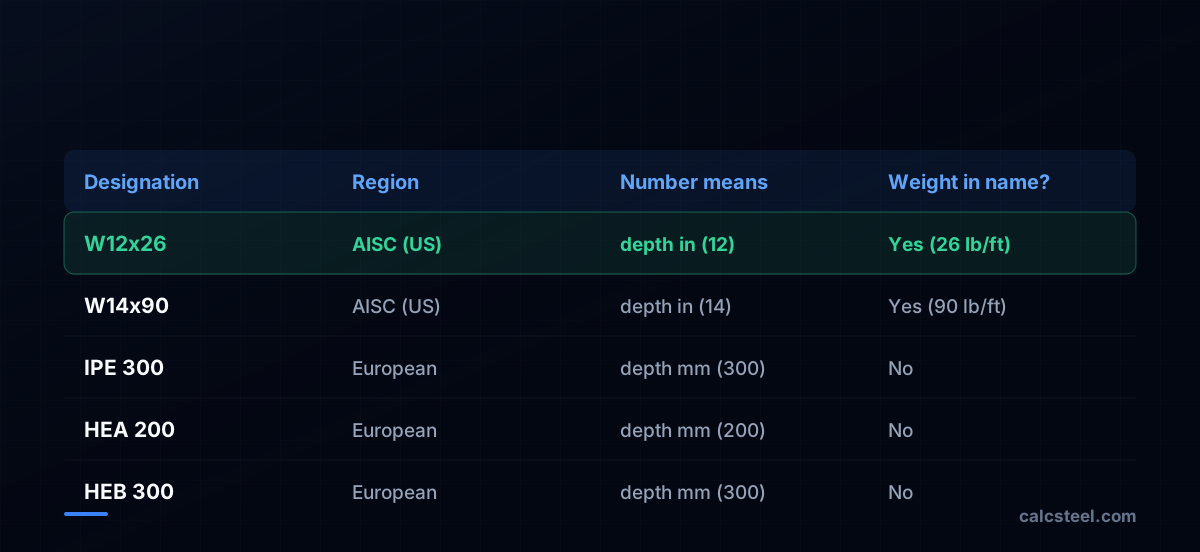
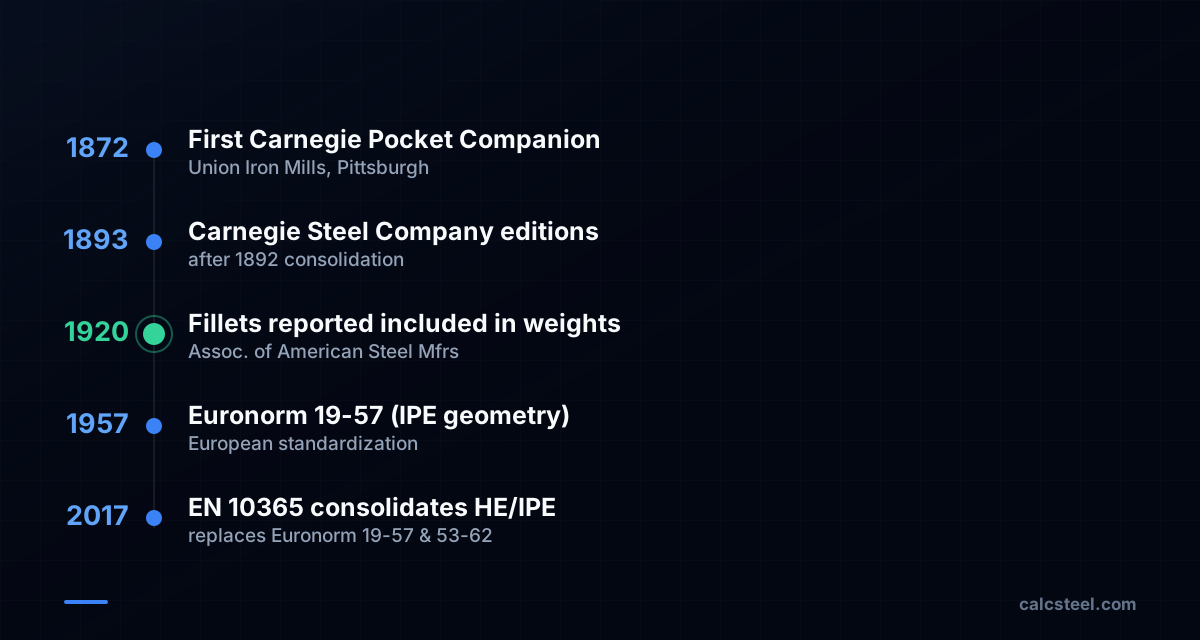
Section tables did not begin as engineering standards, they began as mill catalogues. The first Pocket Companion was compiled by Walter Kappe and issued in 1872 by Carnegie, Kloman & Company, proprietors of the Union Iron Mills in Pittsburgh, listing the dimensions and weights of the shapes that particular mill could roll. New editions followed through the 1870s, 1880s and 1890s, and after the company's 1892 consolidation the book carried the Carnegie Steel Company name.
A pivotal moment came when the industry agreed to standardize how weights were computed: the Association of American Steel Manufacturers is reported to have ruled, effective around 1920, that fillets and rounding be included in the calculation of beam and channel weights. In Europe the same standardizing impulse produced the Euronorm series (Euronorm 19-57 for IPE, Euronorm 53-62 for the HE shapes), later consolidated into EN 10365 (2017). The modern AISC Shapes Database and CalcSteel's library of 1,140+ profiles are the direct digital descendants of those printed tables.
Why your hand calc disagrees with the table
Compute the area of a W-shape as three sharp-cornered rectangles and your weight will come out slightly low. Published values are not idealized, they account for the real geometry of a hot-rolled section, including the root fillet radii where the web meets the flanges and the surface rounding of the rolled corners. That extra metal adds material the textbook rectangle ignores.
The gap is small but real: idealized sharp-corner results are typically within 1-3% on area and roughly 0.5-2% on moment of inertia for standard hot-rolled shapes. Section properties such as area, moment of inertia and section modulus are themselves derived by decomposing the shape and applying the parallel-axis theorem (I = I0 + Ad2). The lesson for everyday work: trust the published nominal mass for ordering and dead load, and reserve the hand calc for custom, built-up or cold-formed shapes that are not in any table.
The verdict: look it up, but know what it means
Weight per metre is the most-used number in steel design and the easiest to take for granted. It is nothing more than density times area, yet it carries 150 years of standardization, from a single Pittsburgh mill's catalogue to globally agreed databases, and it is woven into the very names we give our sections.
The practical takeaway is simple: for any standard rolled shape, read the nominal mass from a trustworthy table rather than re-deriving it, because the table already includes the fillets your hand calc forgets. Use the formula only when you step off the catalogue. CalcSteel is a browser-native structural app, a React/TypeScript front-end with a Python finite-element backend, that ships 1,140+ steel profiles with their nominal masses and full section properties pre-loaded, plus code checks for NBR 8800, AISC 360, Eurocode 3 and IS 800. There is a free plan, and Pro is reported at about US$24/month on the annual cycle. Pick a profile and its weight per metre is already flowing into your model in the editor, no spreadsheet required.
Sources
- 1.Carnegie Steel Company, Pocket Companion (full text, Internet Archive)
- 2.AISC Shapes Database v16.0 and EDI Naming Convention
- 3.EN 10365: The European norm replacing DIN 1025 (Montanstahl)
- 4.Table of material properties for structural steel S235/S275/S355 (density 7850 kg/m3, eurocodeapplied.com)
- 5.Table of properties for IPE, HEA, HEB, HEM profiles (eurocodeapplied.com)
- 6.Steel Weight Calculator (Omni Calculator)
- 7.Image: Miscellaneous Items in High Demand, PPOC, Library of Congress — Public domain (Wikimedia Commons)
Try CalcSteel for free
Model, analyze and design steel structures in your browser. No install, no signup.
Open the 3D editor