NBR 8800 vs AISC 360 vs Eurocode 3: Which Steel Design Standard Should You Use?
NBR 8800, AISC 360, and Eurocode 3 all answer the same question — will this steel member fail? — but they were born in different decades, on different continents, under different philosophies. Understanding where each code came from is the fastest way to pick the right one and to trust the software that automates it.
Key takeaways
- All three codes have converged on limit-state (probabilistic) design, but reached it from different starting points and at different times.
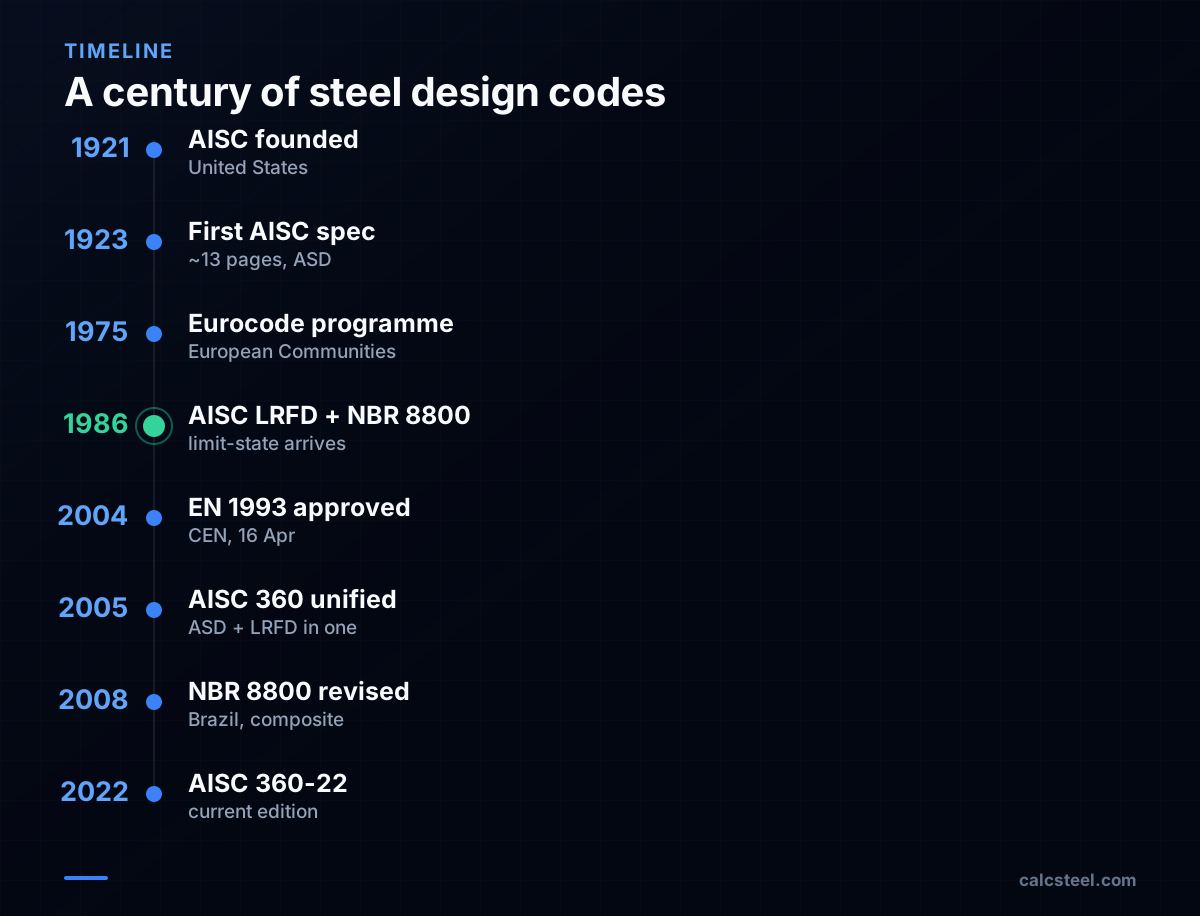
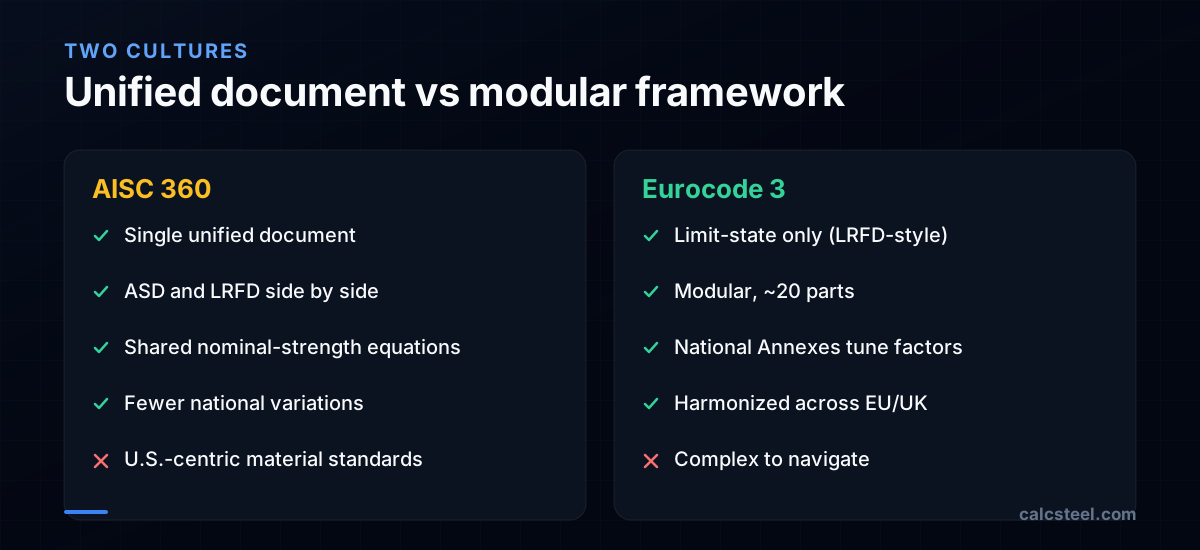
- AISC 360 is the oldest lineage (first U.S. spec 1923) and uniquely keeps both ASD and LRFD in one unified document since the 2005 edition.
- Eurocode 3 grew out of a 1975 European harmonization programme; the definitive EN 1993-1-1 was approved by CEN on 16 April 2004 and published in 2005.
- Pick by jurisdiction first: Brazil uses NBR 8800, the U.S. uses AISC 360, the EU/UK use Eurocode 3 — and the right software automates whichever your project requires.
The question behind the question
Engineers ask which standard should I use as if it were a preference. In practice it is mostly a question of jurisdiction: the building authority that approves your project dictates the code. A warehouse in São Paulo is checked to ABNT NBR 8800, a stadium in Texas to ANSI/AISC 360, and an office block in Frankfurt to EN 1993 (Eurocode 3). India adds a fourth major player, IS 800.
But that is not the whole story. All four codes today share the same intellectual core — limit-state design, where loads are amplified by partial factors and resistances are reduced by them, calibrated against probability of failure. The differences live in the details: buckling curves, resistance factors, and how slenderness, stability, and connections are treated. To choose well, it helps to know how each code grew up.
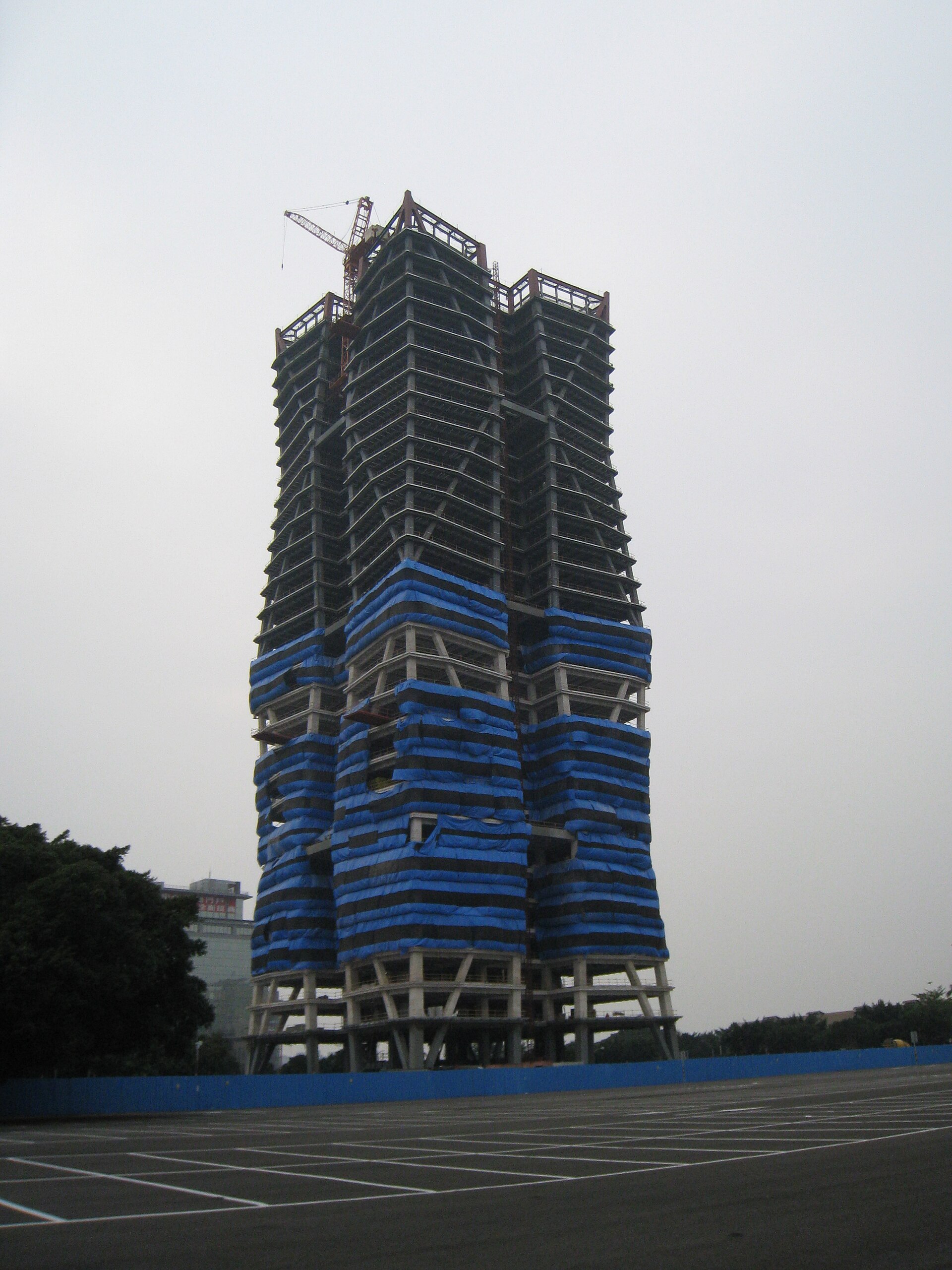
AISC 360: the oldest lineage
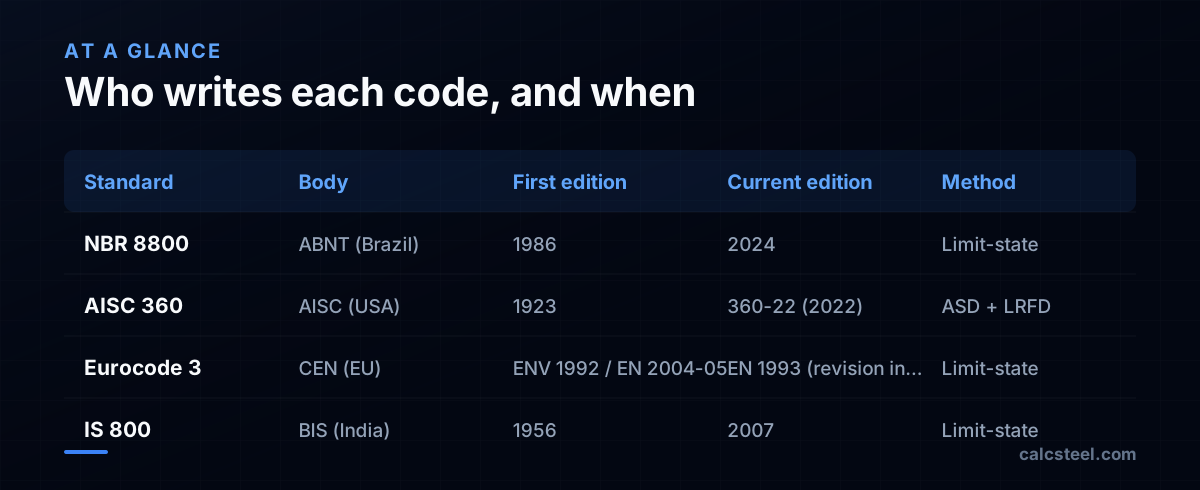
The American Institute of Steel Construction was founded in 1921 and issued the first U.S. structural-steel design code in 1923 — a document reported to be barely more than a dozen pages long (about 13), built entirely on Allowable Stress Design (ASD), where a single safety factor keeps working stresses below a fraction of yield.
ASD ran through nine editions over the following decades. In parallel, AISC introduced Load and Resistance Factor Design (LRFD) in its first 1986 specification, the product of roughly fifteen years of probabilistic research led by T. V. Galambos and colleagues. For two decades the U.S. lived with two competing codes — a headache for designers. AISC's Committee on Specifications resolved it by writing a single unified specification dated 9 March 2005, that contains both ASD and LRFD on a shared set of nominal-strength equations. The current edition, ANSI/AISC 360-22, was published 1 August 2022 and supersedes the 2016 version.
Eurocode 3: the harmonizer
Eurocode 3 is the most ambitious in scope of the three. Its roots go back to 1975, when the Commission of the European Communities launched an action programme to replace divergent national codes with common technical rules, eliminating technical obstacles to trade across member states. A first generation of European codes appeared in the 1980s, followed by ENV pre-standards in the early 1990s (ENV 1993-1-1:1992).
The definitive version, EN 1993-1-1, was approved by the European Committee for Standardization (CEN) on 16 April 2004 and published in 2005, prepared by Technical Committee CEN/TC250 (sub-committee SC3). Eurocode 3 is deliberately modular — split across roughly twenty parts (fatigue, fire, cold-formed, towers, silos, and so on) — and it is paired with National Annexes that let each country tune partial factors and parameters. That flexibility is its strength and its complexity. A second-generation revision of the EN Eurocodes is now under way.
NBR 8800: the pragmatic synthesis
Brazil's ABNT NBR 8800 is a study in pragmatic borrowing. Its first edition, NBR 8800:1986, was a landmark: it replaced the old allowable-stress method with limit-state design and introduced provisions for steel-concrete composite beams just as they were gaining popularity in Brazil.
Rather than reinvent the wheel, the drafters synthesized the best available international work — the 1986 code drew on the contemporary American AISC-LRFD methodology and on European ECCS multiple-buckling-curve concepts, with several annexes (deflections, floor vibration, P-delta effects) reflecting North American practice. A major revision produced NBR 8800:2008, which broadened composite columns, slabs and connections. As of October 2024, ABNT has published a further revision, NBR 8800:2024, which supersedes the 2008 edition. India's IS 800:2007 followed a parallel path, switching from working-stress to limit-state design.
How software automates the check
However the codes differ in pedigree, the computational pattern a design tool follows is remarkably consistent. The software runs a finite-element analysis to get internal forces, builds load combinations per the chosen code, then for every member computes a series of limit-state checks and reports a utilization ratio (demand over capacity).
The code-specific intelligence lives in the resistance formulas:
- Axial buckling — AISC uses its column-curve equations; Eurocode 3 selects a buckling curve (a0–d) by section type; NBR 8800 mirrors the European multi-curve approach.
- Flexure — lateral-torsional buckling and local buckling are checked with each code's own slenderness limits and modification factors.
- Combined forces — interaction equations differ in form but all bound axial-plus-bending demand.
- Factors — resistance and partial factors (φ in AISC LRFD, γ in Eurocode and in NBR 8800) are baked into the code module.
A well-built tool keeps the analysis engine identical and swaps only the verification module, so the same model can be re-checked against a different standard.
The verdict: let the project pick the code
There is no universally best steel code — only the right one for your project's jurisdiction. Use NBR 8800 in Brazil, AISC 360 in the United States, Eurocode 3 across the EU and UK, and IS 800 in India. Because all four now rest on limit-state design, a member that passes one will usually pass the others within a tolerance set by their differing factors and buckling curves — but you must submit calculations to the code your authority recognizes.
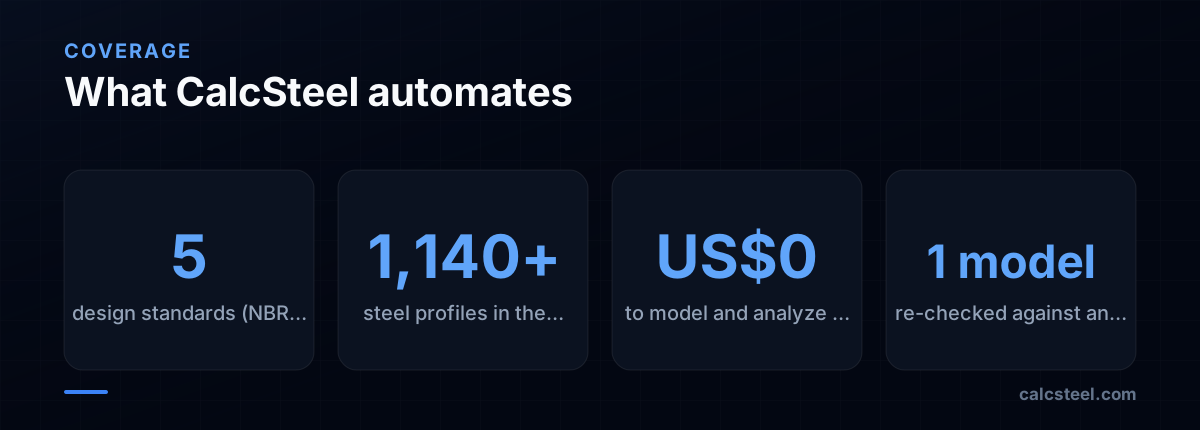
That is exactly why CalcSteel is built code-agnostic: a browser-native app with a React/TypeScript front end and a Python finite-element backend, it carries code checks for NBR 8800, AISC 360, Eurocode 3, AS 4100 and IS 800, plus a library of 1,140+ steel profiles. The free plan covers real modeling and analysis; Pro is US$24/month billed annually when you need exports and more. The honest pitch: model once, verify against the standard your jurisdiction demands. Try it in the editor.
Sources
- 1.AISC — History of the AISC Specification, 1923–2010
- 2.AISC — Releases New Version of Specification for Structural Steel Buildings (ANSI/AISC 360-22)
- 3.AISC — Specification for Structural Steel Buildings, March 9, 2005 (ANSI/AISC 360-05)
- 4.Eurocodes (JRC) — Eurocodes history
- 5.EN 1993-1-1:2005 — Eurocode 3: Design of steel structures (approved by CEN 16 April 2004)
- 6.ResearchGate — The revision of the Brazilian Standard NBR 8800 (design of steel and composite structures)
- 7.Image: Luuva — CC BY-SA 3.0 (Wikimedia Commons)
Try CalcSteel for free
Model, analyze and design steel structures in your browser. No install, no signup.
Open the 3D editor