How much load can a HEB 200 column carry?
"What is the maximum load a HEB 200 column can support?" has no single number — the honest answer is a curve, not a value. The capacity depends on steel grade, the column's length and end restraints, and which design code you trust. This deep-dive traces the engineering concept behind that curve and shows exactly how software turns a section table into a verified capacity.
Key takeaways
- A HEB 200 is a 200 mm deep, 200 mm wide hot-rolled H-section, 61.3 kg/m, with cross-sectional area 7,810 mm² — the starting point for any capacity check.
- Its pure squash load (no buckling) is roughly 1,835 kN in S235 and 2,773 kN in S355 — but a real column buckles long before that as it gets taller.
- The modern buckling formula descends from Euler (1757), refined by the Perry-Robertson (Ayrton-Perry) approach and calibrated by the ECCS column-test campaign behind the European curves around 1970.
- Software like CalcSteel automates the whole chain — section lookup, slenderness, buckling curve, reduction factor — across NBR 8800, AISC 360, Eurocode 3 and IS 800.
A question with no single answer
Asking for the "maximum load" of a HEB 200 column is like asking how far a car can drive on one tank: it depends. A short, stocky HEB 200 stub fails by crushing its own steel. A tall, slender HEB 200 fails by buckling — bowing sideways — at a fraction of that crushing load. So the real answer is a capacity curve that falls as the column gets taller.
Three inputs move the number: the steel grade (S235, S275, S355…), the buckling length (height combined with how the ends are held), and the design code you apply. Get those, and the capacity is deterministic. This article walks the full chain — and shows how a browser tool collapses it into one click.

What a HEB 200 actually is
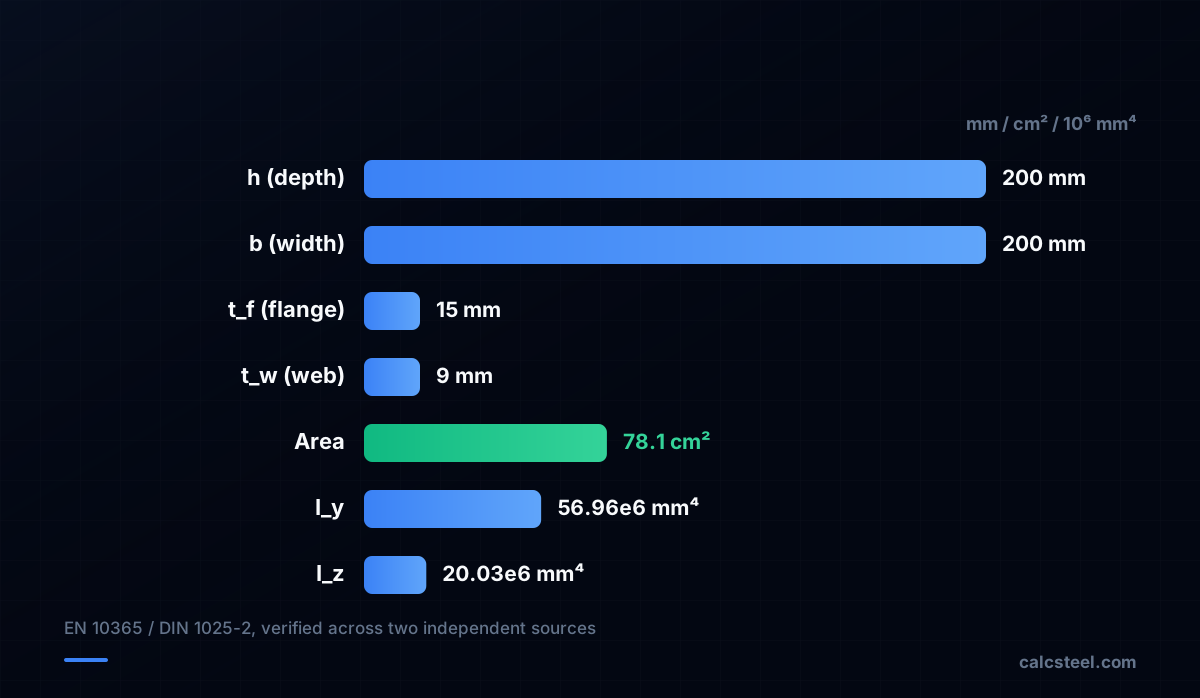
HEB is the wide-flange European "H" series (the "B" denotes the standard, heavier variant versus the lighter HEA). The geometry is fixed by EN 10365 / the older DIN 1025-2. For HEB 200, two independent property tables agree on the core numbers: depth h = 200 mm, width b = 200 mm, web tw = 9 mm, flanges tf = 15 mm.
- Cross-sectional area A = 7,810 mm² (78.1 cm²)
- Mass 61.3 kg/m
- Strong-axis inertia Iy ≈ 56.96 × 10⁶ mm⁴; weak-axis Iz ≈ 20.03 × 10⁶ mm⁴
- Plastic modulus Wpl,y ≈ 642.5 × 10³ mm³
Because the weak-axis inertia is roughly a third of the strong-axis value, a HEB 200 column almost always buckles about its weak (z) axis first — which is exactly where capacity gets decided.
The ceiling: squash load
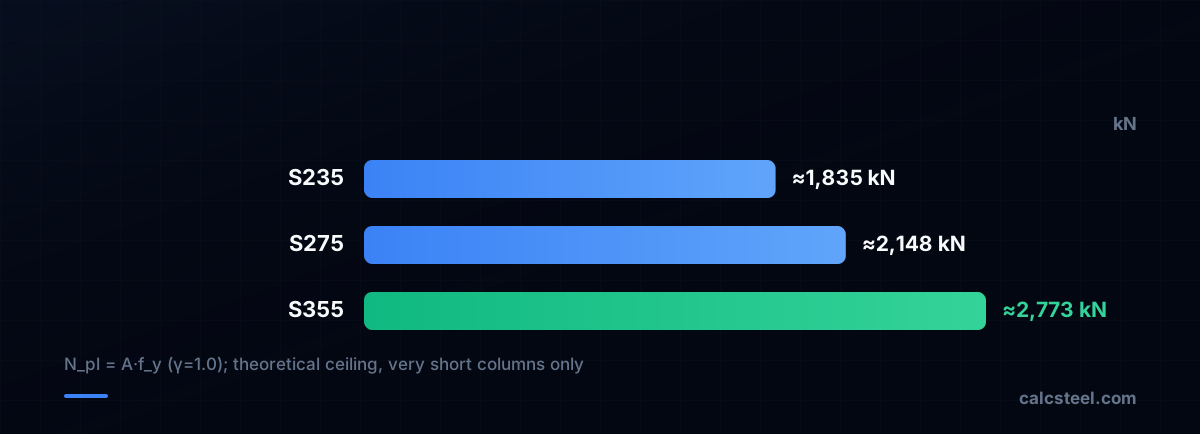
The absolute upper bound is the squash load — the axial force that yields the entire cross-section, ignoring buckling. It is simply area times yield strength: Npl,Rd = A · fy / γM0.
- S235 (fy = 235 MPa): 7,810 × 235 ≈ 1,835 kN
- S275: ≈ 2,148 kN
- S355 (fy = 355 MPa): 7,810 × 355 ≈ 2,773 kN
These are the numbers a very short HEB 200 post (say, under ~0.5 m) approaches. But no practical column is that stubby. The moment you add height, the governing failure switches from yielding to stability — and the headline number drops, sometimes by half or more. That is why quoting the squash load as "the maximum load" is the most common mistake in steel design.
From Euler to the modern buckling curve
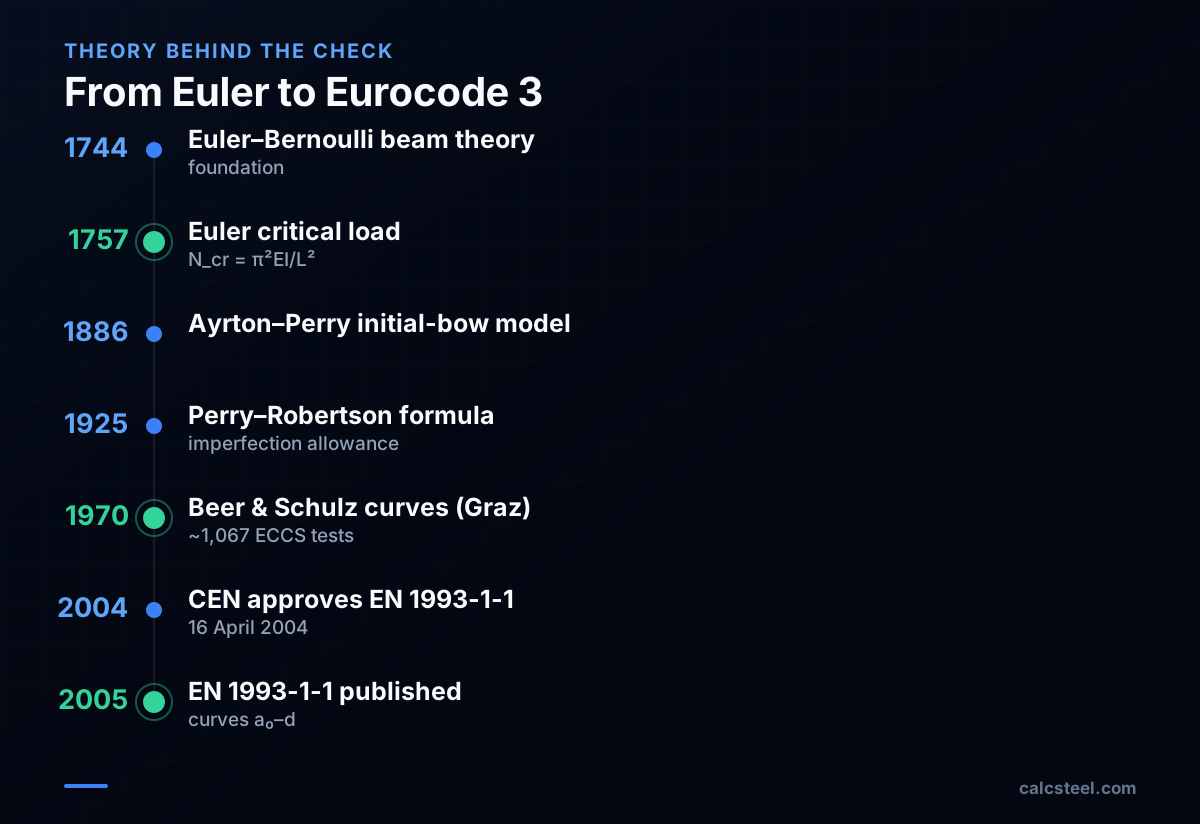
The mathematics is old. In 1757 Leonhard Euler derived the critical load of an ideal, perfectly straight, pin-ended column (published in the Berlin Academy memoirs in 1759): Ncr = π²EI / L². It is elegant and, for real steel, dangerously optimistic — it ignores initial crookedness, residual stresses from rolling, and accidental load eccentricity.
The fix came from the Perry-Robertson formulation (rooted in Ayrton and Perry's 1886 work, and given its experimentally calibrated imperfection values by Robertson around 1925), which models an assumed initial bow and blends Euler's elastic limit with the yield plateau. The decisive empirical calibration was European: the family of buckling curves a₀, a, b, c, d — first proposed by Beer and Schulz of Graz around 1970 — was anchored to a large ECCS test campaign (reported as roughly 1,067 column tests across several countries), each curve carrying a different imperfection factor α.
How software computes the verified capacity
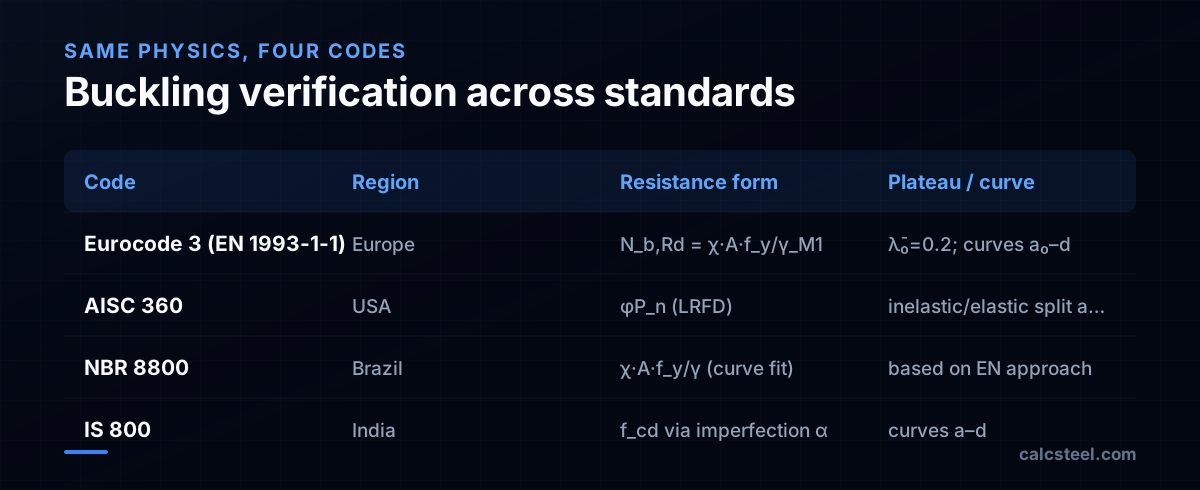
Modern codes wrap this history into a recipe. In EN 1993-1-1:2005 (approved by CEN on 16 April 2004 and published in 2005, superseding the ENV) the buckling resistance is Nb,Rd = χ · A · fy / γM1, where the reduction factor χ ≤ 1 comes from the non-dimensional slenderness λ̄ and the right buckling curve. AISC 360, Brazil's NBR 8800 and India's IS 800 follow the same logic with different curve fits and safety formats.
A program executes this chain automatically:
- Look up the section: A, Iz, radius of gyration iz.
- Compute buckling length Lcr = k·L from the end conditions.
- Form slenderness λ̄ = (Lcr/i) / λ₁, with the plateau at λ̄₀ = 0.2.
- Select the buckling curve (rolled H-section, weak axis, h/b ≤ 1.2 → typically curve c), get α, solve the Perry-Robertson Φ and χ.
- Return Nb,Rd and the utilisation ratio.
The takeaway: the same HEB 200 in S355 might offer ~2,773 kN squashed, but only a fraction of that at 4–6 m unbraced — and only software that walks every step gets it right consistently.
Verdict: the answer is a calculation, not a number
So, the maximum load of a HEB 200 column? Honestly: between roughly 1,835 kN (S235, squash) and a much lower buckling-governed value that depends on your exact height, restraints and code. Anyone who gives you one fixed kN without asking the length and grade is guessing.
That is precisely the chore software exists to remove. CalcSteel is a browser-native structural app — a React/TypeScript front-end over a Python finite-element backend — with 1,140+ steel profiles (HEB 200 included) and built-in code checks for NBR 8800, AISC 360, Eurocode 3, AS 4100 and IS 800. You model the column, set its length and end conditions, pick a grade, and it returns the verified buckling resistance and utilisation — no hand tables. The Free plan covers real work; Pro is reported at US$24/month billed annually. Try it in the editor and let the curve, not a folklore number, give you the answer.
Sources
- 1.HEB 200 (hot rolled) — Steel Section Properties (Structolution)
- 2.Table of properties for IPE/HEA/HEB/HEM profiles — Eurocode 3 (EurocodeApplied)
- 3.Perry–Robertson formula — Wikipedia (Ayrton-Perry 1886, Robertson 1925)
- 4.Euler's critical load — Wikipedia (Euler 1757 / pub. 1759)
- 5.European column buckling curves and finite element modelling (DTU Orbit) — Beer & Schulz 1970, ECCS tests
- 6.Eurocode 3: Design of steel structures — Wikipedia (EN 1993-1-1:2005, CEN approved 16 Apr 2004)
- 7.EC3 Buckling Curves a/b/c/d Explained (SDC Verifier) — weak-axis curve c for hot-rolled H
- 8.Image: w_lemay — CC BY-SA 2.0 (Wikimedia Commons)
Try CalcSteel for free
Model, analyze and design steel structures in your browser. No install, no signup.
Open the 3D editor