Sheet Metal Gauge Chart: Thickness, Weight & Why It's Structural
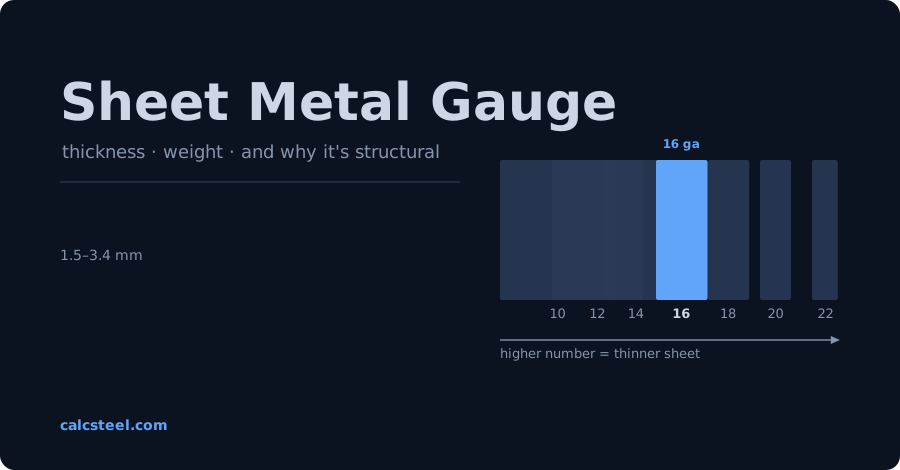
The complete sheet metal gauge chart — thickness and weight for steel, galvanized, stainless and aluminum — plus a live converter and a real FEM study of how gauge decides whether a cold-formed member holds.
Key takeaways
- Gauge is inverse and per-material: a higher number is thinner, and the same 16 gauge is 1.519 mm in steel, 1.613 mm galvanized, 1.588 mm stainless and 1.290 mm aluminum.
- The steps are uneven by design, so gauge is a table lookup, not a formula - except aluminum's AWG, defined by d = 0.005 x 92^((36-n)/39) inches.
- Weight follows thickness directly: w = rho x t, which for steel is 7.85 kg/m2 per millimetre; aluminum weighs about a third as much at the same gauge.
- Always dimension drawings in mm or decimal inches - a gauge number alone is ambiguous across materials and coatings.
- For cold-formed steel, gauge is a structural variable: on a 5 m Ue 150 joist the 16-gauge section never yields but deflects to L/134 and fails serviceability - you must reach 12 gauge to pass, so deflection governs.
- CalcSteel is a deterministic engine, not an AI that guesses: identical inputs always return the same standard-matched numbers, which is what makes them safe to expose through an API and feed to an AI agent, CAD, ERP or spreadsheet - use a language model for language, a deterministic API for the physics.
From a number on a chart to steel that holds
Ask a fabricator, a HVAC installer and an architect what 16 gauge means and you will get three slightly different thicknesses — and none of them is wrong. Gauge is one of the oldest and most stubborn habits in metalworking: a single number that is supposed to tell you how thick a sheet is, except that the same number means something different in steel, in galvanized, in stainless and in aluminum, and it runs backwards so that a bigger number is a thinner sheet. It is a system almost designed to be misread.
This guide is the definitive walkthrough of sheet-metal gauge — what it is, where the backwards scale came from, and the one gauge chart that actually resolves the ambiguity because it keeps every material on its own real standard. There is a live calculator embedded further down that converts any gauge to millimetres, inches and weight as you read.
But we take it one step past every other gauge page on the web. Gauge is not just a purchasing label — for anyone building in cold-formed steel (studs, joists, purlins, decking) the gauge you specify quietly decides whether the member is stiff enough to use. So the second half of this article does something a chart cannot: it takes one real cold-formed joist and runs it through the the CalcSteel finite-element engine at four different gauges, so you can watch the same section pass or fail purely because of a fraction of a millimetre of steel. Every number here was computed by that engine and checked against textbook theory to under one percent.
What sheet-metal gauge actually is
Sheet-metal gauge is a legacy numbering system for the thickness of a metal sheet. The scale is inverse — a higher gauge number is a thinner sheet — and it is not universal: each material grew up with its own gauge standard, so the same gauge number is a different thickness in a different metal.
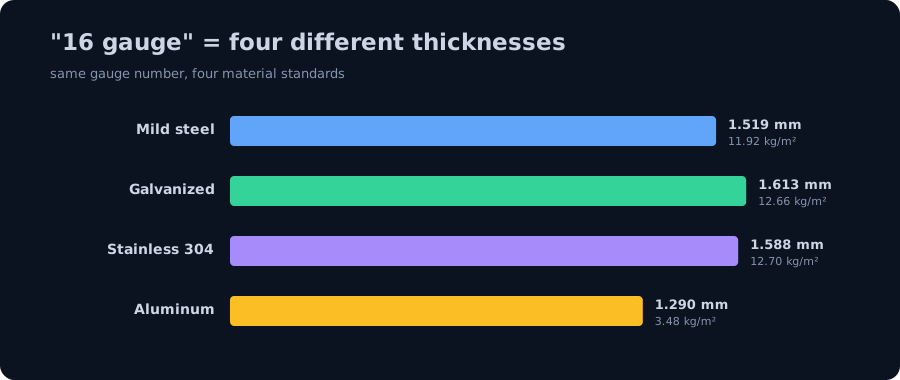
That is the whole idea, and both halves of it trip people up. First the inversion: 10 gauge steel is 3.42 mm thick, while 20 gauge steel is 0.91 mm — nearly four times thinner despite the bigger number. Second the fragmentation: “16 gauge” is 1.519 mm in bare steel, 1.613 mm in galvanized, 1.588 mm in stainless and only 1.290 mm in aluminum. There is no single conversion; there are four.
The practical consequence is that a gauge number on its own is ambiguous. On a drawing, in a purchase order, in a cutting program, the safe move is to state the decimal thickness in millimetres or inches and treat the gauge as a convenience label. This is exactly what the chart and calculator below are built to do: you pick the gauge you know, and you read off the number a CNC, a press brake or a structural check can actually use.
Why a higher gauge number means a thinner sheet
The backwards scale is not arbitrary — it is a fossil of how sheet was originally made. In the 19th-century wire and sheet mills, the gauge number counted the number of drawing or rolling passes a piece had been through. Each pass squeezed the metal thinner, so more passes meant a higher number and a thinner product. The count stuck; the logic behind it did not survive into modern rolling.
That origin also explains the second oddity: the steps between gauges are uneven. Going from 10 to 11 gauge steel drops the thickness by about 0.31 mm; going from 24 to 25 gauge drops it by about 0.08 mm. The ladder is not a neat decimal progression, which is precisely why gauge has to be read from a table and cannot be reduced to a single tidy formula (the one clean exception is aluminum, whose AWG scale is defined by the geometric law d = 0.005 · 92(36−n)/39 inches).
The nominal-weight basis is the other piece worth knowing. Uncoated steel gauge is fixed by the Manufacturers’ Standard Gauge, defined so that one gauge point corresponds to a nominal 41.82 lb/ft² per inch of thickness. That is why steel gauge thicknesses look like the slightly irregular decimals they are, and why they differ from the galvanized and stainless ladders that were standardized against different references.
The sheet metal gauge chart (steel)
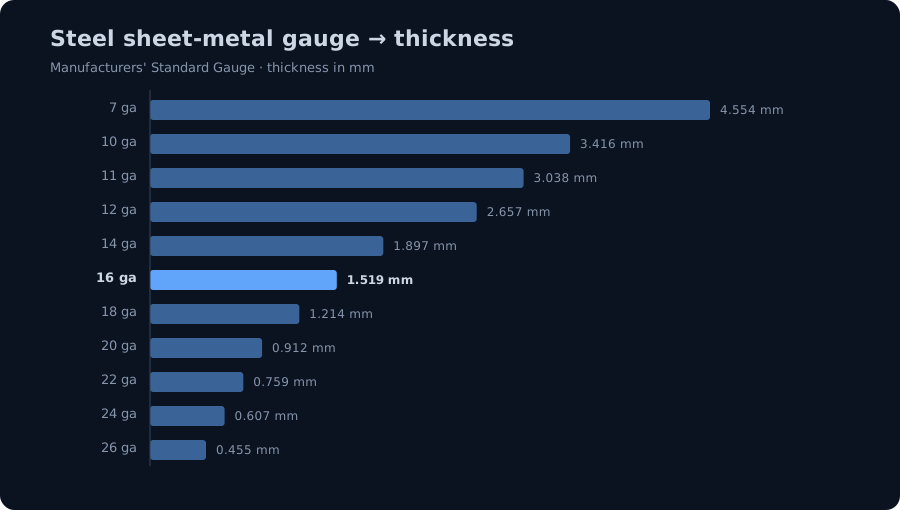
Here is the reference chart for uncoated mild / carbon steel on the Manufacturers’ Standard Gauge, with the thickness in both inches and millimetres and the weight per square metre. These are the exact values the calculator below uses, so the chart and the tool agree to the last digit.
| Gauge | Thickness (in) | Thickness (mm) | Weight (kg/m²) | Weight (lb/ft²) |
|---|---|---|---|---|
| 7 | 0.1793 | 4.554 | 35.75 | 7.32 |
| 10 | 0.1345 | 3.416 | 26.82 | 5.49 |
| 11 | 0.1196 | 3.038 | 23.85 | 4.88 |
| 12 | 0.1046 | 2.657 | 20.86 | 4.27 |
| 14 | 0.0747 | 1.897 | 14.89 | 3.05 |
| 16 | 0.0598 | 1.519 | 11.92 | 2.44 |
| 18 | 0.0478 | 1.214 | 9.53 | 1.95 |
| 20 | 0.0359 | 0.912 | 7.16 | 1.47 |
| 22 | 0.0299 | 0.759 | 5.96 | 1.22 |
| 24 | 0.0239 | 0.607 | 4.77 | 0.98 |
| 26 | 0.0179 | 0.455 | 3.57 | 0.73 |
A few landmarks worth memorizing: 16 gauge (1.52 mm) is the general-fabrication workhorse and the most-searched gauge of all; 10-12 gauge (3.4-2.7 mm) is structural sheet and heavy bracket territory; and 22-26 gauge (0.76-0.46 mm) is the roofing, flashing and light-duct range. The full ladder from 3 to 36 gauge, plus galvanized, stainless and aluminum, is live in the calculator further down.
Why “16 gauge” is four different thicknesses
This is the single most expensive misunderstanding about gauge, so it earns its own section. Search “16 gauge in mm” and you will get several answers — all correct, for different materials — because each metal is on a different standard. Uncoated steel uses the Manufacturers’ Standard Gauge; galvanized steel uses the Galvanized Sheet Gauge, which is thicker because the number includes the zinc coating; stainless uses a fraction-of-inch Stainless Steel Gauge; and aluminum, brass and copper use the American Wire Gauge (AWG). Here is 16 gauge on each:
| Material | Standard | 16 ga (in) | 16 ga (mm) | Weight |
|---|---|---|---|---|
| Mild / carbon steel | Manufacturers’ Standard | 0.0598 | 1.519 mm | 11.92 kg/m² |
| Galvanized steel | Galvanized Sheet Gauge | 0.0635 | 1.613 mm | 12.66 kg/m² |
| Stainless steel 304 | Stainless Steel Gauge | 0.0625 | 1.588 mm | 12.70 kg/m² |
| Aluminum (6061 / 3003) | AWG (Brown & Sharpe) | 0.0508 | 1.290 mm | 3.48 kg/m² |
From bare steel to galvanized is a 6 % jump in thickness; from galvanized down to aluminum is a 20 % drop. A “16 gauge bracket” is therefore 1.29 mm of aluminum or 1.61 mm of galvanized steel depending on nothing more than which metal it is cut from. And because roofing and ductwork are usually galvanized, and architectural work is often stainless or aluminum, this trap shows up constantly on real jobs. The calculator below shows all four bars side by side for any gauge — pick 16 and watch them separate.
From gauge to weight per square metre
Once you have the thickness, weight per unit area is elementary — it depends only on thickness and density, never on the sheet’s length or width:
w = ρ · t → Weight (kg/m²) = ρ (kg/m³) × t (mm) ÷ 1000
For carbon steel (ρ = 7850 kg/m³) that collapses to a rule worth memorizing: 7.85 kg/m² per millimetre of thickness. So 16 ga steel at 1.519 mm weighs 7.85 × 1.519 = 11.92 kg/m² (2.44 lb/ft²). The densities the calculator uses are 7850 kg/m³ for carbon and galvanized steel, 8000 kg/m³ for stainless (about 2 % heavier) and 2700 kg/m³ for aluminum — roughly one third of steel, which is the whole reason aluminum is chosen for skins, panels and ductwork where weight matters.
A worked total: a standard 1.2 m × 2.4 m sheet (2.88 m²) of 16 ga steel weighs 11.92 × 2.88 = 34.3 kg; the same sheet in 16 ga aluminum weighs only 3.48 × 2.88 = 10.0 kg. Same gauge, same footprint, less than a third of the mass.
Reverse: a micrometer reading back to a gauge
In the shop you often have the opposite problem — you miked a mystery sheet at, say, 1.60 mm and need to know what gauge to order. Because the steps are uneven and material-specific, “nearest gauge” is a lookup, not a formula. The Reverse field in the calculator does exactly that: type a measured thickness and it returns the closest gauge in the currently selected material, plus the signed percentage difference so you can judge the fit.
For example, 1.60 mm against the galvanized table lands on 16 ga (1.613 mm, +0.8 %) — an excellent match. The very same 1.60 mm against the bare-steel table sits between 16 ga (1.519 mm) and 15 ga (1.709 mm), nearest 16 ga at −5.1 %. This is the moment the material-specific tables earn their keep: the right answer depends on which metal you are holding.
Mill rolling tolerances matter here too. Sheet is delivered to a thickness band, not an exact number, so a micrometer reading a couple of percent off the book value is normal and does not mean you have the wrong gauge.
Gauge vs. metric thickness — which to specify
Most of the world outside North America simply orders sheet by its metric thickness (0.8, 1.0, 1.2, 1.5, 2.0, 3.0 mm …), and modern drawings increasingly do the same even where gauge is spoken day to day. The reasons are practical:
- No ambiguity. “1.5 mm CRS” means exactly one thing; “16 gauge” means four things depending on material and coating.
- CAD and CAM want a number. Press-brake bend deductions, laser-cut parameters and nesting all run on the decimal thickness — the gauge label gets translated to it anyway.
- Cross-material design. If you swap aluminum for steel to save weight, matching the thickness (for stiffness) is a different decision from matching the gauge, and only the decimal makes that explicit.
The pragmatic workflow: think in gauge, buy in gauge, but dimension in millimetres or decimal inches. That hand-off — from the gauge you know to the exact number the next step needs — is precisely what the tool below is built for.
Does gauge actually matter structurally?
For a bracket or a duct, gauge is about stiffness-in-the-hand and dent resistance. But an enormous amount of real steel is cold-formed — wall studs, floor joists, roof purlins and steel deck are all just sheet that has been roll-formed into a shape. There the gauge is the wall thickness of a structural member, and it drives the two quantities that decide whether the member works: the section modulus (which sets bending stress) and the moment of inertia (which sets deflection).
Both scale hard with thickness. Take a lipped C-channel — a Ue 150×60×20 section, one of the most common cold-formed joist and purlin shapes — and roll it from four different sheet gauges. Only the gauge changes; the outside dimensions are identical. Here is what that does to the section itself:
| Gauge | Thickness | Self-weight | Ix (cm⁴) | Wx (cm³) |
|---|---|---|---|---|
| 16 ga | 1.50 mm | 3.60 kg/m | 163 | 21.8 |
| 14 ga | 2.00 mm | 4.77 kg/m | 215 | 28.7 |
| 12 ga | 2.66 mm | 6.31 kg/m | 282 | 37.6 |
| 10 ga | 3.35 mm | 7.89 kg/m | 349 | 46.5 |
Going from 16 to 10 gauge — roughly 1.85 mm more steel — more than doubles both the stiffness (Ix: 163 → 349 cm⁴) and the bending capacity (Wx: 21.8 → 46.5 cm³), while the weight only rises from 3.6 to 7.9 kg/m. (These section properties are the ones the CalcSteel engine computes for the NBR 6355 profile catalog; the roll-formed library snaps to standard mill thicknesses of 1.5, 2.0, 2.66 and 3.35 mm — the nearest real steel to 16, 14, 12 and 10 gauge.) The question is what that means for an actual span — so let’s load it.
The gauge study: one joist, four gauges, real FEM
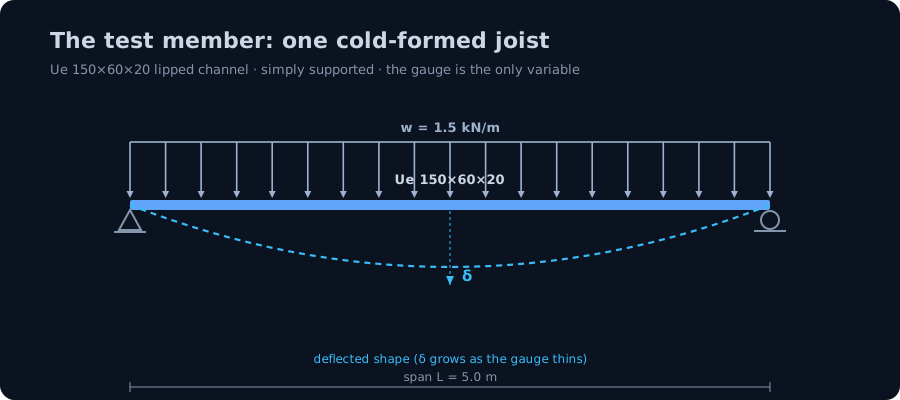
Here is the experiment, run in the shipping the CalcSteel finite-element engine. The member is that same Ue 150×60×20 lipped channel in ZAR 250 steel (fy = 250 MPa), on a single simply-supported span of L = 5.0 m, carrying a service load of w = 1.5 kN/m — a realistic case for a cold-formed joist at 600 mm centres under a light floor. The applied load is identical for every run; the only thing that changes is the gauge. The engine’s bending moment matched the hand value wL²/8 = 4.69 kN·m and its mid-span deflection matched 5wL⁴/384EI to under 1 %.
| Gauge (t) | Moment | Bending stress σ | Deflection | vs L/180 |
|---|---|---|---|---|
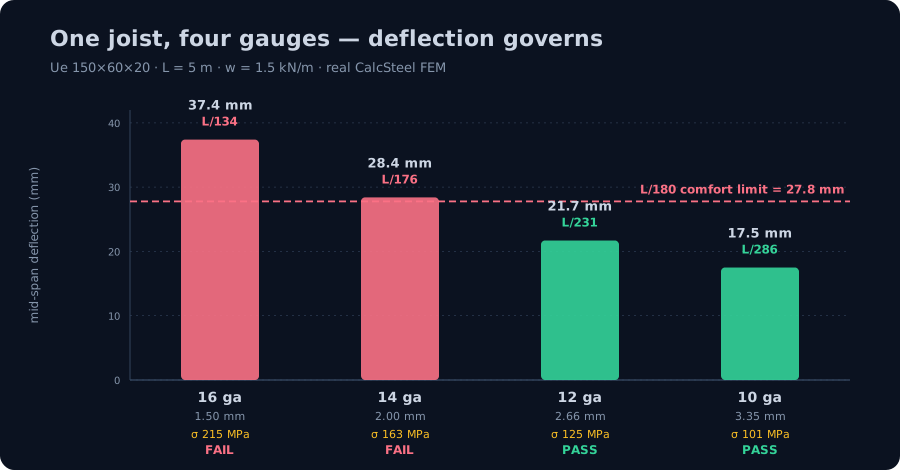
| 16 ga (1.50 mm) | 4.69 kN·m | 215 MPa · 0.86 fy | 37.4 mm · L/134 | FAILS |
| 14 ga (2.00 mm) | 4.69 kN·m | 163 MPa · 0.65 fy | 28.4 mm · L/176 | fails (just) |
| 12 ga (2.66 mm) | 4.69 kN·m | 125 MPa · 0.50 fy | 21.7 mm · L/231 | passes |
| 10 ga (3.35 mm) | 4.69 kN·m | 101 MPa · 0.40 fy | 17.5 mm · L/286 | passes comfortably |
Read the moment column first: it never changes. The demand on the beam is fixed by the load and the span, not by the section — 4.69 kN·m every time. What changes is the member’s response. At 16 gauge the bending stress is 215 MPa, comfortably below the 250 MPa yield, so on strength alone the section looks fine. But the deflection is 37.4 mm — a span-to-deflection ratio of only L/134, well past the L/180 comfort limit a floor is usually held to. The joist would not break; it would bounce.
Now walk up the gauges. 14 gauge is still a hair outside the limit at L/176. It is not until 12 gauge — just about 1.1 mm more steel than 16 gauge — that the joist comfortably satisfies both strength and deflection, at L/231. That is the entire point of the article in one row of a table: the gauge you pick is a structural decision, and here it was decided by deflection, not by strength.
Why cold-formed design is usually deflection-governed
The result above is not a fluke of the numbers chosen — it is the normal behaviour of thin cold-formed steel, and it is worth understanding so you can anticipate it. Deflection scales with 1/I, and for a thin sheet the moment of inertia grows fast with thickness; but capacity also has to reckon with something a solid rolled beam mostly ignores: local buckling. A 16-gauge web on a 150 mm channel has a width-to-thickness ratio of about 100, slender enough that the compression zone can ripple and buckle locally before the whole section yields.
Design codes (AISI S100, Eurocode 3 Part 1-3, and NBR 14762 in Brazil) handle this with an effective width method: the buckled parts of the section are discounted, so a thin gauge is penalized twice — less material and a reduced effective section. The gross-section stresses in our table are therefore the optimistic case; the full effective-section check that CalcSteel runs is stricter still on the thinnest gauge, which only sharpens the conclusion. When someone asks “can I drop from 12 to 14 gauge to save cost?”, the honest answer is almost always check the deflection and the effective section first, not the yield stress.
The takeaway for specification is simple: for cold-formed members, gauge is not a finish detail you can shave to trim a budget — it is a primary structural variable, and a change of one or two gauges can move a member from working to failing without ever getting near the yield stress.
Deterministic by design: an engine, not a guess
Sheet-metal gauge is a domain where a plausible-but-wrong answer costs real money. Ask a general-purpose chatbot “how thick is 16 gauge galvanized in mm?” and you might get 1.5, 1.52 or 1.61 mm on different days — each is a real number for some material, but a large language model interpolates from text; it does not look up the governing standard. That variability is fine for prose and dangerous for a cut list.
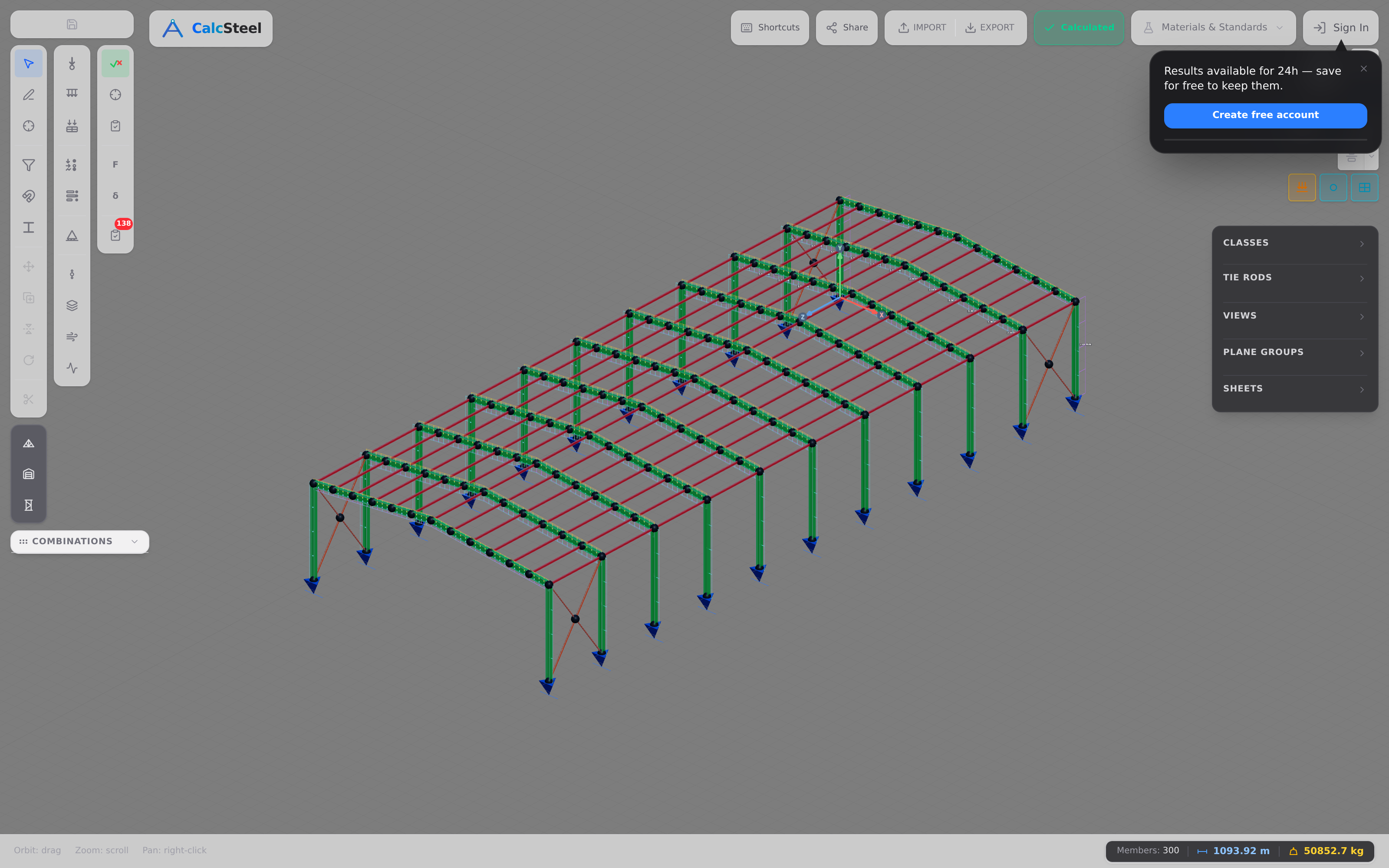
CalcSteel is built the other way round. Every number in this article — the gauge tables, the weight rule, the four-gauge FEM study — comes from a deterministic heuristic and finite-element engine: the same inputs always return the same output, matched to the published mill standard to the last digit and cross-checked against closed-form theory. It is not a model that estimates; it is an engine that computes. Run it a thousand times and you get one answer.
That reproducibility is exactly what makes the numbers safe to build on — and it is the whole argument for pulling engineering data through an API rather than a chat prompt. A deterministic endpoint can feed a whole platform the same ground truth: an AI agent that needs real thicknesses instead of hallucinated ones, a CAD or BIM pipeline that auto-fills bend deductions, an ERP that costs a nesting, or a spreadsheet a detailer actually trusts. The CalcSteel REST API exposes the same profiles, design standards and structural analysis behind this page for exactly that reason.
The pattern generalizes well beyond gauge. Let the AI do what it is good at — reading intent, drafting, explaining — but let a deterministic API own the physics. Ask the model what you want; ask the engine what is true. Pair the two and you get automation you can sign off on; use the language model alone for the numbers and you are back to four different thicknesses.
Convert any gauge yourself: the live calculator
Here is the full converter, live and embedded on this page. Pick a material — mild steel, galvanized, stainless or aluminum — choose a gauge with the dropdown or the +/− stepper, and read the exact thickness in millimetres and inches and the weight in kg/m² and lb/ft². Type a measured thickness into the Reverse field to go the other way, and watch the side-by-side panel show the same gauge across all four materials at once.
It is the real tool, not a teaser: every value matches the published mill standards to the last digit, and it is completely free with no login. If it opens in its own tab, here is the direct link to the sheet metal gauge calculator. When you want to take the next step and see what a gauge does under load, the steel weight calculator and the free CalcSteel 3D editor pick up where the chart leaves off.
Uncoated cold- or hot-rolled sheet steel. Nominal weight basis 41.82 lb/ft²·in.
Thickness
1.519 mm
0.0598 in
Weight / area
11.92 kg/m²
2.442 lb/ft²
Reverse — thickness → nearest gauge
Δ% is how far the standard gauge sits from your measured thickness — useful when a mic reads between two gauges. Click the gauge to load it above.
Weight per area — w = ρ · t
t = 0.0598 in × 25.4 = 1.519 mm
w = ρ · t = 7,850 kg/m³ × 1.519 mm ÷ 1000 = 11.92 kg/m²
= 11.92 × 0.204816 = 2.442 lb/ft²
16 gauge across all four materials
same number → different thicknessA 16 ga part is 1.519 mm in steel but 1.613 mm galvanized and only 1.290 mm in aluminum — never mix gauge numbers across materials on a drawing. Specify the thickness in mm/in when it matters.
Export — free, no login
Take the numbers with you: a copy-ready spec for 16 ga Steel, or the whole gauge table as CSV (both unit systems in the file).
Send this gauge into an engine
The thickness you picked feeds a real weight/BOM engine — not just a related link.
Open in Steel Weight Calculator1 m² coupon · Steel · 1.519 mm pre-loadedCold-formed sections built from ≈ this gauge (matched against 418 cold-formed catalog sections)
Cold-formed local buckling — effective width
NBR 14762 · AISI S100A capability a plain converter can’t have: how wide can a flat element of this 1.519 mm sheet be before it buckles locally? Winter’s effective-width method, λ = (1.052/√k)·(b/t)·√(fy/E).
Slenderness λ
0.979
Factor ρ
0.792
Effective width bₑ
63.3 mm
Full-effective ≤
55 mm
A 80 mm flat at this gauge is slender (b/t = 52.7, λ = 0.98 > 0.673): only 63 mm is structurally effective. Keep flats below 55 mm for full effectiveness, or add a stiffening lip.
Mild / carbon steel — full gauge table (Manufacturers' Standard Gauge)
| Gauge | in | mm | kg/m² | lb/ft² |
|---|---|---|---|---|
| 3 ga | 0.2391 | 6.073 | 47.67 | 9.764 |
| 4 ga | 0.2242 | 5.695 | 44.7 | 9.156 |
| 5 ga | 0.2092 | 5.314 | 41.71 | 8.543 |
| 6 ga | 0.1943 | 4.935 | 38.74 | 7.935 |
| 7 ga | 0.1793 | 4.554 | 35.75 | 7.322 |
| 8 ga | 0.1644 | 4.176 | 32.78 | 6.714 |
| 9 ga | 0.1495 | 3.797 | 29.81 | 6.105 |
| 10 ga | 0.1345 | 3.416 | 26.82 | 5.493 |
| 11 ga | 0.1196 | 3.038 | 23.85 | 4.884 |
| 12 ga | 0.1046 | 2.657 | 20.86 | 4.272 |
| 13 ga | 0.0897 | 2.278 | 17.89 | 3.663 |
| 14 ga | 0.0747 | 1.897 | 14.89 | 3.051 |
| 15 ga | 0.0673 | 1.709 | 13.42 | 2.748 |
| 16 ga | 0.0598 | 1.519 | 11.92 | 2.442 |
| 17 ga | 0.0538 | 1.367 | 10.73 | 2.197 |
| 18 ga | 0.0478 | 1.214 | 9.53 | 1.952 |
| 19 ga | 0.0418 | 1.062 | 8.33 | 1.707 |
| 20 ga | 0.0359 | 0.912 | 7.16 | 1.466 |
| 21 ga | 0.0329 | 0.836 | 6.56 | 1.344 |
| 22 ga | 0.0299 | 0.759 | 5.96 | 1.221 |
| 23 ga | 0.0269 | 0.683 | 5.36 | 1.099 |
| 24 ga | 0.0239 | 0.607 | 4.77 | 0.976 |
| 25 ga | 0.0209 | 0.531 | 4.17 | 0.854 |
| 26 ga | 0.0179 | 0.455 | 3.57 | 0.731 |
| 27 ga | 0.0164 | 0.417 | 3.27 | 0.67 |
| 28 ga | 0.0149 | 0.378 | 2.97 | 0.608 |
| 29 ga | 0.0135 | 0.343 | 2.69 | 0.551 |
| 30 ga | 0.012 | 0.305 | 2.39 | 0.49 |
| 31 ga | 0.0105 | 0.267 | 2.09 | 0.429 |
| 32 ga | 0.0097 | 0.246 | 1.93 | 0.396 |
| 33 ga | 0.009 | 0.229 | 1.79 | 0.368 |
| 34 ga | 0.0082 | 0.208 | 1.63 | 0.335 |
| 35 ga | 0.0075 | 0.19 | 1.5 | 0.306 |
| 36 ga | 0.0067 | 0.17 | 1.34 | 0.274 |
Click any row to select it. Weights use ρ = 7,850 kg/m³. Toggle SI/Imperial above.
Common gauges and where they show up
A rough field guide to the gauges you will actually meet (steel thicknesses shown — remember the same number is thinner in aluminum and thicker in galvanized):
- 7-10 ga (4.6-3.4 mm): structural sheet, heavy brackets, trailer decks, base plates for light framing, cold-formed members on longer spans.
- 11-14 ga (3.0-1.9 mm): machine guards, enclosures, shelving, heavier HVAC plenums, studs and joists that must not deflect.
- 16 ga (1.52 mm): the workhorse — brackets, electrical boxes, automotive panels, general fabrication, light framing.
- 18-20 ga (1.21-0.91 mm): appliance panels, HVAC ductwork, light enclosures, decorative stainless.
- 22-26 ga (0.76-0.46 mm): roofing and siding, flashing, residential ductwork, light galvanized work.
Because roofing and ductwork are so often galvanized and architectural work so often stainless or aluminum, the “same gauge, different metal” trap is a daily reality, not a textbook curiosity. Confirm the actual thickness before you cut — and if the sheet is going to carry load, confirm the section, too.
Key takeaways
Gauge is a habit worth keeping and a trap worth naming. Here is what to carry away.
- The scale is inverse and per-material. A higher number is a thinner sheet, and the same gauge is a different thickness in steel, galvanized, stainless and aluminum — 16 gauge alone spans 1.29 to 1.61 mm.
- Gauge is a lookup, not a formula. The steps are uneven by design; read the chart or the calculator. Aluminum’s AWG is the one clean geometric exception.
- Weight follows thickness directly. w = ρt gives 7.85 kg/m² per mm for steel; aluminum at the same gauge weighs about a third as much.
- Specify the decimal. Think and buy in gauge, but dimension drawings in mm or decimal inches so a CNC, a press brake or a structural check has one unambiguous number.
- For cold-formed steel, gauge is structural. On a 5 m Ue 150 joist, the 16-gauge section never yields yet deflects to L/134 and fails serviceability; you have to climb to 12 gauge to pass. Deflection, not strength, decided the gauge — a call only a section-level check can make.
Sources
- 1.ASTM A480/A480M - General Requirements for Flat-Rolled Stainless and Heat-Resisting Steel
- 2.Manufacturers' Standard Gauge for Sheet Steel (nominal 41.82 lb/ft2-in) - engineering reference
- 3.AISI S100 - North American Specification for the Design of Cold-Formed Steel Structural Members
- 4.ABNT NBR 6355 - Perfis estruturais de aco formados a frio (cold-formed steel profiles)
Try CalcSteel for free
Model, analyze and design steel structures in your browser. No install, no signup.
Open the 3D editor