Mix IS 800 and AISC 360 Profiles in One Project
Steel does not care which country wrote your design code, but your design code very much cares which steel you feed it. IS 800 and AISC 360 grew up on opposite sides of the planet with different units, different naming, and different safety philosophies. This deep-dive traces where each code came from and explains exactly what happens, mathematically, when you mix their profiles in one project.
Key takeaways
- A profile from any catalogue is just geometry plus material - it can live in any model. The code you verify against is a separate choice.
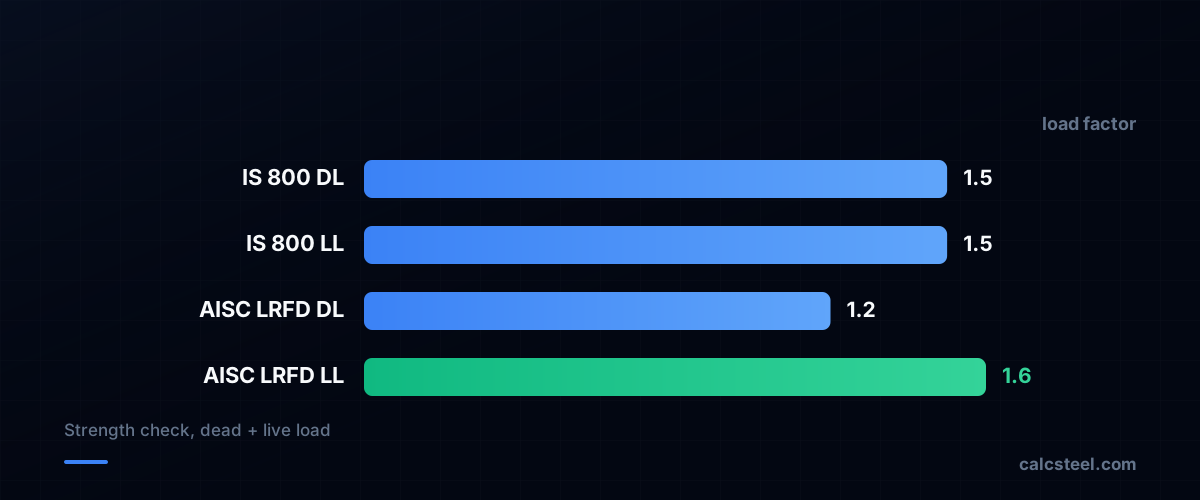
- IS 800:2007 uses a single limit-state method with a 1.5 load factor on dead and live load; AISC 360 offers LRFD (1.2D + 1.6L) and ASD side by side.
- The danger of mixing is never the section table - it is applying one code's safety factors and stability rules to a member, then checking it against the other code's limits.
- CalcSteel keeps geometry universal but runs the verification per the code you select, so an ISMB and a W-shape can coexist in one model.
Two codes born a continent and decades apart
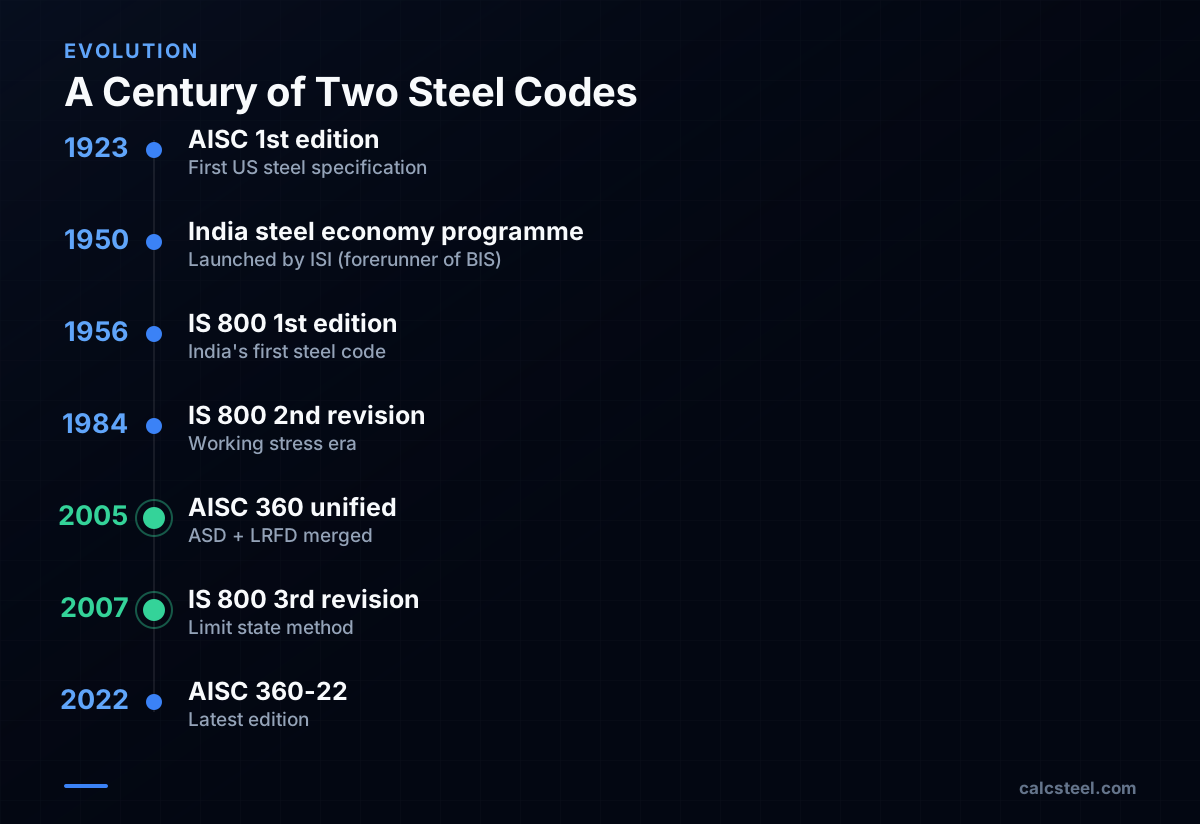
The American steel specification is the elder. The American Institute of Steel Construction published its first edition in 1923 - a modest 13-page document adopted on 1 June 1923 - and it has evolved continuously ever since, a lineage AISC itself frames as a century of practice. For most of that history the US used Allowable Stress Design (ASD), then added Load and Resistance Factor Design (LRFD) as a separate, reliability-based track in the 1980s.
India's story starts later but moves with purpose. The Indian Standards Institution - the forerunner of today's Bureau of Indian Standards - launched a steel economy programme in 1950 to use structural steel rationally, and IS 800 first appeared in 1956 as the first standard under that programme. It was revised in 1962, again in 1984, and most importantly in 2007 as the third revision - the version still in force today.
So when you put an ISMB next to a W-shape, you are really putting two engineering cultures, decades apart, into the same file.
The same goal, two safety philosophies
Here is the heart of the matter. IS 800:2007 is built on the limit-state method: you amplify loads by partial factors and reduce material strength by partial factors, then prove the factored demand stays below the factored capacity. For the basic strength combination, IS 800 applies a partial factor of 1.5 on both dead load and live load, and a material partial factor of 1.10 (γm0) on yielding.
AISC 360 hosts two methods in one book. Since the landmark 2005 unified specification - the first edition to give ASD and LRFD equal treatment - the document presents both together. In LRFD, the closest cousin to limit-state design, the governing gravity combination is 1.2D + 1.6L: a smaller factor on the well-known dead load and a larger one on the more uncertain live load.
Both approaches deliver safe structures. But the numbers are not interchangeable. Apply IS 800's flat 1.5 to a member, then judge it against AISC's resistance equations, and you are no longer following either code.
Different labels, different rulers
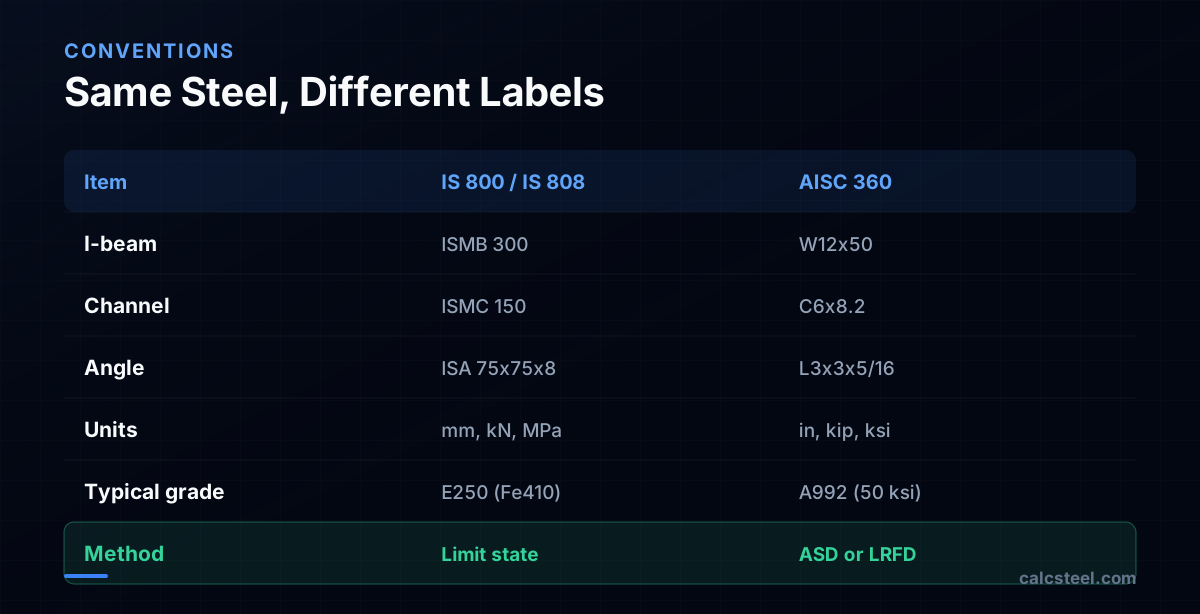
The two ecosystems even name steel differently. India catalogues hot-rolled section dimensions in IS 808: ISMB beams, ISMC channels, ISA angles, all in millimetres. A drawing reads ISMB 300 - a 300 mm deep beam. The US labels a wide-flange as W12x50 - roughly 12 inches deep at 50 pounds per foot.
The sections are genuinely different, not just relabelled. An ISMB 300 and a W12x50 sit at similar depth, yet the ISMB has a much narrower flange and weighs far less per metre - the Indian series tends to be slimmer in the flange than its AISC counterpart of similar depth.
- Units: IS works in mm, kN and MPa; AISC in inches, kips and ksi.
- Grades: India's common structural grade is E250 / Fe410 (per IS 2062); the US wide-flange default is A992 at 50 ksi.
- Notation: Indian drawings spell out the full series; US drawings use the depth-and-weight shorthand.
None of this blocks coexistence - it just means a tool has to normalize geometry and units before it can compute anything.
What actually mixes - and what must not
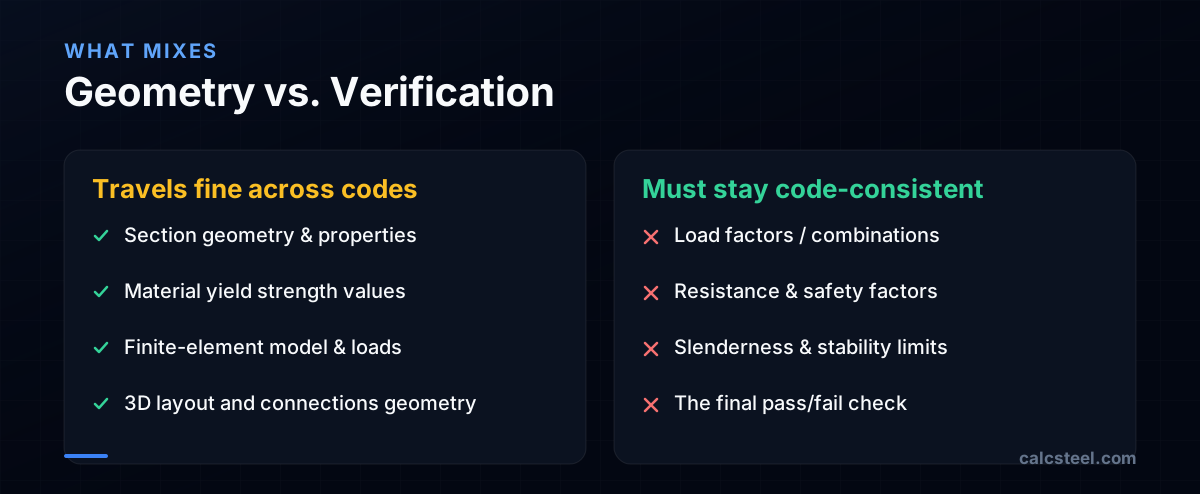
The key insight: a profile is just geometry plus a material. Area, moment of inertia, section modulus, radius of gyration - those numbers are physics, not nationality. An ISMB cross-section has the same second moment of area whether a US or Indian engineer is looking at it. So the geometry of any catalogue, IS or AISC, can live in any finite-element model alongside any other.
What does not travel is the verification logic. Load combinations, resistance factors, slenderness and local-buckling limits, lateral-torsional-buckling formulas - these are written into each code as a self-consistent system. Mixing them member by member is fine; mixing them within a single member's check is the error.
In practice that means: yes, you can have W-shapes for an imported steel-frame portion and ISMBs for a locally-fabricated portion in the same building model. Each member simply needs to be verified against one chosen code, consistently.
How software keeps the two straight
This is where modern structural software earns its keep. The cleanest architecture separates three concerns: a universal section/material database, a code-agnostic finite-element solver that computes forces and displacements, and a swappable verification layer that applies one code's clauses to those results.
Because the solver only needs geometry and stiffness, it never has to know whether a member is an ISMB or a W-shape. The forces come out the same. The verification module then takes those forces and runs them through, say, IS 800 limit-state clauses or AISC 360 LRFD chapters - whichever the engineer selected for that check.
The latest specifications keep this layer moving: AISC 360-22, published in 2022 by the AISC Committee on Specifications (chaired by James Malley), supersedes the 2016 edition with refinements that software vendors then encode clause by clause. Good tools track those revisions so your checks reflect the code year you actually intend.
The honest verdict for your project
Can you mix IS 800 and AISC 360 profiles in one project? Yes - the section tables coexist without any conflict, because geometry and material are universal. What you must never do is blur the verification: pick one code per member and run a consistent, self-contained check against it.
This is exactly how CalcSteel is built. The browser-native editor (React/TypeScript front-end, Python finite-element backend) keeps a single library of 1,140+ steel profiles spanning Indian, American and European series, solves the model code-agnostically, then verifies against the code you choose - NBR 8800, AISC 360, Eurocode 3 or IS 800. So an ISMB column and a W-shape beam can share one model, each checked correctly.
It runs on a free plan with the full editor, solver and code checks; Pro is reported at US$24/month on the annual plan. If you have a mixed-standard project sitting on your desk, open it in the browser, assign profiles from any series, and let the verification layer apply the right code to each member.
Sources
- 1.History of the AISC Specification, 1923-2010 — American Institute of Steel Construction
- 2.IS 800 (2007): General Construction in Steel — Code of Practice (Third Revision)
- 3.AISC Releases New Version of Specification for Structural Steel Buildings (ANSI/AISC 360-22)
- 4.The new 2005 AISC specification (unified ASD + LRFD)
- 5.ASTM A992 — Wikipedia (Fy = 50 ksi wide-flange default)
- 6.IS 2062 E250 / Fe410 structural steel grade
- 7.Image: Meow2021 — CC BY-SA 4.0 (Wikimedia Commons)
Try CalcSteel for free
Model, analyze and design steel structures in your browser. No install, no signup.
Open the 3D editor