Do You Need a License to Calculate a Steel Beam?
The honest answer is that the math behind a steel beam has been free for almost seventy years. What you pay for today is not the physics, but the packaging: the codes, the reports, the support, and the legal weight of a professional seal. To see why, it helps to trace the tools from a Berkeley lab that gave its code away to the subscription dashboards of 2026.
Key takeaways
- The finite element method, the engine inside every beam tool, traces to a 1956 paper and was named 'finite element' by Ray Clough in 1960 — it has always been public knowledge.
- Edward Wilson's SAP program (Berkeley, ~1970) was written in FORTRAN; the 1973 SAP IV release was distributed free and reportedly reached over a thousand users before the industry commercialized it.
- A 'license' today bundles two different things: a software subscription, and the separate legal authority of a stamping engineer — only the first is what software vendors sell.
- Modern browser tools split the market: free calculators for quick checks, and paid plans (reported from ~$24 to ~$199/month) for code-checked design and exports.
The math was free before the software existed
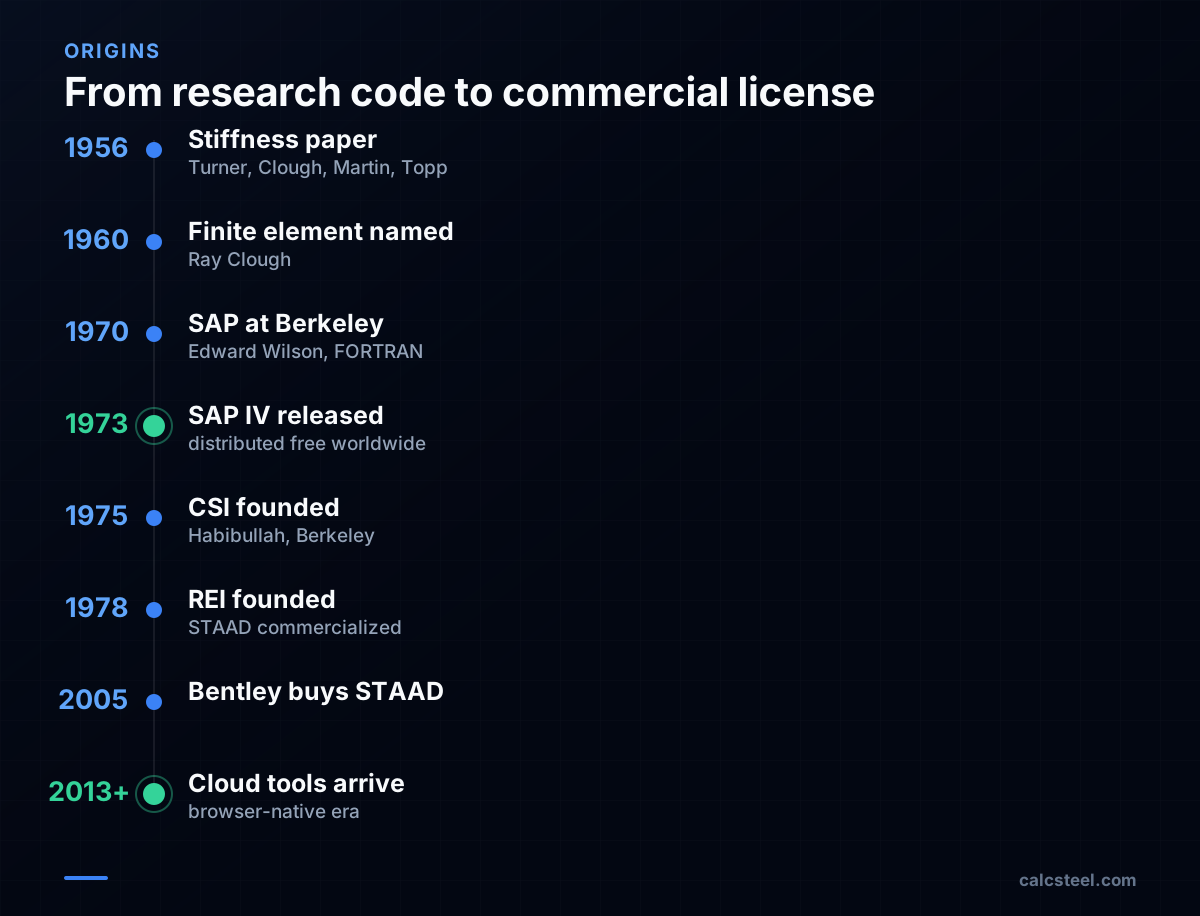
Long before any company sold a beam calculator, the underlying method was published in the open literature. In 1956, M. J. Turner, Ray Clough, Harold Martin and L. J. Topp published Stiffness and Deflection Analysis of Complex Structures, the paper now widely recognized as the birth of the direct stiffness method behind modern finite element analysis. In 1960, Clough coined the term finite element in his paper The Finite Element Method in Plane Stress Analysis.
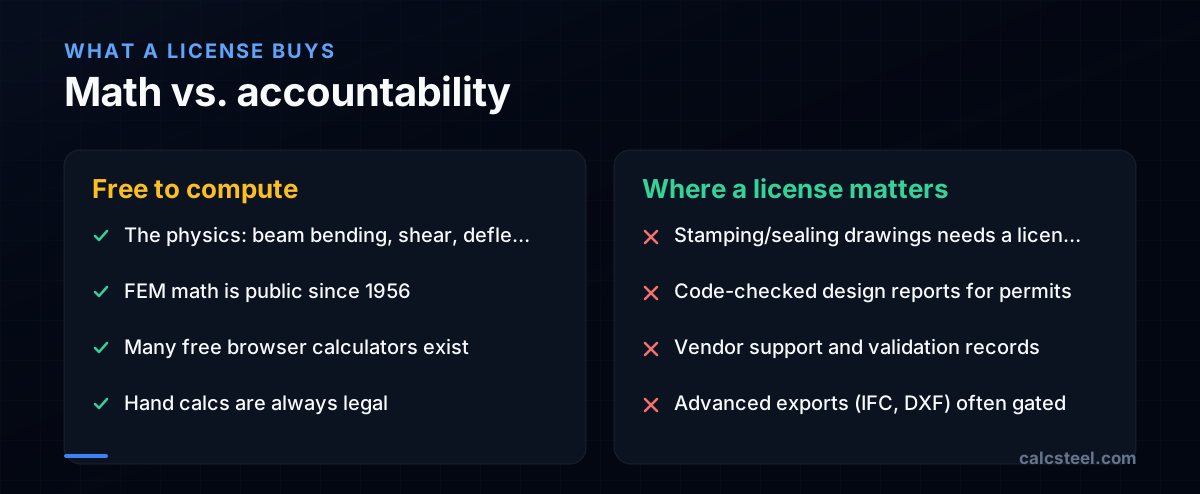
That distinction matters for the licensing question. The equations that tell you whether a steel beam bends too far, yields, or buckles are not anyone's intellectual property. They are textbook physics. What you can buy is software that applies them quickly, against a recognized code, and produces a defensible record.
The free FORTRAN era at Berkeley
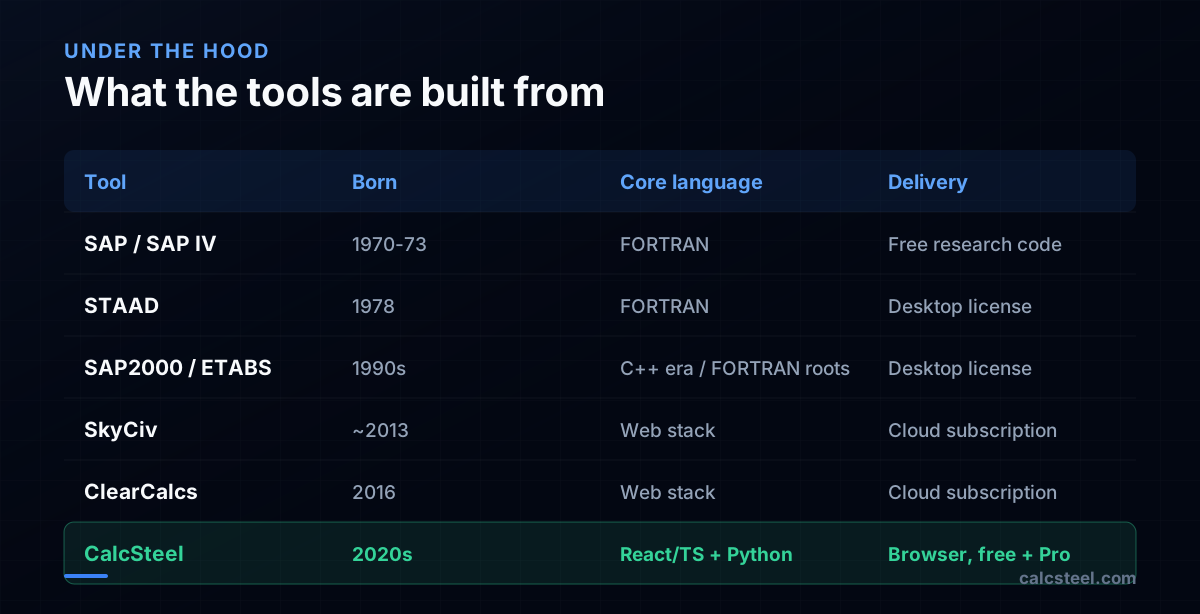
The first widely used structural analysis package was literally given away. Around 1970, Edward L. Wilson and students at the University of California, Berkeley wrote SAP (Structural Analysis Program) in FORTRAN. The 1973 release, SAP IV, was developed at Berkeley's Earthquake Engineering Research Center, distributed freely, and is reported to have reached more than a thousand users worldwide by 1974.
This is the part of the story people forget: structural software started as a free academic gift. The shift to paid licenses came later, when companies took on the cost of maintaining, validating and supporting the code for professional practice — and of keeping it current with constantly revised design standards.
So if someone asks whether you need to pay to calculate a beam, the historical answer is no. You needed to pay once the calculation had to be trustworthy, repeatable, supported, and tied to a code.
How calculation became a license
Commercialization arrived through two channels. In 1975, Ashraf Habibullah founded Computers and Structures, Inc. (CSI) in Berkeley, eventually turning the academic SAP lineage into the commercial SAP2000 and, with Wilson, ETABS. Separately, Research Engineers International (REI) was founded in 1978 by Amrit Das to commercialize STAAD, whose first version, STAAD-III, also dates to 1978; Bentley Systems completed its acquisition of the STAAD product lines in 2005.
These desktop suites established the license model that dominated the industry for decades: a perpetual or annual license, often quoted only through a sales rep rather than listed publicly. The product was no longer the equations — it was the curated, code-compliant, vendor-supported implementation of them.
What a license actually buys (and what it doesn't)
Here is the crucial confusion buried in the question. The word license means two completely different things in structural engineering:
- A software license/subscription — your right to use a particular program.
- A professional engineering license (the seal/stamp) — the legal authority of a qualified engineer to take responsibility for a design.
No software, free or paid, grants the second one. If a beam goes into a permitted building, a licensed engineer must take responsibility for it — regardless of which tool produced the numbers. Conversely, you do not need any software license to learn, to do a quick check, or to verify a result. Free calculators are entirely legitimate for that.
The cloud split the market in two
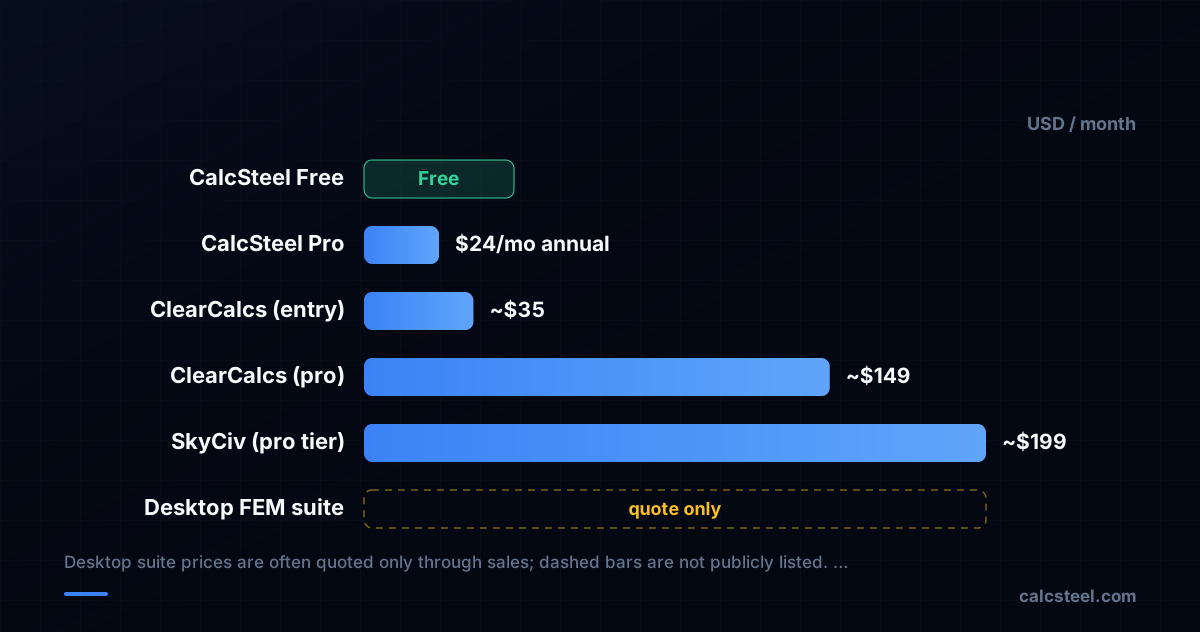
Web-native tools changed the pricing conversation. SkyCiv (reported to have begun around 2013 as a free beam calculator by Sam Carigliano and Paul Comino, formally founded in 2014) and ClearCalcs (founded 2016 in Melbourne) moved structural calculation into the browser with monthly subscriptions. Reported plans run roughly from $35/month at the entry level to around $149–$199/month for professional tiers — figures that vary by review aggregator and are a very different model from a quote-only desktop suite.
The same vendors also publish genuinely free single-purpose calculators (a free beam tool, a quick deflection check). So the market effectively split: free for quick checks and learning, paid for code-checked, project-grade design with full reports and exports. The question is no longer 'license or nothing' — it is 'which tier do I actually need?'
Where CalcSteel fits
So, do you need a license or subscription to calculate a steel beam? No — not to calculate it. The math is free, free tools exist, and hand calculations are always legal. You need a paid tool when you want speed, a recognized code check, a clean report, and dependable exports; and you need a professional engineer's seal — an entirely separate kind of license — whenever that beam goes into a permitted, real-world structure.
CalcSteel sits deliberately on both sides of that line. The Free plan lets you model, calculate, and learn in the browser at no cost — exactly the spirit of the original Berkeley code. The Pro plan (reported at about $24/month on the annual cycle) adds code-checked design, full reports, and advanced exports such as IFC and DXF for project-grade work. What it never sells you is the seal: that responsibility always belongs to a licensed engineer, whichever software produced the numbers.
Sources
- 1.The first paper on the FEM (1956) — ESRD timeline
- 2.Stiffness and Deflection Analysis of Complex Structures — Journal of the Aeronautical Sciences (AIAA)
- 3.Edward L. Wilson — Wikipedia (SAP / SAP IV, FORTRAN, free distribution)
- 4.Ashraf Habibullah — Wikipedia (CSI founded 1975, SAP2000, ETABS)
- 5.STAAD — Wikipedia (REI 1978, Bentley acquisition 2005)
- 6.Bentley Completes Acquisition of STAAD Product Lines (2005) — Business Wire
- 7.About Us — SkyCiv (founders Carigliano & Comino, ~2013/2014)
- 8.ClearCalcs pricing and plans (entry to professional tiers)
- 9.Image: Peikko — Public domain (Wikimedia Commons)
Try CalcSteel for free
Model, analyze and design steel structures in your browser. No install, no signup.
Open the 3D editor