IS 800 Compliance: What CalcSteel Checks

IS 800 is the backbone of structural steel design in India, and its 2007 third revision moved the country from the old working-stress approach to a modern limit-state philosophy influenced by Eurocode 3. This deep-dive traces who wrote the code, how it evolved since 1956, the engineering logic behind its checks, the specific IS 800:2007 clauses CalcSteel actually computes, and how the code compares with Eurocode 3 and AISC 360.
Key takeaways
- IS 800 began under India's 1950 steel economy programme; the first edition (1956) was revised in 1962 and 1984, the third revision arrived in 2007, and a draft fourth revision (IS 800:2025, BIS doc CED 07 (27869) WC) is now circulating for public comment.
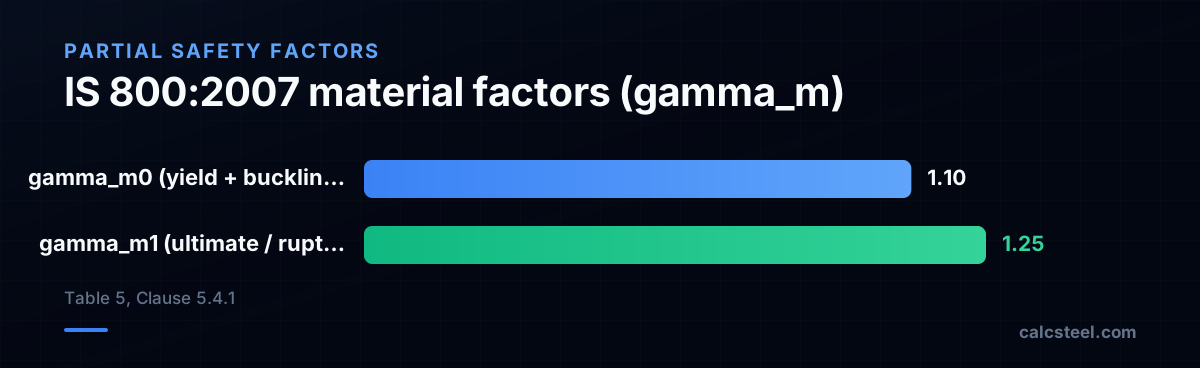
- The 2007 third revision adopted the limit state method with partial safety factors (gamma_m0 = 1.10 for yielding and buckling resistance, gamma_m1 = 1.25 for ultimate stress and net-section rupture), drafted on a review by IIT Madras with INSDAG Kolkata and committee CED 7.
- IS 800's foreword lists Eurocode 3 (ENV 1993-1-1:1992), AS 4100, BS 5950 and CAN/CSA-S16.1 among the publications considered, so its member checks share much of the logic of AISC 360 and EC3 — though IS 800 packages resistance with partial factors (EC3-style), not AISC's resistance factors.
- CalcSteel runs IS 800:2007 member checks in the browser (tension Cl. 6.2, compression Cl. 7.1.2/7.5, bending + LTB Cl. 8.2.2, shear Cl. 8.4, interaction Cl. 9.3.1) as one of 41 supported design standards, on a 1,140+ profile library that includes Indian ISMB, ISMC and ISA sections per IS 808.
What IS 800 actually is
IS 800 is the Bureau of Indian Standards (BIS) code of practice titled General Construction in Steel. It is the prime document for steel design in India and, as its own foreword states, influences many other codes governing special steel structures such as towers, bridges, silos and chimneys.
The current in-force edition is IS 800:2007, the third revision. It is organised into sections covering general design requirements, methods of structural analysis, limit state design, and member-by-member chapters for tension (Section 6), compression (Section 7), bending (Section 8) and connections (Section 10). When an engineer in India asks whether a tool "does IS 800," they almost always mean these limit-state member checks.
Crucially, IS 800 is a design code: it tells you how to compute capacities and verify safety. It is not a section-property table (that lives in IS 808 and the SP 6 handbooks) nor a material spec (IS 2062 for the steel itself).
Origins: the 1950 steel economy programme
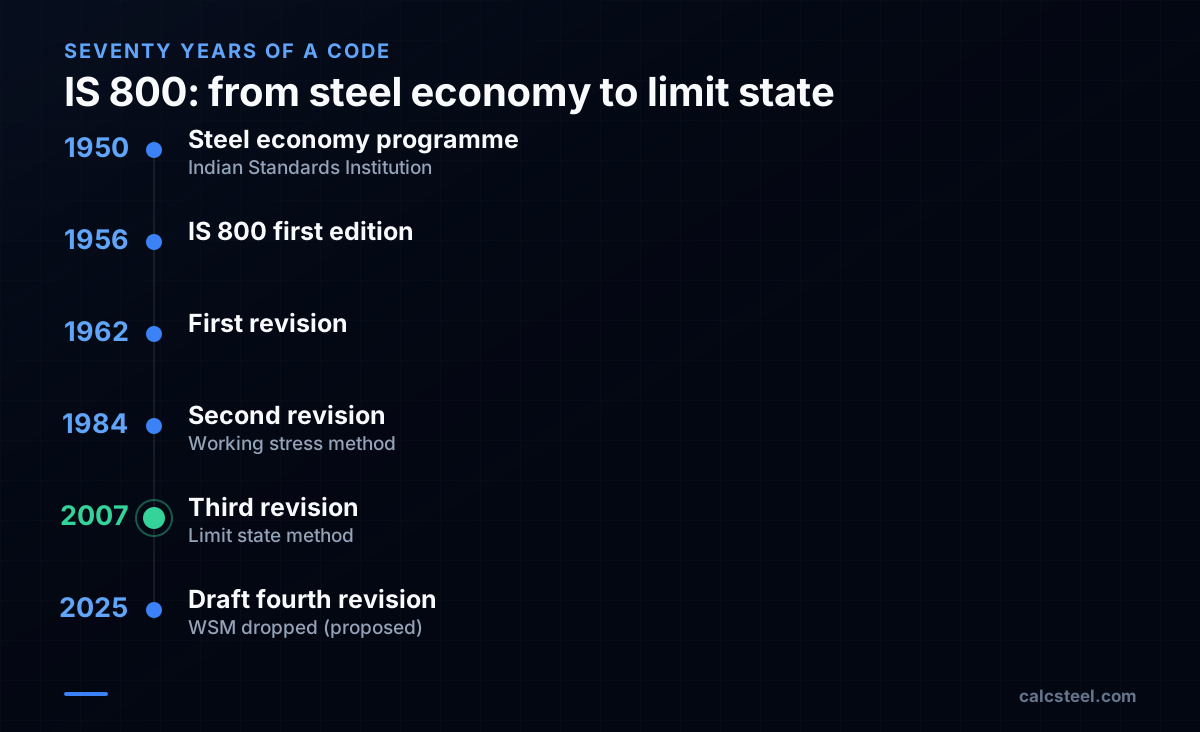
The story starts in 1950. According to the official foreword, "the steel economy programme was initiated by erstwhile Indian Standards Institution in the year 1950" with the objective of achieving economy in the use of structural steel. IS 800:1956 was the first standard published under that programme.
The motive was post-independence pragmatism: steel was scarce and expensive, so a national code that encouraged rational, efficient and optimum use of it had real economic stakes. That framing — economy through standardisation — still echoes in modern software, which lets engineers iterate quickly to find the lightest compliant section.
The Indian Standards Institution was later reconstituted as the Bureau of Indian Standards, which remains the publisher today.
Four revisions and a philosophy shift
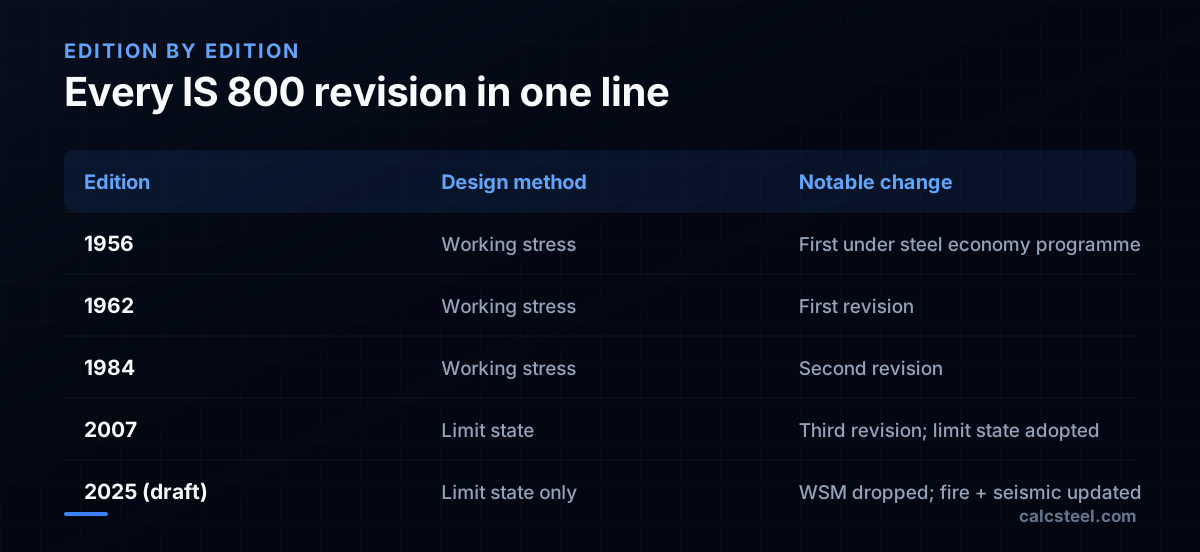
The foreword records the lineage precisely: IS 800:1956 "was revised in 1962 and subsequently in 1984." The 1984 edition was built on the working stress method (WSM) — capacities divided by a single global safety factor, stresses kept below an allowable.
The 2007 third revision was the watershed. As the foreword states, the standard "is based on limit state method, reflecting the latest developments and the state of the art." The revision "was based on a review carried out and the proposals framed by Indian Institute of Technology Madras (IIT Madras)," supported by the Institute of Steel Development and Growth (INSDAG) Kolkata, and finalised by the Structural Engineering and Structural Sections Sectional Committee, CED 7.
A draft fourth revision (IS 800:2025) was circulated for public comment by BIS in April 2025 (document CED 07 (27869) WC). According to that draft circulation, it discontinues the working stress method entirely and revises the fire-design and seismic provisions. Broader claims sometimes attributed to it — embodied carbon, deconstruction and fatigue — are not confirmed by the BIS circulation notice, so we treat them as unverified pending the final published code.
Shared DNA — and where the codes diverge
One reason IS 800 feels familiar to international engineers is that its authors deliberately read the global codes. The foreword lists the publications considered in formulating the standard: AS 4100:1998 (Australia), BS 5950:2000 (UK), CAN/CSA-S16.1-94 (Canada) and ENV 1993-1-1:1992 — Eurocode 3.
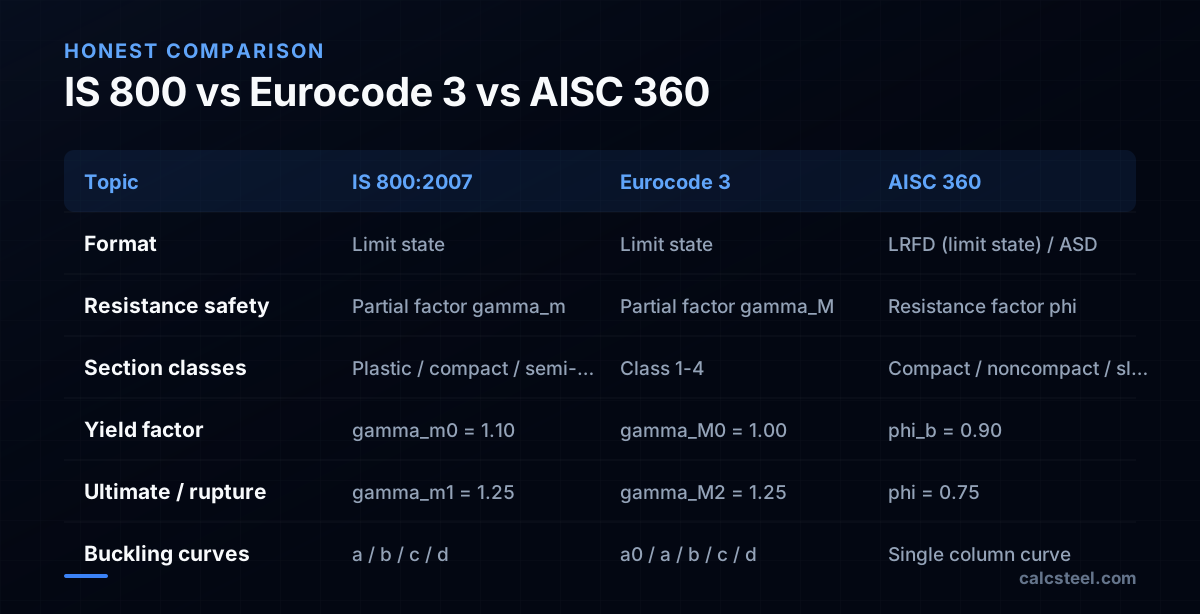
The fingerprints show. IS 800 classifies cross-sections as plastic, compact, semi-compact and slender — directly analogous to Eurocode 3's Class 1-4 — and applies partial safety factors to both loads and resistance, the hallmark of the Eurocode/limit-state family.
Here is the honest nuance the comparison table makes explicit: AISC 360 (LRFD) is also a limit-state method, but it packages member safety differently. AISC multiplies the nominal resistance by a resistance factor phi (e.g. 0.90 for yielding, 0.75 for rupture), whereas IS 800 and EC3 divide the resistance by a partial factor gamma_m. The outcome is similar; the bookkeeping differs. So IS 800 shares the limit-state framework with all three codes, but its factor philosophy mirrors EC3 rather than AISC. That is why a finite-element engine that already speaks EC3 can add IS 800 by changing only the capacity formulas and factors, not the analysis core.
What CalcSteel computes for IS 800
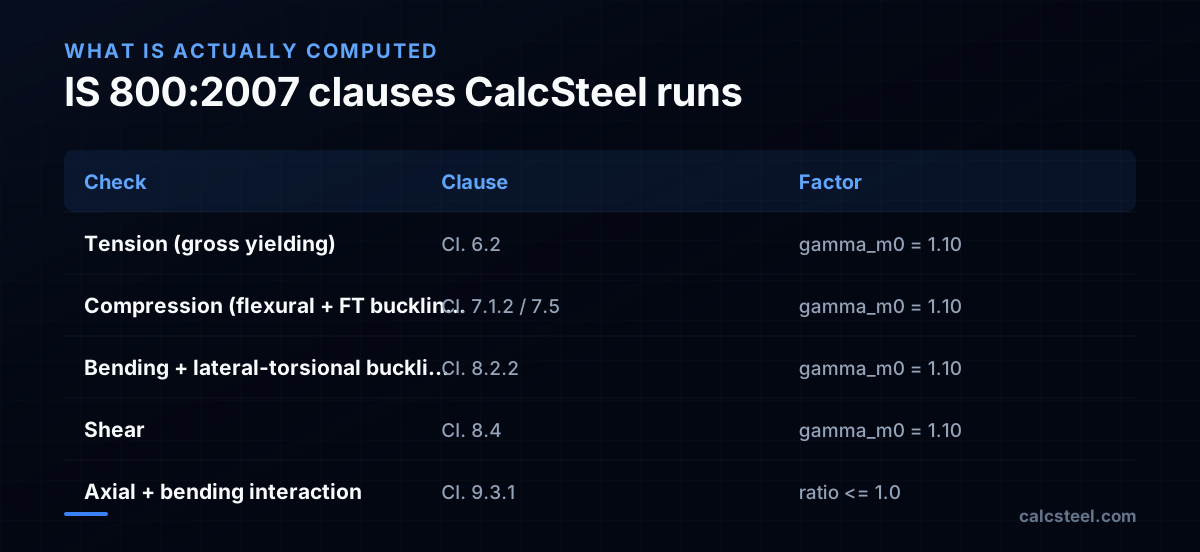
Under the limit state method, a member is safe when its design strength exceeds the factored load effect. CalcSteel's Python finite-element backend resolves the structure under IS 800 load combinations to get axial force, shear and moment in every member, then applies the IS 800:2007 capacity formulas. The specific clauses implemented are concrete and verifiable:
- Tension — Cl. 6.2: gross-section yielding, Td = Ag x fy / gamma_m0 (1.10). Note this is the yield mode; net-section rupture and block shear (the other Section-6 modes) are not computed automatically and remain a manual check.
- Compression — Cl. 7.1.2 + 7.5: flexural and flexural-torsional buckling, with the buckling curve (a/b/c/d) selected by section family, capacity governed by gamma_m0 (1.10) — not gamma_m1.
- Bending — Cl. 8.2.2: moment capacity with lateral-torsional buckling reduction (chi_LT), governed by gamma_m0.
- Shear — Cl. 8.4: Vd = Av x fy / (sqrt(3) x gamma_m0).
- Combined axial + bending — Cl. 9.3.1: a conservative linear interaction, N/Nd + Mx/Mdx + My/Mdy <= 1.0.
Each member returns a utilisation ratio; anything above 1.0 fails. Connection design (Section 10), fatigue (Section 13) and fire (Section 16) are outside this member-check scope.
Where CalcSteel fits
So, is CalcSteel "compliant" with IS 800? The precise answer is that CalcSteel implements IS 800:2007 member checks, not that it is a certified compliant product. "Compliance" with a code is a property of a finished, stamped design and the engineer who signs it — no software can hold it on your behalf. What software can do is run the code's clauses correctly, which is why "implements the checks listed above" is the honest answer to "is it compliant."
CalcSteel runs those checks as one of its 41 supported design standards, alongside the limit-state family IS 800 was modelled on — NBR 8800, AISC 360 and Eurocode 3, plus codes such as AS 4100 and CAN/CSA-S16. It runs entirely in the browser on a React/TypeScript front end with a Python finite-element backend, over a library of 1,140+ steel profiles that includes the Indian hot-rolled sections engineers actually specify — ISMB beams, ISMC channels and ISA angles per IS 808.
Honest gaps to weigh against alternatives: the IS 800 module covers member design, so connection design (Section 10), seismic detailing (IS 1893), fatigue (Section 13) and fire (Section 16) are out of scope, and tension is checked for yielding only. Tools such as STAAD.Pro, ETABS or Tekla Structural Designer carry deeper IS-specific connection and seismic modules; CalcSteel's edge is being free to start, browser-native and multi-code. As always, the responsible engineer of record owns the final verification, and outputs are only as good as the load cases you feed in.
CalcSteel has a free plan with full editor capabilities, and Pro is US$24/month billed annually, which unlocks the full export workflow. The current implementation targets IS 800:2007; the draft 2025 fourth revision is not yet in force. You can model a frame and run an IS 800 check right now in the editor.
Sources
- 1.IS 800 (2007): General Construction in Steel — full BIS code text (foreword), Internet Archive
- 2.IS 800:2007 — full BIS standard PDF (law.resource.org public mirror)
- 3.IS 800:2007 — BIS official record, Bureau of Indian Standards (Know Your Standards)
- 4.IS 800 draft fourth revision — BIS official draft for comment, doc CED 07 (27869) WC, CED 7 committee
- 5.IS 800:2025 draft — key changes summary (working stress removed, fire, seismic), Civil Engineering Ascent
- 6.As per IS 800-2007, the partial safety factor for material (Testbook)
- 7.CalcSteel — model editor and supported design standards (NBR 8800, AISC 360, Eurocode 3, IS 800)
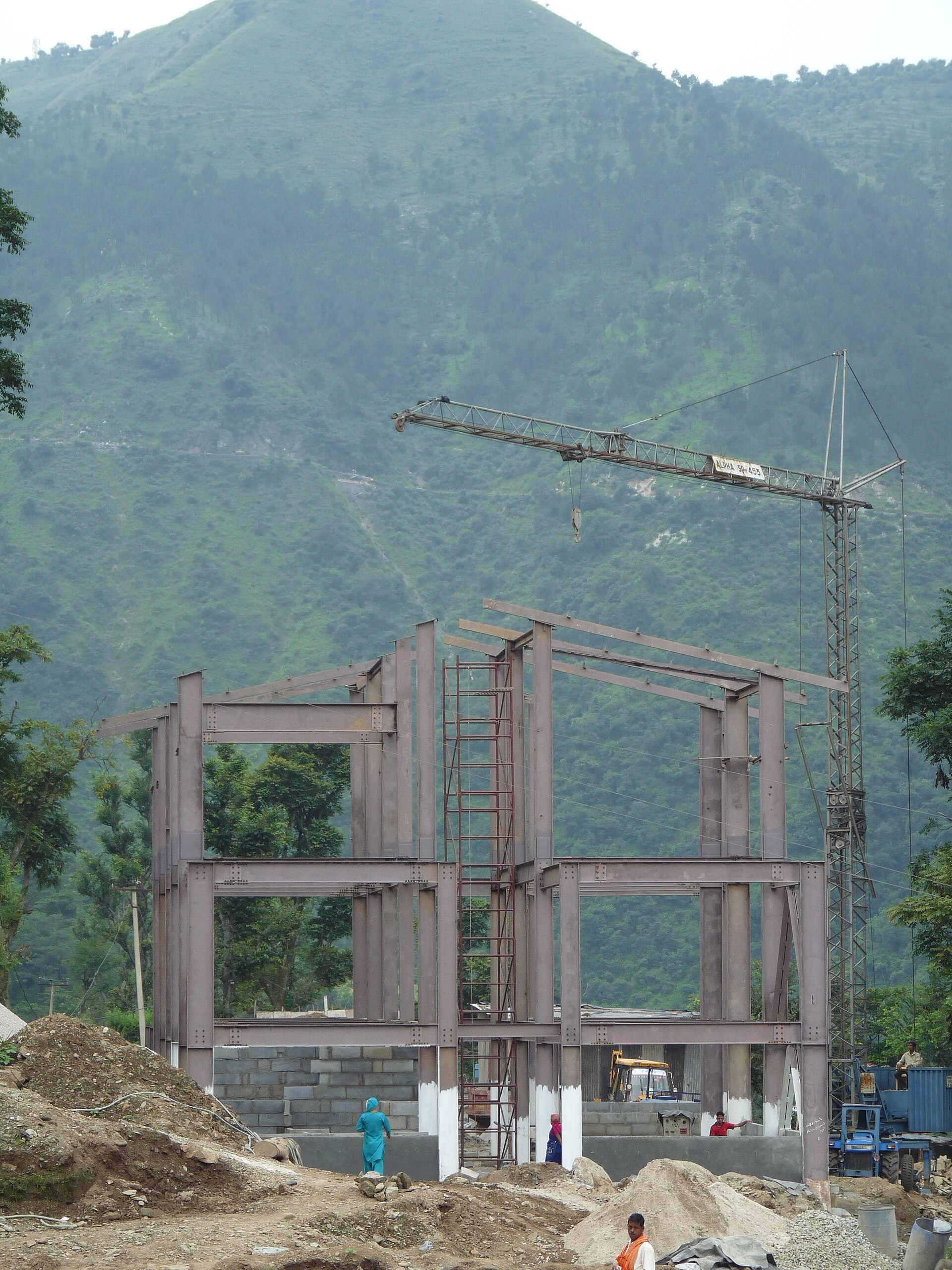
- 8.Image: Timothy A. Gonsalves — CC BY-SA 4.0 (Wikimedia Commons)
Try CalcSteel for free
Model, analyze and design steel structures in your browser. No install, no signup.
Open the 3D editor