Hot-Rolled vs Cold-Formed Steel Design
Hot-rolled and cold-formed steel members look like cousins on a drawing, but the codes that govern them grew up on opposite sides of an engineering divide. One world fights yielding and global buckling; the other fights thin-plate local buckling that begins long before the steel ever yields. Here is where those two design philosophies came from, how their standards evolved, and how software actually verifies each.
Key takeaways
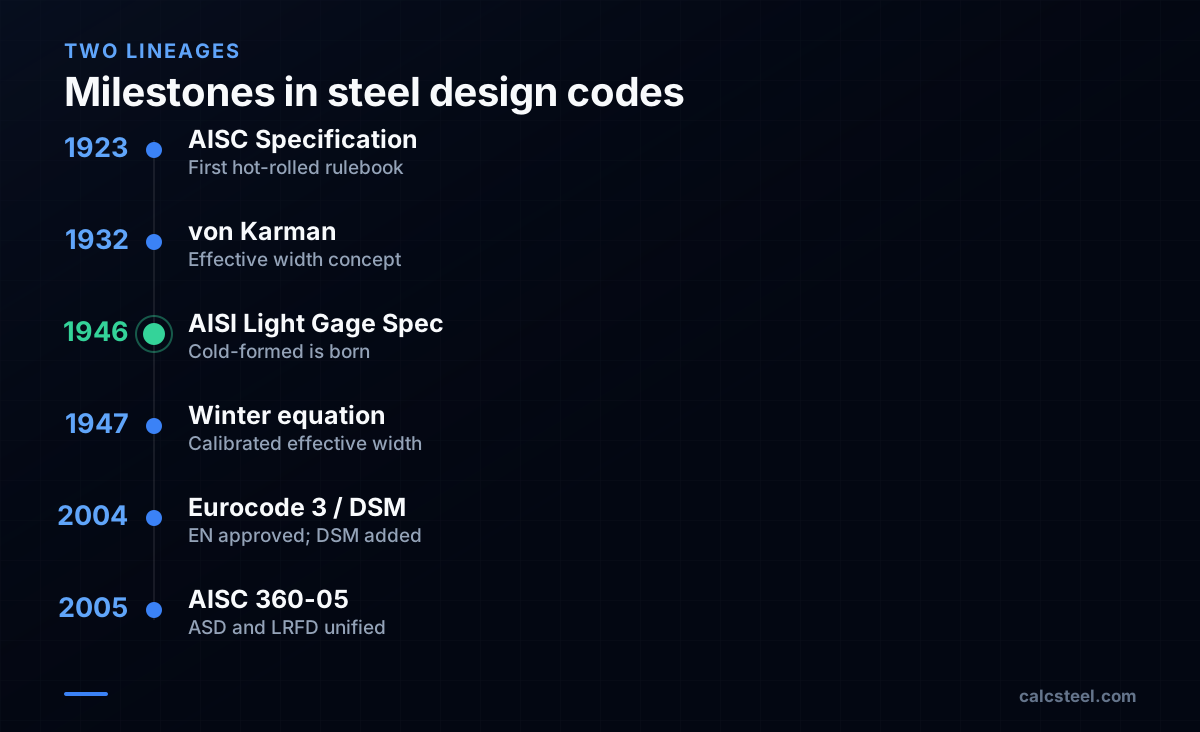
- Hot-rolled design traces to the first AISC Specification of 1923; cold-formed design was effectively born in 1946 with the AISI 'Light Gage' Specification, built on George Winter's research at Cornell starting in 1939.
- The core technical split is local buckling: cold-formed thin plates buckle before yielding, so codes use von Karman's effective width (1932), Winter's 1947 calibration, and the Direct Strength Method added in 2004.
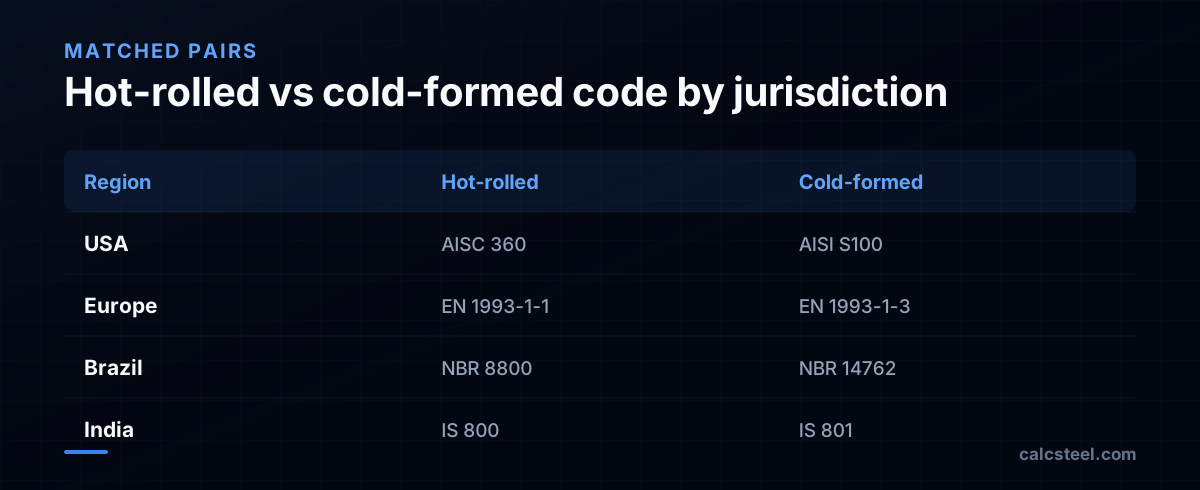
- Modern code families pair the two: AISC 360 / NBR 8800 / Eurocode EN 1993-1-1 for hot-rolled, and AISI S100 / NBR 14762 / EN 1993-1-3 for cold-formed.
- Software automates both by running the same finite-element frame analysis, then routing each member to the correct limit-state checks for its fabrication route.
Two ways to make a steel member
The difference starts in the mill, not the math. Hot-rolled sections are squeezed into shape while the steel glows around 1,100-1,300 degrees C, producing the familiar thick I-beams, channels and angles with generous fillets and relatively stocky walls. Cold-formed sections are bent from thin steel strip at room temperature on a roll-forming line or press brake, yielding lightweight C, Z, hat and lipped channels often less than 3 mm thick.
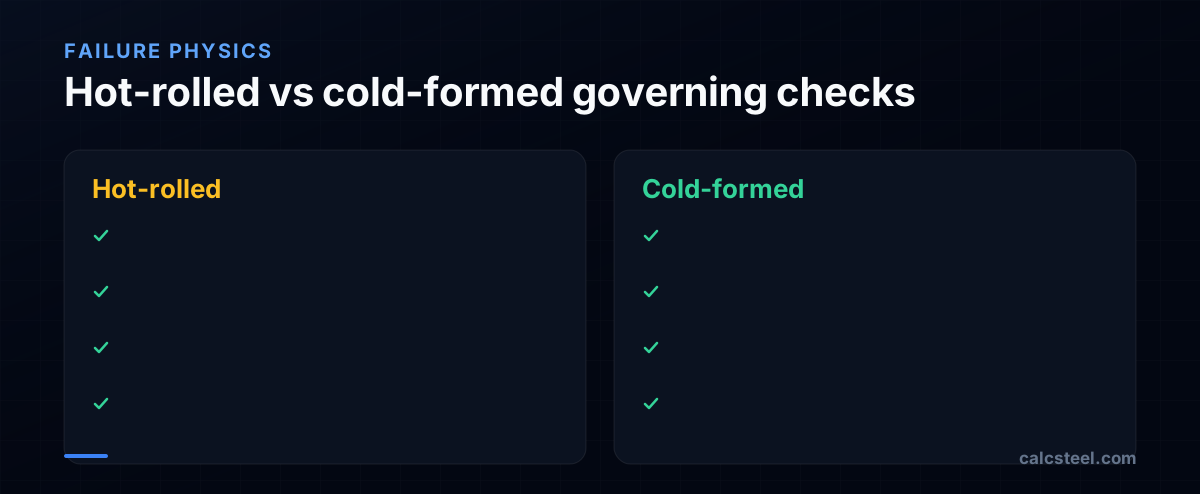
That single decision cascades into everything downstream. Cold work raises the yield strength near the bends but leaves residual stresses; the walls are thin enough that they can ripple and buckle locally long before the cross-section as a whole reaches its yield load. Hot-rolled members, with their chunkier plates, usually fail by yielding or by buckling as a whole member. Two failure stories, two sets of code rules.

1923 and 1946: the birth of two rulebooks
Hot-rolled design came first. The American Institute of Steel Construction issued its Standard Specification for Structural Steel Buildings in 1923 - a modest 13-page document - partly to end what engineers called the 'column formula dilemma': AISC reportedly bemoaned some 28 competing column formulas in use at the time. It was an allowable-stress document, and it set the template most national codes would follow for decades.
Cold-formed steel had no place in US building codes until much later, precisely because its thin-walled behavior was poorly understood. That changed when the American Iron and Steel Institute sponsored research at Cornell University under Professor George Winter, beginning in 1939. The result was the first Specification for the Design of Light Gage Steel Structural Members in 1946. Winter is widely called 'the grandfather of cold-formed steel design,' and that 1946 document is the ancestor of today's AISI S100.
The real divide: local buckling and effective width
The engineering reason the codes diverged is local buckling. A thin compression plate does not simply collapse when it first buckles; the buckled middle sheds load to the stiffer edges, which keep carrying force. Theodore von Karman captured this in 1932 with the effective width idea: replace the full plate width with a narrower strip that carries the real load. George Winter calibrated it against tests in 1947, adding an empirical imperfection correction, and the 'Winter curve' became the internationally accepted formula for plate local-buckling strength.
Hot-rolled codes rarely need this. They classify cross-sections (compact, non-compact, slender) and only the rare slender element triggers a reduction. Cold-formed codes, by contrast, reduce almost every element to its effective width, iterating because the effective section depends on the stress it carries. This is the single biggest reason cold-formed hand calculations are so much more laborious.
How the modern code families line up
Over the last two decades both families converged on limit-state design and unified documents. AISC merged its separate allowable-stress and load-and-resistance-factor specifications into a single AISC 360-05, approved on 13 April 2005 and giving equal standing to ASD and LRFD. The cold-formed side unified North American practice into AISI S100, now shared across the US, Canada and Mexico.
Europe split the job by document: EN 1993-1-1 (Eurocode 3, approved by CEN on 16 April 2004) covers general steel design for thicknesses of roughly 3 mm and above, while EN 1993-1-3 adds the supplementary rules for cold-formed members and sheeting. Brazil mirrors the same divide with NBR 8800:2008 for hot-rolled and composite structures and NBR 14762:2010 for cold-formed profiles. India's IS 800:2007 moved the country's general steel code to the limit-state method.
The Direct Strength Method: software's quiet revolution
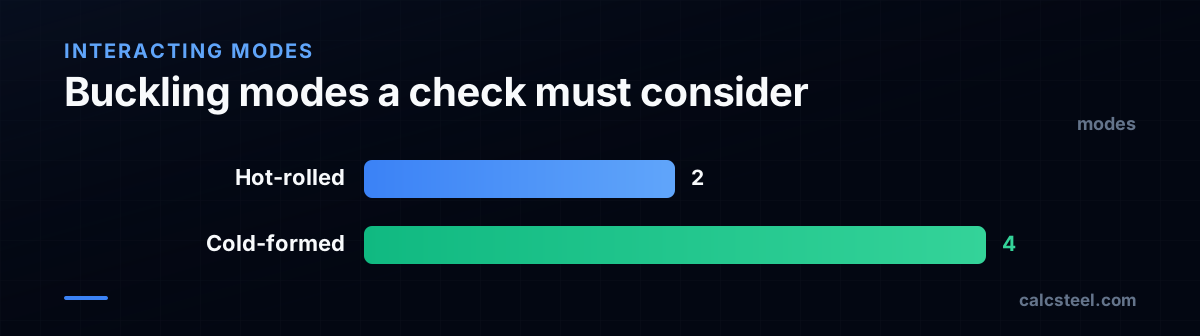
Effective-width calculations are tedious and break down on complex stiffened shapes. The answer, developed largely by Benjamin Schafer and adopted as Appendix 1 of the North American Specification in 2004, is the Direct Strength Method (DSM). Instead of slicing each plate into effective widths, DSM asks a computer for the cross-section's elastic buckling loads in three modes - local, distortional and global - typically via a finite-strip analysis, then plugs those into calibrated strength curves.
This is a method designed for the computer age. It needs no iteration and no effective-section bookkeeping, which is exactly why it suits automated tools. The trade-off is honest: DSM leans on a buckling analysis the engineer largely cannot do by hand, so its accuracy is only as good as the section model behind it. For hot-rolled members there is no equivalent revolution, because local buckling rarely governs in the first place.
The verdict: one model, the right checks per member
So the difference is not cosmetic. Hot-rolled design fights yielding and member buckling with section classification; cold-formed design fights local and distortional buckling with effective width or the Direct Strength Method. Same statics, different failure physics, different code paths.
Good software hides none of that - it just routes each member correctly. CalcSteel is a browser-native tool with a React/TypeScript front-end and a Python finite-element backend: it runs one frame analysis, then verifies members against the relevant code, including NBR 8800, AISC 360, Eurocode 3 and IS 800, drawing on a library of 1,140+ steel profiles. There is a free plan, with paid Pro tiers (reported from US$9/month). If you want to see both worlds checked side by side on a real model, open the editor and build one. The honest caveat: always confirm which code clause governs your specific member before you trust any automated number.
Sources
- 1.Cold-formed steel - Wikipedia (1946 AISI spec, George Winter, AISI S100, DSM)
- 2.History of the AISC Specification 1923-2010 (AISC webinar handout, PDF: 1923, 13 pages, 28 column formulas)
- 3.AISI Specifications and Research Reports (1946-present), Wei-Wen Yu Cold-Formed Steel Library, Missouri S&T
- 4.The AISI Direct Strength Method: A Practicing Engineer's Introduction (SGH)
- 5.Eurocode 3: Design of steel structures - Wikipedia (EN 1993-1-1 approved 16 April 2004, EN 1993-1-3)
- 6.Code implementation ABNT NBR 14762:2010 (Brazil) - CYPE
- 7.Image: Alim saputra — CC BY-SA 4.0 (Wikimedia Commons)
Try CalcSteel for free
Model, analyze and design steel structures in your browser. No install, no signup.
Open the 3D editor